


The economy is hiring again, but workers are still getting squeezed


Last Friday brought some unexpectedly good news for the American labor market, but Tuesday’s inflation report delivered the bill.
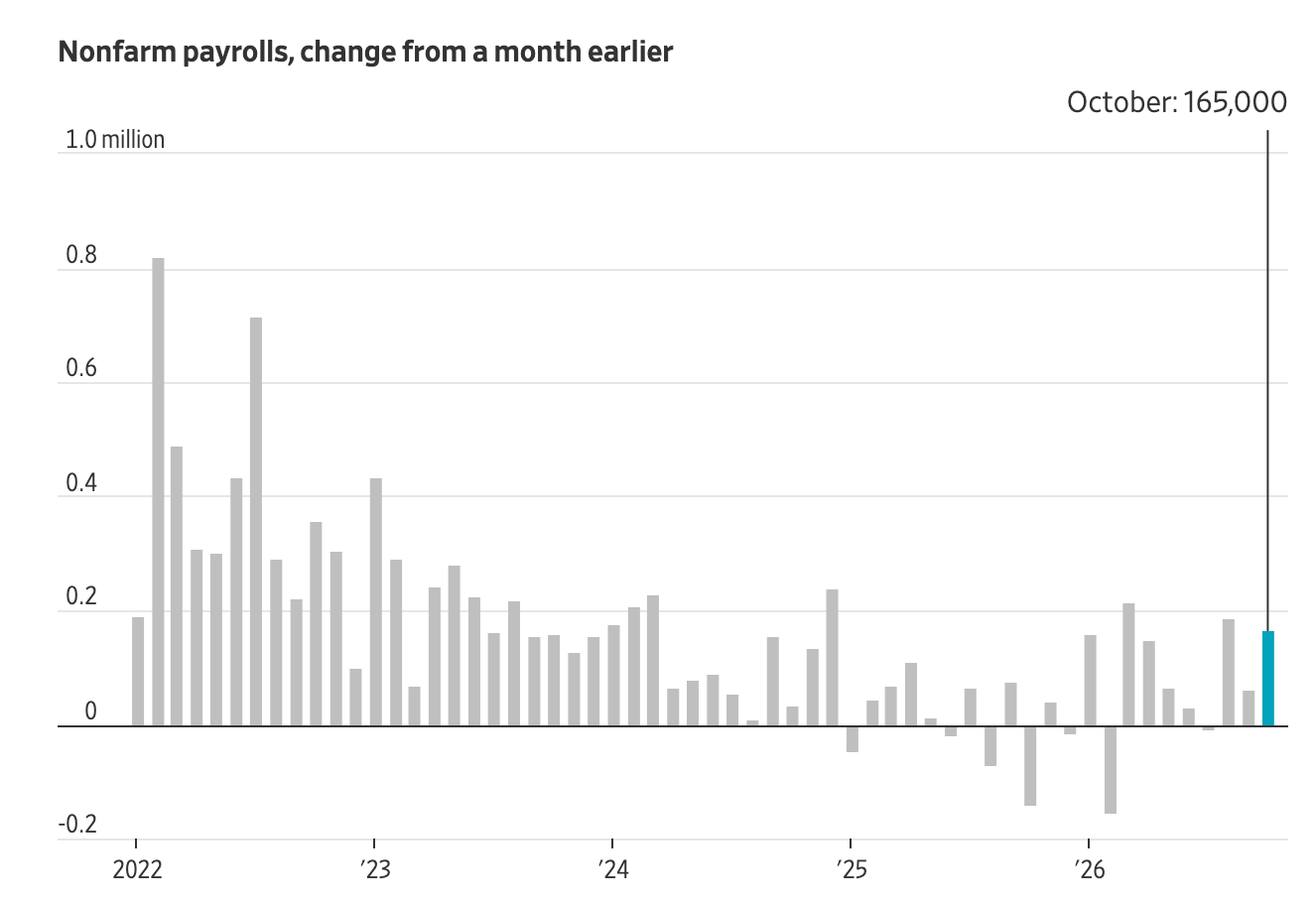
Employers added 165,000 jobs in October, which was nearly triple the 59,000 economists had expected, while unemployment unexpectedly fell from 4.2% to 4.1%. Better yet, the Bureau of Labor Statistics revised August and September payroll gains upward by a combined 84,000, bringing the three-month average to 137,000 jobs. That is a substantial improvement from the labor-market stagnation we've been discussing for much of 2026.
Visual source: WSJ
Arguably more encouraging was where some of those jobs appeared. Professional and business services — a sector that had become something of a poster child for AI-related white-collar displacement fears — added 70,000 positions, suggesting employers aren't quite ready to replace their office workers with algorithms; at least, not yet. Health care contributed another 42,000, and transportation and warehousing gained 25,000. Even manufacturing, which has faced its share of economic headwinds, added 19,000 positions.
So, great news for American workers, right? Well, yeah, kinda, but also no — not cleanly.
Average hourly earnings increased 0.4% in October, bringing annual wage growth to 3.1%. That's respectable in isolation, but Tuesday's inflation report arrived with a reminder: Getting a raise and actually being able to afford more things are two entirely different experiences.
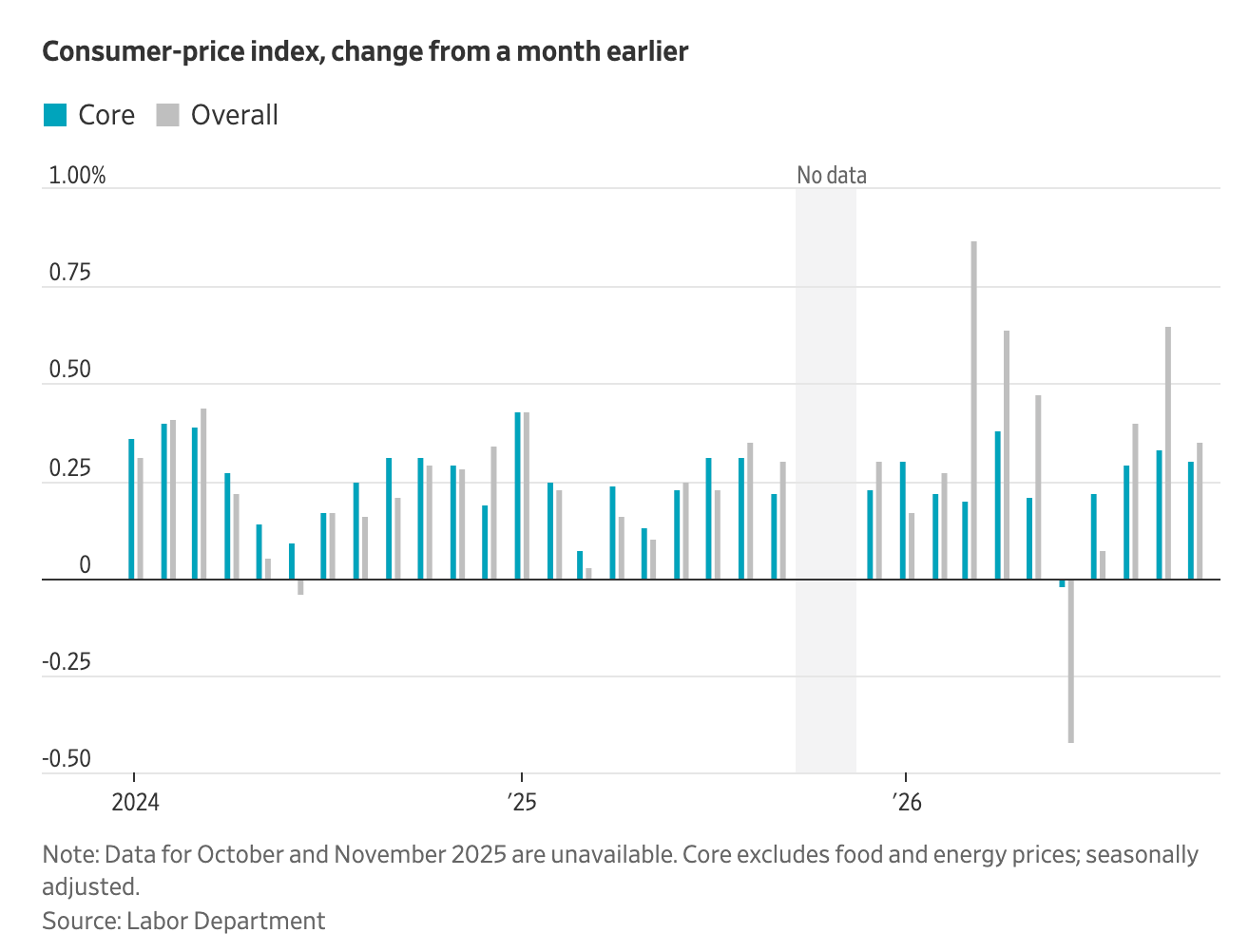
Meanwhile, consumer prices rose 0.4% in October, exceeding economists' expectations of 0.3%. That's an improvement from September's rather ugly 0.6% increase, although core inflation — which excludes food and energy — rose another 0.3% for the third consecutive month. The devil’s in the details, though, and he didn’t provide any consolation. Food prices climbed 0.5%, shelter costs increased 0.3%, and energy prices rose another 0.7%. Over the past three months, headline inflation has now run at an approximately 5.7% annualized pace. That's what the recent three-month increase would amount to if it continued for a full year, not an actual 12-month inflation reading. Core inflation's corresponding pace was roughly 3.7%.
By the way, if you're wondering where the usual year-over-year inflation figures went, you're not alone. The BLS couldn't calculate its customary October annual comparisons because last year's October CPI data were unavailable following the government shutdown.
Visual source: WSJ
So, at the end of the data, hourly earnings were flat in October. Workers received a nominal 0.4% hourly raise, and prices said “Yep, I’ll take that,” subsequently rising 0.4% as well. So much for celebrating that raise.
We also got a productivity report to go along with the jobs and inflation data. American businesses are getting considerably better at producing more with less. Nonfarm labor productivity surged 3.6% annualized in Q3, as output rose 3.7% while hours worked barely budged. Unit labor costs actually declined 0.7%, suggesting that labor expenses aren't currently the primary source of inflationary pressure. That may be encouraging for the broader economy; higher productivity can support growth without requiring proportionately more workers or driving up production costs. But the benefits haven't been distributed equitably — workers' share of nonfarm business output fell to 53% in Q3, the lowest in records dating back to 1947. In other words, just 53 cents of every dollar of output generated by American businesses went toward employee compensation, including wages and benefits. It's another sign of the growing disconnect between economic productivity and how much of that prosperity actually reaches workers.
Putting a bow on it: This all coalesces into the Fed’s next rate decision in December. Friday’s strong employment report offered further evidence of economic resilience, while Tuesday’s inflation figures presented a more immediate problem. Historically, robust hiring, spending, and GDP growth have strengthened the case for higher rates, but with productivity improving and some price pressures potentially stemming from war-related supply disruptions rather than excessive demand, economic strength isn't necessarily the inflationary warning sign it once was. The Fed appears increasingly focused on whether prices themselves are cooling, rather than assuming a resilient economy means they won't.
So Tuesday's hotter-than-expected inflation reading provided a better argument for keeping monetary policy restrictive than anything else. Oddsmakers took notice pretty quickly, upping the chance of another rate hike in December to over 90% today — that means no reprieve for borrowing costs any time soon, and higher yields on your idle cash too. A two-sided coin.
There's an additional complication: The next CPI report isn't scheduled until December 10, one day after the Fed's December 8–9 meeting. Unless other data substantially change the picture, today's inflation figures will therefore carry unusual weight in the committee's decision.
Answers to your questions
Yes. Origin offers partner access so you can manage your finances together at no additional cost. You’ll be able to filter transactions by member—making it easy to see which spending is yours and which belongs to your partner.

Yes. You can edit existing transactions and add new ones directly in Origin, so your records stay accurate and personalized.
Origin connects securely through trusted partners including Plaid, MX, and Mastercard.
Yes. Origin supports CSV uploads. You can upload a .csv file of your transactions, and we’ll import them into your account.
Yes. Your data is protected with bank-level security and advanced encryption. When you connect accounts through Origin, your login credentials are never shared with us. Instead, our partners generate secure tokens that let Origin access only the data you authorize—keeping your personal information private while enabling personalized insights.
Yes. You have full control to organize your spending in Origin. Transactions are automatically categorized by Origin, but you can always edit categories, add your own tags, and filter transactions however you like—so your spending reflects the way you actually manage money.