


This housing market is bad for everyone involved


America's housing market has somehow managed to become a buyer's market where nobody can afford to buy, a seller's market where nobody can sell, and a construction market where nobody particularly wants to build. Quite an achievement.
And the latest numbers suggest the situation is getting worse.
So, what's going on? Well, essentially everything.
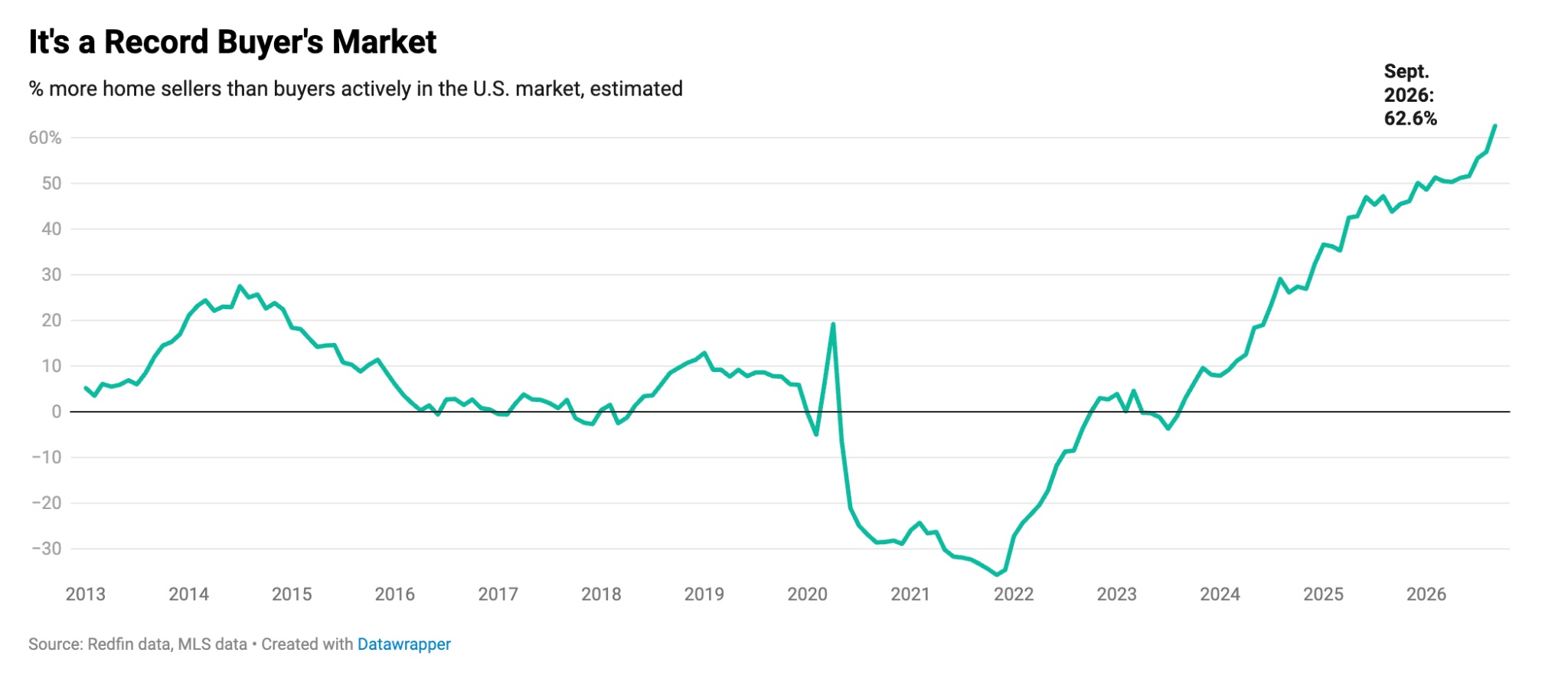
Let's start with buyers. As we discussed in a previous edition, prospective homebuyers have more negotiating leverage than they've had in years. In September, sellers outnumbered buyers by a record (yes, another) 63%; nearly three in five homes sold below their original asking prices, and listings hit a six-year high. Nashville alone had 139% more sellers than buyers, the widest metro-level gap Redfin had recorded.
On paper, that's wonderful news for house hunters. In practice, the financing has become almost comically prohibitive.
Visual source: Redfin
Despite a slight decline in recent weeks, the average 30-year mortgage rate is still comfortably above 7%, near its highest sustained level since 2000. Using the assumptions from our previous affordability analysis — a $410,000 home, a 7.5% mortgage, and $87,000 in median annual household income — a buyer putting 20% down would face a monthly housing payment of roughly $3,013, including estimated taxes and insurance.
That's 41% of gross household income, before accounting for any other debts. Put less down, add mortgage insurance, and the payment climbs further. Oh, and that original scenario requires an $82,000 down payment — a minor detail — which we won’t trouble you with the math on again. Check out the deep dive here.
And sellers aren't having much fun either. More listings and fewer qualified buyers mean longer waits, more price reductions, and increasingly uncomfortable negotiations. Homeowners who secured 3% mortgages years ago face another problem: Selling means giving up extraordinarily cheap financing and buying into today's considerably more expensive market. So…even people sitting on substantial home equity can find themselves effectively trapped in their existing homes.
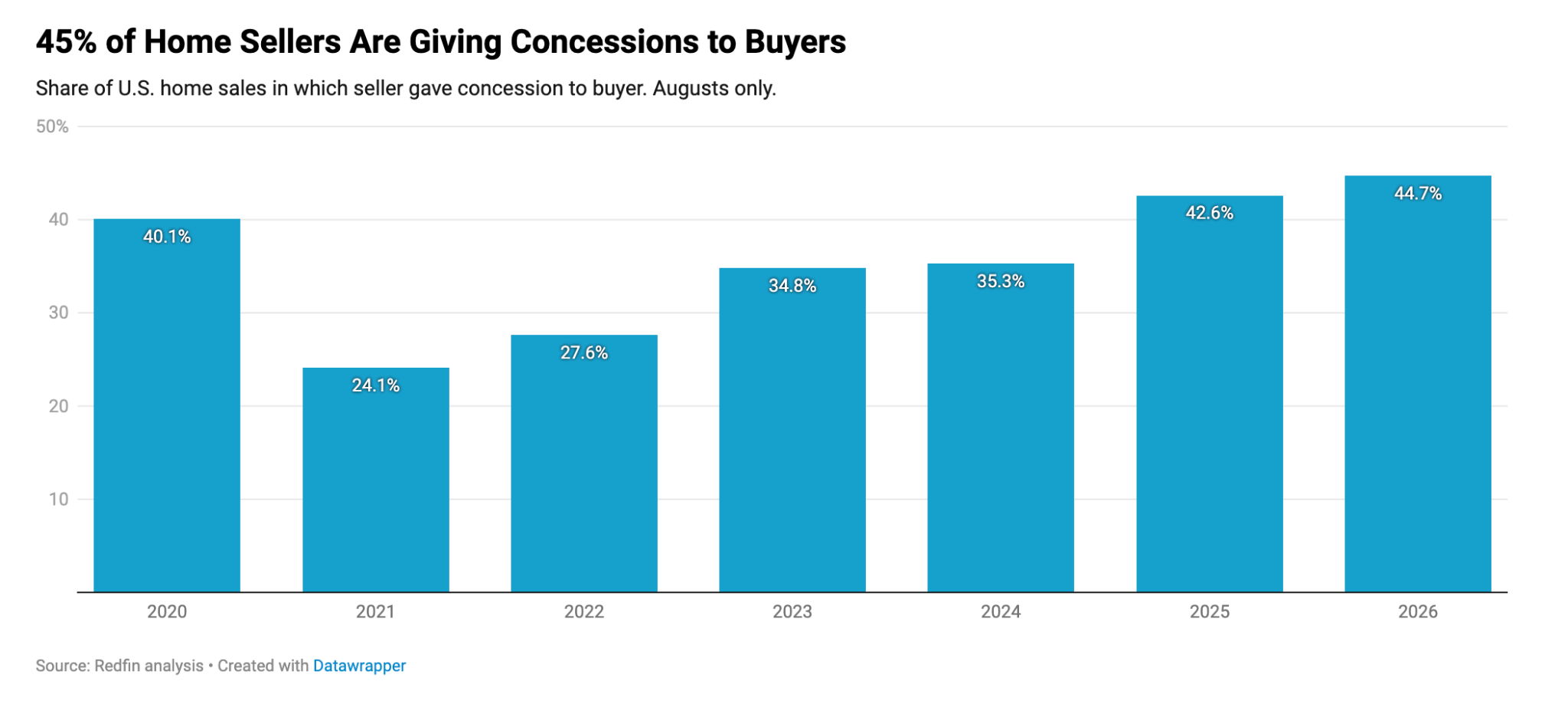
As a result, successful sellers are giving up more concessions (financial incentives or perks a home seller agrees to pay or provide) than ever to grease the transaction, hitting 44% this year—the highest August share in Redfin's records.
Visual source: Redfin
And then there is the construction aspect, which is not helping. You might assume a country struggling with housing affordability would respond by constructing more homes. Unfortunately, the economics are moving in precisely the opposite direction.
According to the Census Bureau, housing starts fell 5.2% in September, to an annualized 1.22 million units, down 7.4% from a year earlier and approaching post-pandemic lows. Single-family construction fell another 4.6%, reaching its lowest level since March 2023. Meanwhile, pending home sales plunged 7.3% to their lowest level since the National Association of Realtors began tracking them in 2001. Understandably, homebuilder confidence has now also fallen to its lowest level since 2012. The explanation behind this outcome is pretty plain. Higher interest rates make development financing more expensive, while weaker buyer demand makes new projects harder to justify. Meanwhile, the enormous AI infrastructure boom is competing with residential construction for labor, concrete, copper, and HVAC equipment. As a result, residential investment has actually subtracted from GDP growth in five of the past six quarters.
In other words, the same economy finding hundreds of billions of dollars to construct data centers is struggling to finance enough places for human beings to live. Should I insert a joke here? Yeah, sure. Apparently, the servers have better credit than people do.
And, to add insult to injury: Today's weak housing market could make tomorrow's affordability problem worse. Fewer construction starts mean fewer new homes entering the market down the road. That might eventually help existing sellers by tightening inventory, but it does little for younger Americans already priced out of ownership. Lower prices would help buyers, but builders struggling with financing and construction costs can't necessarily deliver them.
The result is a market where buyers need lower prices and rates, sellers need stronger demand, builders need cheaper capital, and existing homeowners need a compelling reason to surrender their old mortgages.
Everyone is waiting for someone else's circumstances to improve first. And until something changes, America's housing market may remain stuck in its current predicament: Too expensive to buy, too difficult to sell, and increasingly uneconomical to build.
Answers to your questions
Yes. Origin offers partner access so you can manage your finances together at no additional cost. You’ll be able to filter transactions by member—making it easy to see which spending is yours and which belongs to your partner.

Yes. You can edit existing transactions and add new ones directly in Origin, so your records stay accurate and personalized.
Origin connects securely through trusted partners including Plaid, MX, and Mastercard.
Yes. Origin supports CSV uploads. You can upload a .csv file of your transactions, and we’ll import them into your account.
Yes. Your data is protected with bank-level security and advanced encryption. When you connect accounts through Origin, your login credentials are never shared with us. Instead, our partners generate secure tokens that let Origin access only the data you authorize—keeping your personal information private while enabling personalized insights.
Yes. You have full control to organize your spending in Origin. Transactions are automatically categorized by Origin, but you can always edit categories, add your own tags, and filter transactions however you like—so your spending reflects the way you actually manage money.