


Claude Personal Finance vs. Origin: What Can Claude Actually Do With Your Money?


Summary: Anthropic launched Personal Finance in Claude on November 5, 2026, bringing connected bank accounts, spending analysis, bill tracking, and customizable financial dashboards to its AI assistant. Claude can read up to two years of transactions across connected accounts and answer questions using real financial data. But its investment and loan connections currently provide balances rather than detailed holdings, trades, rates, or terms, and Anthropic explicitly says the product isn't designed to give investment advice. Origin combines connected financial accounts with investment tracking, budgeting, credit monitoring, forecasting, estate planning, and a proactive AI Advisor that provides personalized financial guidance within a registered investment adviser framework. Claude is becoming a genuinely useful way to understand your money. Origin is built to help you manage and plan around it.
Anthropic has officially entered personal finance.
On November 5, 2026, the company introduced Personal Finance in Claude, a dedicated experience that lets users connect their financial accounts and ask questions about their money without exporting spreadsheets, uploading bank statements, or manually explaining their financial situation to a chatbot.
It follows OpenAI's launch of ChatGPT Finance in May, which means two of the world's leading general-purpose AI companies now have dedicated consumer finance products.
For people who already spend half their working lives inside Claude or ChatGPT, the appeal is obvious. Their AI assistants can now see where their money is going, too.
And Claude's implementation is pretty good.
It can organize spending, identify recurring bills, flag unusual transactions, and build customized financial dashboards. Someone can ask how much they'll have left before payday, and Claude can work through the relevant balances and upcoming payments.
That's a substantial improvement over the old arrangement of asking a language model to analyze a CSV file you downloaded from your bank.
But Anthropic's launch documentation also reveals some important boundaries, particularly around investments, financial planning, and advice.
Those boundaries are where the comparison with Origin becomes interesting.
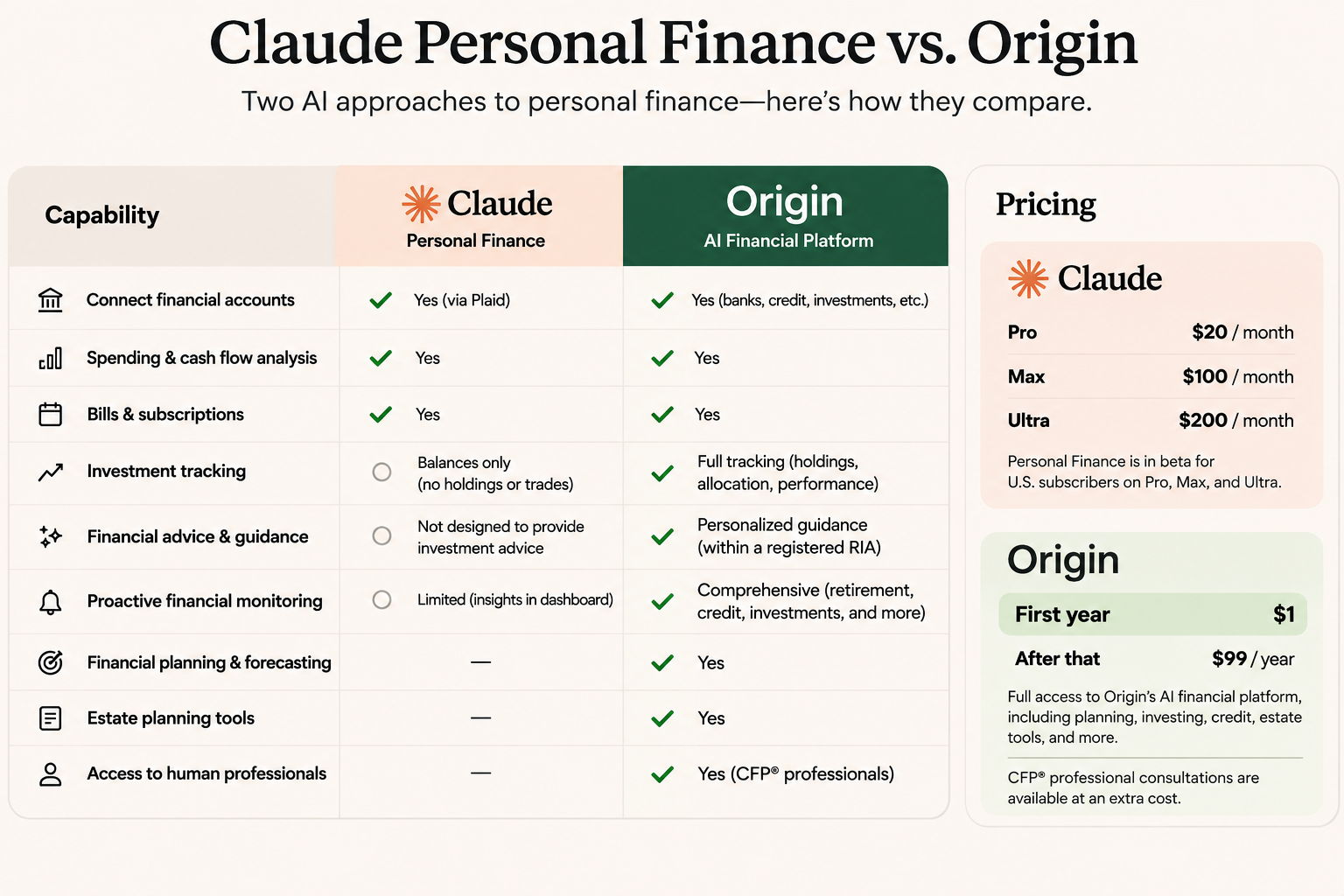
What Can Claude Personal Finance Actually Do?
Claude Personal Finance connects financial accounts through Plaid, the same financial-data network used by many established personal finance apps.
Once connected, Claude can access account names, balances, credit limits, and up to 24 months of transaction history. It uses that information to answer questions about spending, cash flow, subscriptions, and upcoming expenses.
Users can ask Claude to identify duplicate charges, explain unfamiliar financial terms, compare spending across months, or calculate how much interest they've paid.
It can also generate editable financial dashboards, spending charts, and bill calendars.
Anthropic's launch example is particularly illustrative. Claude examines $4,309.37 in monthly spending, identifies a membership renewal and four upcoming payments, and calculates that the user should have $1,393.22 remaining before payday.
That's useful financial analysis, grounded in actual account information rather than assumptions.
Claude's dashboard also includes customizable widgets for spending, cash flow, accounts, subscriptions, upcoming bills, and AI-generated insights.
And unlike some AI products that are seemingly determined to become an entire financial institution, Anthropic says Claude doesn't offer its own credit cards, loans, or savings accounts. It also doesn't serve sponsored financial recommendations.
The company has chosen a fairly clear role: help people understand their finances without becoming the institution managing them.
Claude Can Connect Investment Accounts. There's a Catch.
This is probably the most revealing detail in Anthropic's Personal Finance documentation.
Claude can connect bank accounts, credit cards, loans, and investment accounts.
That sounds comprehensive until you look at what it actually retrieves.
For investment and loan accounts, Claude currently reads balances and credit limits, not holdings, trades, interest rates, or loan terms.
That's a meaningful distinction.
Knowing that someone has $150,000 in a brokerage account is useful for understanding their overall finances. It tells you very little about the composition of that $150,000.
Is the portfolio diversified? Is it concentrated in one stock? How much is allocated to bonds? Has the allocation drifted away from the investor's target?
Without holdings-level information, Claude can't independently analyze those questions from its connected investment data.
The same limitation applies to loans. A balance tells you how much someone owes, but not necessarily the interest rate, repayment terms, or other details required to evaluate the debt.
Origin's investment tools go further, tracking holdings, allocations, and portfolio performance. That information can also inform AI Advisor's broader analysis of a member's financial picture.
This doesn't make Claude's account connections useless. For someone who primarily wants to understand balances, spending, and cash flow, they may be perfectly sufficient.
But connecting an account and understanding everything inside it are two different accomplishments.
Claude Can Explain Your Finances. Origin Can Provide Personalized Financial Guidance.
Anthropic makes another distinction explicitly.
Claude Personal Finance is not designed to give investment advice.
The product is read-only, meaning it cannot move, manage, or invest money on someone's behalf. Anthropic also warns that Claude can make mistakes and encourages users to verify important figures against their financial institutions.
That's a sensible boundary for a general-purpose AI assistant.
Origin operates differently.
Origin's AI Advisor is designed specifically for financial reasoning and personalized guidance. It operates within Origin Investment Advisory LLC's registered investment adviser framework, with suitability requirements before personalized advice can be provided.
Its architecture also reflects that specialization.
Origin uses specialized AI agents, deterministic calculation engines, real-time financial data, structured memory, and an automated compliance system that performs 138 checks on AI Advisor responses.
Those checks address areas including numerical accuracy, suitability, disclosures, and privacy.
Financial questions can become mathematically complicated rather quickly. A model might correctly explain how compound interest works while making an arithmetic error in a particular calculation.
Origin separates the reasoning from the underlying math, using dedicated computational tools for financial calculations and modeling.
That doesn't make AI Advisor infallible. It can still make mistakes, and important decisions may warrant review with a qualified professional.
But it does illustrate the difference between a general-purpose assistant that can discuss financial decisions and a system engineered specifically to provide financial guidance.
What Happens When You Don't Know What to Ask?
Claude's launch also exposes a problem that extends well beyond Anthropic.
People tend to ask financial questions when something prompts them to.
A credit card bill looks unusually high. They're considering buying a house. They realize retirement is closer than it used to be. Someone mentions estate planning at dinner, and suddenly everyone remembers mortality exists.
But plenty of financial problems develop quietly.
An emergency fund becomes inadequate as expenses rise. A portfolio grows increasingly concentrated. Retirement contributions fall behind. A credit issue goes unnoticed. An estate plan becomes outdated.
Someone may have all the information necessary to recognize these problems and still never think to look.
Claude can analyze financial information and generate insights when users interact with it. Its dashboard also includes short AI-generated observations.
What Anthropic hasn't documented is an equivalent to Origin's broader, continuously running financial-health monitoring system.
Origin's Proactive AI Advisor runs financial checks across areas including spending, savings, investments, retirement, credit, housing, protection, education, and estate planning.
Those findings contribute to a Financial Health Score and personalized Actions, which identify potential issues, explain their significance, and help members prioritize what to address.
A member doesn't have to independently decide to investigate their retirement savings or credit utilization for those areas to receive attention.
This is an important distinction because financial intelligence isn't exclusively about answering questions correctly.
Sometimes the harder job is identifying which questions deserve to be asked.
Origin Covers More Than Claude's Financial Dashboard
Claude's financial dashboard is genuinely useful. It brings account balances, spending, cash flow, subscriptions, and bills into an interface that can be customized conversationally.
For someone who already uses Claude extensively, that's a compelling proposition.
But Origin offers a broader collection of financial tools designed to work together.
Beyond spending and account aggregation, Origin includes dedicated budgeting, investment tracking, net worth tracking, credit monitoring, financial forecasting, estate planning tools, and Partner Access for couples.
Members can also access human CFP® professionals.
The forecasting tools are particularly relevant to the difference between financial analysis and financial planning.
Someone considering buying a home might need to understand how a down payment affects emergency savings, monthly cash flow, investment contributions, and retirement projections.
Claude can help reason through a hypothetical purchase. Origin has dedicated financial modeling infrastructure designed to examine those decisions alongside a member's broader financial situation.
And because the tools share financial context, someone doesn't have to reconstruct their entire financial life every time they move from budgeting to retirement planning.
A dedicated financial app isn't inherently superior to a general-purpose AI. Nobody needs another subscription just because a company has successfully built a prettier pie chart.
The advantage matters when the dedicated platform can replace several disconnected tools and connect the decisions those tools are supposed to support.
That's where Origin's broader scope becomes useful.
Claude Personal Finance vs. Origin: What About Privacy?
Anthropic deserves credit for being unusually specific about what Claude can access.
Claude uses Plaid to connect accounts, and the user authorizes access through their financial institution. Claude doesn't receive banking passwords.
The connection is read-only, and users can unlink accounts.
Anthropic also says conversations inside the dedicated Personal Finance hub aren't used to train its models. Conversations involving financial information outside that hub may be subject to different privacy settings.
There are some limitations worth knowing, though.
Claude's account balances can be a day or two old. If a bank connection fails, the dashboard may exclude that institution's information. Accounts linked through multiple logins can sometimes be counted twice.
And Claude's connected financial accounts currently can't be used in scheduled tasks, Cowork tasks, or Claude Code.
These are reasonable limitations for a newly launched beta. They're also reminders that a financial dashboard is only as reliable as the data it can actually retrieve.
Origin likewise depends on accurate, up-to-date connected financial information, and members should verify important figures before making consequential decisions.
Neither product eliminates the need for basic financial judgment. Technology has made enormous progress, but the bank statement remains annoyingly relevant.
Claude Personal Finance vs. Origin: Pricing
Claude Personal Finance is currently rolling out in beta to U.S. subscribers on Claude's Pro, Max, and Ultra plans.
It isn't available on Claude's Free, Team, or Enterprise plans, and Anthropic says availability is being expanded gradually.
That means someone who doesn't already pay for Claude needs a qualifying subscription to access the feature.
Origin currently offers new members their entire first year for $1, with the standard annual membership priced at $99 afterward.
That's an unusually low barrier to trying a dedicated financial platform.
For someone already paying for Claude Pro, Personal Finance may be a useful addition to a product they would subscribe to anyway.
For someone evaluating financial software specifically, however, Origin offers a considerably broader set of financial capabilities for a dollar in the first year.
At that price, the decision probably doesn't require an elaborate financial model. Which is convenient, given the subject matter.
Is Claude Personal Finance Better Than Origin?
It depends on the job.
Claude is an exceptionally capable general-purpose AI assistant, and its new financial experience makes that intelligence substantially more useful for everyday money questions.
Someone who wants to connect accounts, understand spending, inspect cash flow, identify recurring expenses, and build a customized financial dashboard may find that Claude does everything they need.
Its ability to generate and modify visualizations conversationally is particularly appealing.
Origin makes more sense when someone wants financial software to do more than organize and explain account information.
Its dedicated investment tracking, credit monitoring, forecasting, estate planning, proactive financial-health checks, personalized guidance, and access to human professionals extend well beyond Claude's initial release.
And the distinction around financial advice is particularly clear.
Anthropic says Claude Personal Finance isn't designed to give investment advice.
Origin has built an entire financial-advice system around that responsibility.
The Bigger Picture: Claude, ChatGPT, and the Future of Personal Finance
Claude's launch is significant partly because of what it says about the direction of AI.
In May, OpenAI brought connected financial accounts into ChatGPT. Now Anthropic has done something similar with Claude.
Both companies recognize that financial questions become much more useful when AI has access to the actual numbers.
The next question is what happens after that access becomes commonplace.
A connected bank account is no longer much of a differentiator. Neither is a chatbot that can categorize spending or summarize transactions.
Those are increasingly baseline capabilities.
The harder problems involve understanding investments in detail, modeling long-term decisions, identifying financial risks before someone asks about them, providing appropriate personalized guidance, and coordinating everything inside a system that people can rely on over time.
Anthropic seems to recognize that its initial release is only a starting point.
In its launch announcement, the company says it wants to explore how Claude can work alongside licensed professionals and regulated financial firms for larger financial decisions.
That's a particularly interesting admission.
Origin has already built around that relationship between AI, financial data, specialized planning infrastructure, and regulated advice.
Claude's entry into personal finance makes the category more competitive. It also makes the distinction between understanding your money and managing your financial life considerably more important.
Frequently Asked Questions
What is Claude Personal Finance?
Claude Personal Finance is a dedicated financial experience launched by Anthropic on November 5, 2026. It lets eligible users connect financial accounts through Plaid, analyze spending and cash flow, identify bills and subscriptions, and create customizable dashboards using conversational AI.
Can Claude connect to bank accounts?
Yes. Claude Personal Finance supports connections to U.S. financial institutions through Plaid. Users can link bank, credit card, loan, and investment accounts, with Claude receiving read-only access to supported financial information.
Can Claude analyze investment portfolios?
Claude can read balances from connected investment accounts, but its current Personal Finance integration does not retrieve individual holdings or trades. That limits its ability to analyze portfolio composition directly from connected account data. Origin offers dedicated investment tracking with holdings and allocation information.
Can Claude give financial advice?
Claude can explain financial concepts and help users reason through financial decisions. However, Anthropic explicitly says Claude Personal Finance isn't designed to provide investment advice. Origin's AI Advisor is designed to provide personalized financial guidance within a registered investment adviser framework, subject to suitability requirements.
Does Claude Personal Finance monitor spending automatically?
Claude can display spending, cash flow, subscriptions, upcoming bills, and short AI-generated insights using connected account information. However, Anthropic hasn't documented a broad proactive financial-health monitoring system equivalent to Origin's checks across retirement, credit, investments, housing, protection, and estate planning.
Is Claude Personal Finance free?
No. At launch, Claude Personal Finance is available in beta to eligible U.S. subscribers on Pro, Max, and Ultra plans. It isn't available on the Free plan. Origin currently offers new members their first year for $1, followed by the standard $99 annual membership.
Is Origin better than Claude for personal finance?
Claude is compelling for conversational spending analysis, cash-flow questions, and customizable financial dashboards, particularly for people who already use Claude. Origin is better suited to users who want dedicated investment tracking, credit monitoring, financial forecasting, proactive financial-health analysis, estate planning, personalized guidance, and access to human CFP® professionals in one platform.
Answers to your questions
Yes. Origin offers partner access so you can manage your finances together at no additional cost. You’ll be able to filter transactions by member—making it easy to see which spending is yours and which belongs to your partner.

Yes. You can edit existing transactions and add new ones directly in Origin, so your records stay accurate and personalized.
Origin connects securely through trusted partners including Plaid, MX, and Mastercard.
Yes. Origin supports CSV uploads. You can upload a .csv file of your transactions, and we’ll import them into your account.
Yes. Your data is protected with bank-level security and advanced encryption. When you connect accounts through Origin, your login credentials are never shared with us. Instead, our partners generate secure tokens that let Origin access only the data you authorize—keeping your personal information private while enabling personalized insights.
Yes. You have full control to organize your spending in Origin. Transactions are automatically categorized by Origin, but you can always edit categories, add your own tags, and filter transactions however you like—so your spending reflects the way you actually manage money.