


How We Built the First Finance App That Actually Tells You What to Do — A Proactive AI Financial Advisor


Most financial tools and AI assistants in the fintech landscape are built around a single assumption: That you already know what to look for.
The problem with this is that the financial questions that end up costing you the most are usually the ones you didn't know to ask.
The typical experience goes something like: You open the app, check your balance, maybe ask AI Advisor a question, and get an answer. The system waits. It's patient, technically capable, and only as useful as whatever you happened to think to ask about. That's not a criticism of any one product — or our own until now — it's how the whole category was built, because it mirrors how traditional financial advice works. You schedule a meeting, come with questions, and an advisor responds. The calendar, not your financial situation, determines when guidance arrives.
We kept coming back to the exact same problem with that model, so we did something about it.
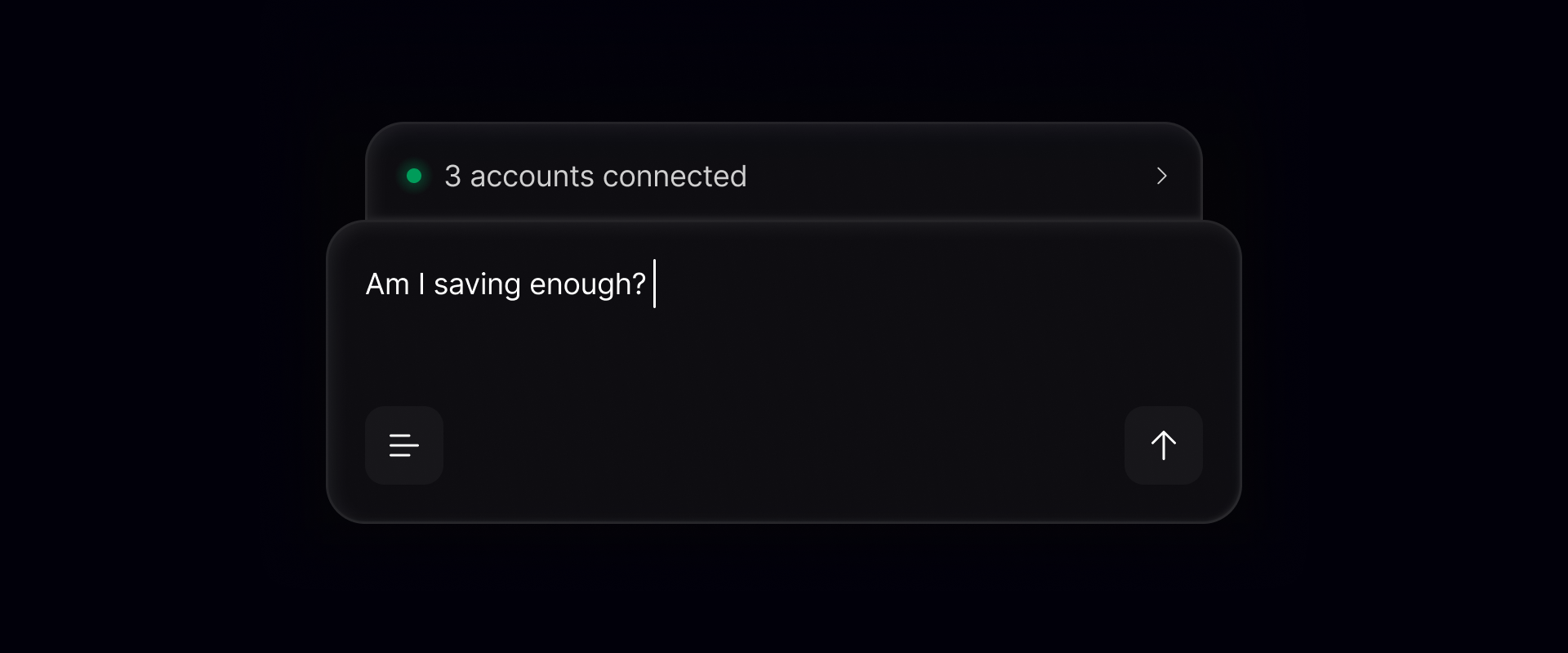
The Questions You Don't Know to Ask
Bad decisions get the most blame for costly financial mistakes, but most of the time, shortfalls are actually the result of inaction — not actively messing up. And inaction is a passive sin; it almost always comes down to not knowing a decision needed to be made.
You don't often think to open your budgeting app and ask, "Am I underinsured?" You don't think to check whether your cash allocation is working against your savings rate. You don't wake up wondering if your estate planning documents still reflect your actual life. These aren't questions people walk around with. They're the things a good financial advisor catches on your behalf — because they're already looking, whether you've thought to ask or not.
The average person has a hundred financial variables in motion at any given time: Cash flow patterns, credit utilization, retirement contributions, debt ratios, insurance coverage, investment allocations, tax exposure — the list could swallow pages.
Keeping all of that (and more) in view simultaneously is impossible, and it’s not indicative of a lack of discipline either. It's a cognitive load problem that no individual person can reasonably solve.
But maybe…the right financial tool could.
What We Built
Origin's AI Advisor now has a proactive command center behind it.
AI Advisor was already our calling card. Combine it with Forecasting, budgeting, investing, net worth tracking, tax filing, estate planning, access to real CFPs too, and you’ve already got a tool that encompasses your financial life in one place.
But we wanted it to solve the most glaring problem of all: It needed to become proactive.
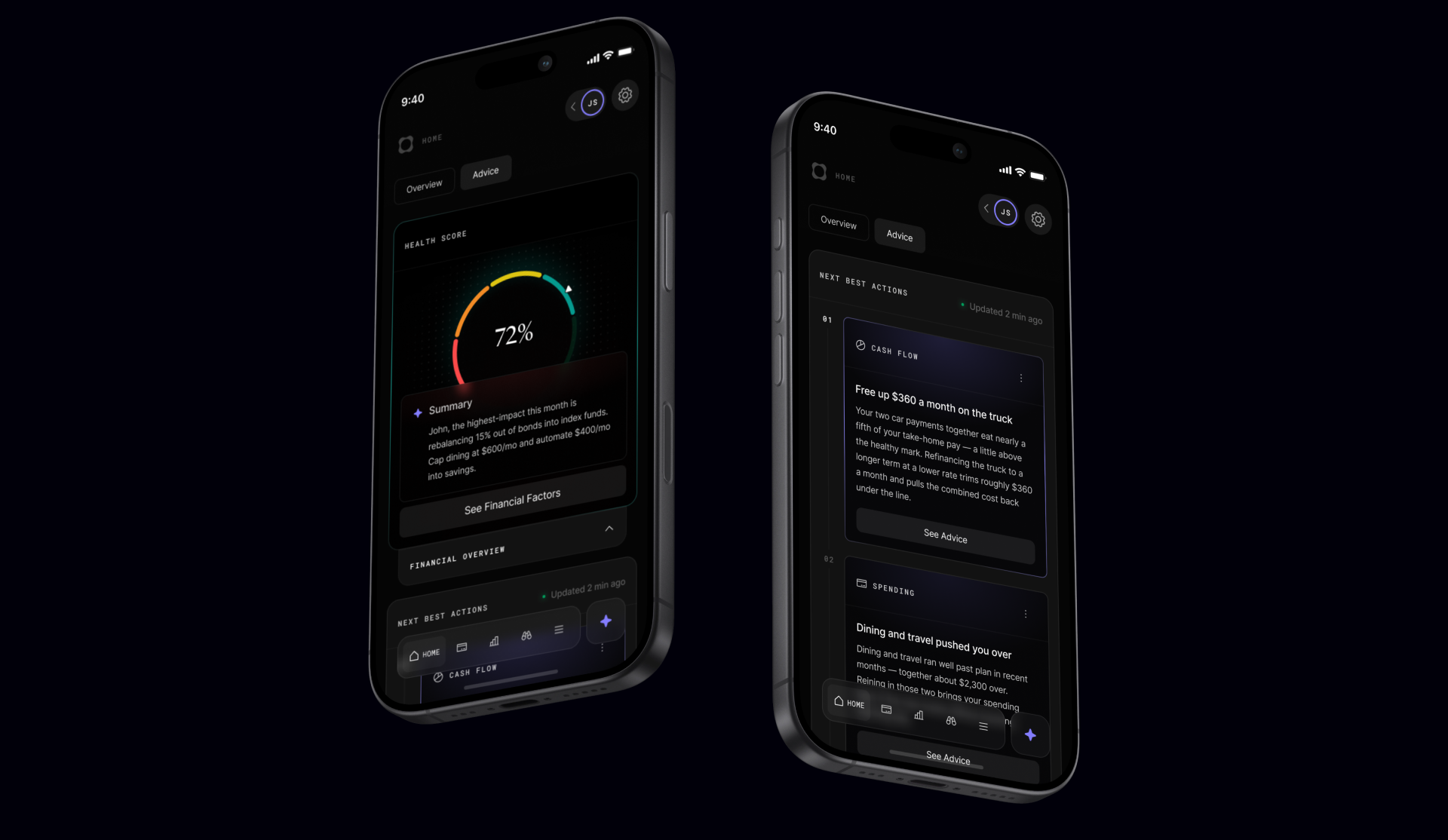
AI Advisor now runs hundreds of checks against your actual financial data — every day, automatically — across every major dimension of your financial life: Retirement readiness, housing costs, credit health, cash flow, investments, debt management, tax efficiency, estate planning, and protection. Not alerts that fire after something has already gone wrong. Checks that surface what needs your attention before you'd think to look for it.
Each check either resolves cleanly or generates an Action — a specific, prioritized task, with the reasoning and data clearly laid out.
Not "you might want to think about your savings rate." More like: your emergency fund covers 1.8 months of expenses, below the standard 3-month threshold, and here's what closing that gap actually requires. Those Actions roll up into a Financial Health Score — a single number reflecting the actual state of your finances, updated continuously as your situation changes and as you act on what's surfaced.
The AI Advisor sits atop it all. The same system that already outperforms human CFP® professionals on financial reasoning benchmarks now has full context: your score, your open Actions, and your complete financial history. When you ask it something, the answer it gives you is built on a real-time picture of your finances — not a generic knowledge base, and not just whatever you happened to share in the conversation.
The goal is straightforward: You should never miss something important about your money because life got busy and you forgot to check.
The Architecture Behind Always-On
Building a system that monitors hundreds of financial variables simultaneously — across millions of users, with the precision financial decisions require is an infrastructure problem, not a prompt-engineering one.
Getting the AI to sound smart isn't the hard part. Getting it right, consistently, on the math that actually affects people's financial lives is a different challenge entirely.
Here are the intricacies
- Origin's AI Advisor runs as a multi-agent ensemble coordinated by a central orchestration layer. Claude Sonnet 5 and Gemini 3.5 Flash handle multi-pillar reasoning across domains, leveraging its long context window for the kind of multi-hop analysis that connects, say, an RSU vesting schedule to its downstream tax implications. OpenAI GPT 5.4 handles tool orchestration across 150+ proprietary MCP tools — an order of magnitude beyond typical agent frameworks — abstracting complex operations like Monte Carlo simulations and tax table lookups without bloating the reasoning layer. Exa.AI provides real-time market grounding, pulling live data at inference so that answers reflect what's happening in markets today, not last week. Perplexity Sonar Pro manages retrieval and contextual linking across Origin-specific knowledge, so the Advisor can surface not just what to do but how to do it within the product.
- The math doesn't go through an LLM. One of the more persistent failure modes in AI financial tools is numerical fragility — a model that can fluently explain compound interest but miscalculates it under specific conditions. Origin uses deterministic computational engines via MCP tools and code execution capabilities for the underlying math. The LLM layer interprets, reasons, and orchestrates; the calculation layer computes. That hybrid design is what allows the system to operate with the precision financial advice requires, not just the fluency.
- Every output passes through a compliance gateway — 138 automated checks validating numerical accuracy, suitability, disclosure compliance, and privacy — before anything reaches a user. Full audit logging at every step. SOC 2 certified. Zero Data Retention agreements with all LLM providers. The infrastructure is built for a regulated domain because financial advice is one, and the consequences of getting it wrong are real.

A Proactive AI Advisor Changes the Standard
The shift from reactive to proactive reframes what a financial tool is actually for.
A reactive tool assumes you're the expert on your own financial blind spots. You ask; it answers. The burden of knowing what to look for stays with you, and the gap between what you think to ask and what you should be asking is where most financial drag quietly accumulates in dozens of small ones that never got caught.
Origin's proactive monitoring inverts that relationship. The checks run whether you open the app or not. The Actions surface when something needs your attention, not when you happen to remember to look. The AI Advisor answers questions with the full picture already loaded — your score, your history, your open items — so the conversation starts from somewhere useful instead of from scratch.
That's what "advice before you ask for it" means in practice. A system that has already done the work by the time you open the app, that notifies you when something changes, and that gives you the reasoning so you understand what to do and why. The goal, genuinely, is that you never have to think about money again — not because you've ignored it, but because something is already thinking about it for you.

What This Means For The Finance Industry
The financial advice industry has a long history of building tools for people who already know how to use them — and people who are wealthy enough to get an advisor’s attention.
That means the people who get the most out of a traditional financial advisor are, almost by definition, those who already know enough to ask the right questions, have time to do so, or can afford to have someone do it for them.
Everyone else — the person with a 401(k), some investments, a full-time job, a family, and a vague feeling they're probably leaving something on the table — has largely been on their own.
Origin was built to change that, and this is the most direct expression of it we've shipped.
Not a better budgeting app. Not a smarter dashboard. A proactive financial advisor that monitors everything, surfaces what matters, and delivers the kind of personalized guidance that used to require either wealth or luck to access.
It's already watching. Go check what it found.
Answers to your questions
Yes. Origin offers partner access so you can manage your finances together at no additional cost. You’ll be able to filter transactions by member—making it easy to see which spending is yours and which belongs to your partner.

Yes. You can edit existing transactions and add new ones directly in Origin, so your records stay accurate and personalized.
Origin connects securely through trusted partners including Plaid, MX, and Mastercard.
Yes. Origin supports CSV uploads. You can upload a .csv file of your transactions, and we’ll import them into your account.
Yes. Your data is protected with bank-level security and advanced encryption. When you connect accounts through Origin, your login credentials are never shared with us. Instead, our partners generate secure tokens that let Origin access only the data you authorize—keeping your personal information private while enabling personalized insights.
Yes. You have full control to organize your spending in Origin. Transactions are automatically categorized by Origin, but you can always edit categories, add your own tags, and filter transactions however you like—so your spending reflects the way you actually manage money.