


The worst buyer’s market ever


Prospective homebuyers just got handed more leverage than they've ever had, and they still can't afford to use it.
August's numbers: sellers outnumbered buyers by 57.9%, the widest gap Redfin has ever recorded, up from 52.1% in July — which was itself the previous record. Listings hit a six-year high. Nearly three in five homes are selling below their original asking price. All ten of the strongest buyer's markets in the country sit in the Sun Belt, led by Nashville at 139% more sellers than buyers, the widest metro-level gap on record dating back to 2013.
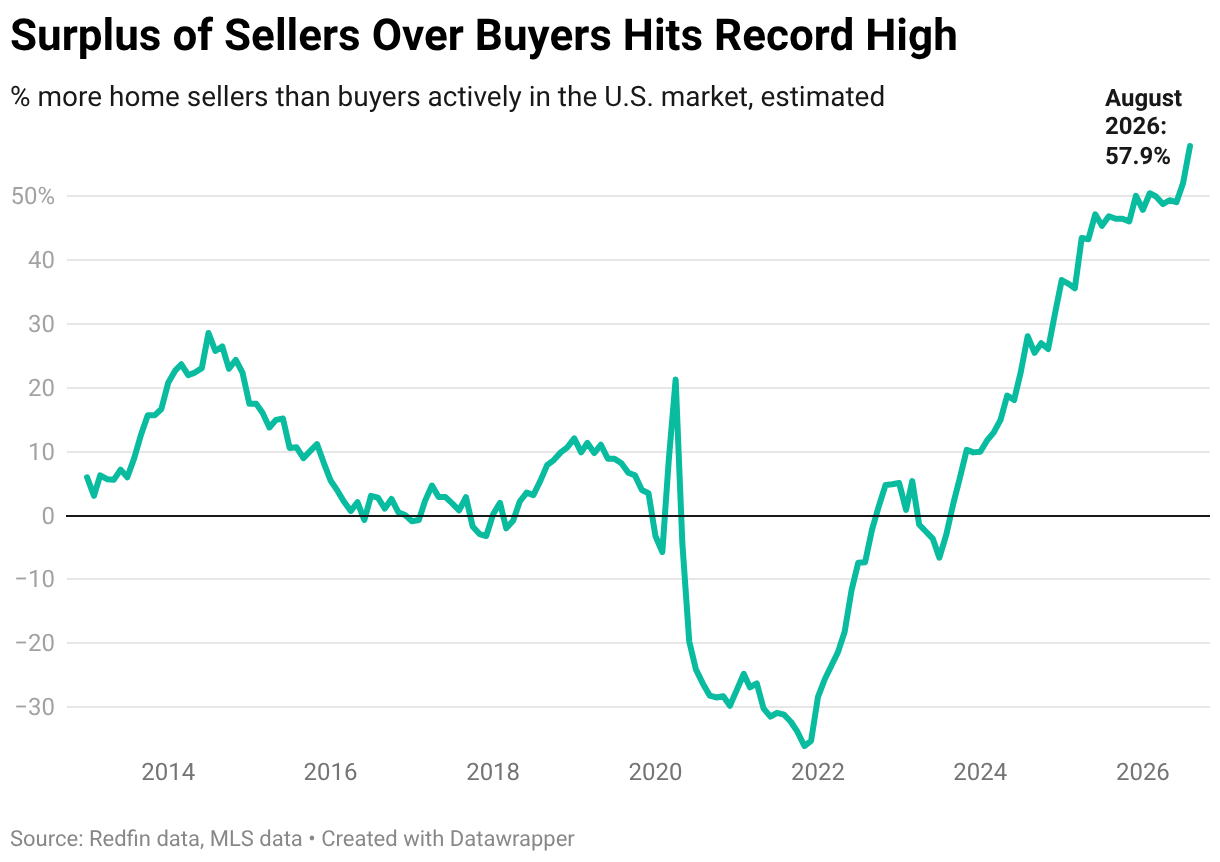
Visual source: Redfin
On paper, this is the moment house hunters have waited years for. In practice, the thing that was supposed to hand buyers the advantage — mortgage rates cooling off — never showed up. The 10-year Treasury (which mortgage rates track alongside very closely) has been on a tear, with its yield hitting a 24-year high of over 5.3% this past week. Understandably, mortgage rates have followed suit and topped 7.5% last week.
So sellers are outnumbered and cutting prices in a market where almost nobody can qualify for a loan, regardless of the price tag.
Almost nobody? Statistically, yes. Most lenders prefer their borrowers to have a debt-to-income ratio of 36% or less — i.e., your monthly obligations should not exceed 36% of your gross monthly income. Look at the current landscape: The median-priced home in America is $410,000, the average 30-year mortgage is about 7.5%, and the median household income is now $87,000. Straightforward math with these assumptions yields this crime scene: $3,013 a month, including taxes and insurance. That’s 41% of your gross monthly income; borderline rejection territory already. Oh, and this assumes you could cover a 20% down payment of $82,000. Can’t? Add PMI to the list, and your mortgage is now $3,377, and we’re at 46% DTI.
And this baseline also ignores important asterisks. DTI is based on gross income, not net. So even if you manage to get in under the apron at 41%, the actual math (depending on your state and local taxes) is more like ~55% of your actual monthly income without PMI, and 61% with it. Absolutely diabolical. And let’s not forget — other loans count towards your debt-to-income ratio too. Got an auto loan or student debt? Yep, the odds of qualifying just got even worse. This math is also based on household income. The median individual income in the U.S. is just $47k. Let’s not even bother with the math on that and just call it what it is — Impossible. But this is particularly pertinent because many prospective first-time home buyers are younger, and younger people are getting married or partnering at historically low rates, meaning a single income is more likely to be the norm.
What do you actually need to make in order to reasonably metabolize the typical mortgage, then? Assuming you’d prefer not to spend your entire income on the house (let’s keep it under 35% DTI), you’d need to gross about ~$105,000 per year for that if you can foot the 20% down payment, and $115,000 if you can’t — and the lower the down payment, the higher the monthly mortgage payment can go. Again, these “just getting by” numbers are still pre-tax, so that payment will still consume an uncomfortable amount of monthly income even if you get qualified.
Based on current U.S. income distributions, roughly 15% to 20% of Americans can realistically qualify for and comfortably manage this scenario.
As always, these numbers are national averages and will vary materially depending on your exact location — but they accurately surmise the current, broader housing market situation.
That being said, what can the average person do to decrease the burden and increase their odds of becoming a homeowner?
- Aggressively clear non-housing debt: Wipe out car loans and credit cards to lower your total back-end DTI and maximize your borrowing power.
- Leverage family capital: Tap into the "Bank of Mom and Dad" for down payment assistance, a strategy used by 40% of all current homeowners — and a staggering 78% of Gen Z buyers — with over a third of recipients stating they could not have bought their home without it.
- Target low-DTI alternative loans: Explore FHA or state-specific programs that permit flexible, higher DTI limits up to 50% for qualified buyers.
- Secure a non-occupant co-signer: Add a parent or relative's income to the application to dilute the DTI ratio and secure an approval.
- Execute geographic arbitrage: Relocate to lower-cost-of-living regions where the median home price aligns with a single, average income.
- Pool resources via co-buying: Partner with a sibling, friend, or unmarried partner to stack multiple individual incomes against one mortgage.
- Hunt for assumable loans: Look for sellers with assumable FHA or VA mortgages to take over their existing, historically low interest rates.
Answers to your questions
Yes. Origin offers partner access so you can manage your finances together at no additional cost. You’ll be able to filter transactions by member—making it easy to see which spending is yours and which belongs to your partner.

Yes. You can edit existing transactions and add new ones directly in Origin, so your records stay accurate and personalized.
Origin connects securely through trusted partners including Plaid, MX, and Mastercard.
Yes. Origin supports CSV uploads. You can upload a .csv file of your transactions, and we’ll import them into your account.
Yes. Your data is protected with bank-level security and advanced encryption. When you connect accounts through Origin, your login credentials are never shared with us. Instead, our partners generate secure tokens that let Origin access only the data you authorize—keeping your personal information private while enabling personalized insights.
Yes. You have full control to organize your spending in Origin. Transactions are automatically categorized by Origin, but you can always edit categories, add your own tags, and filter transactions however you like—so your spending reflects the way you actually manage money.