


AI for Your Money Is Not Good Enough Alone — So We Made It Work for You


The personal finance industry converged pretty quickly on a version of AI for your money: a chat interface connected to your financial data. The user flow is logical: you ask a question and get a personalized answer. It's a meaningful improvement over a generic chatbot that doesn't understand your personal finances or history. It’s a great tool if the reasoning is solid, the answers are specific, and the math is right.
But this model has a structural limitation that better AI alone can't fix, and it's worth being honest about it.
The chat model is reactive by definition. It answers what you ask, which means its value is bounded by your ability to ask the right questions — and most people, most of the time, don't know what they don't know.
You can ask an AI advisor whether your savings rate is healthy. You can't ask it to flag the thing you haven't thought to worry about yet. That's not a criticism of any particular product; it's just what a question-and-answer interface is. The ceiling is your own financial awareness, and for most people, that ceiling is lower than it should be — not because they're not smart, but because personal finance has a hundred moving parts and no one is watching all of them.
What "Proactive" Actually Requires
The natural response to this problem is to say, "Make the AI more proactive." Surface insights automatically. Send alerts. Generate a weekly summary.
Those are useful features. They're also not the same thing as proactive financial intelligence, and the difference matters more than it might seem.
An alert that fires when your account balance drops below $500 is reactive — it's just a rule with a notification attached. A weekly spending summary is a recap, not a recommendation. Even an AI-generated insight like "your dining spend is up 23% this month" is descriptive. It tells you what happened. It doesn't tell you whether that matters given everything else going on in your finances, what you should do about it, or whether there are five other things that need your attention more urgently.
Genuinely proactive financial intelligence requires something more than a smarter notification system. It requires a system that continuously monitors your entire financial picture — not individual metrics in isolation — evaluates everything against a coherent set of standards, prioritizes what actually matters, and delivers that in a form you can act on. That's a different architecture, not a better feature.
What Origin Built
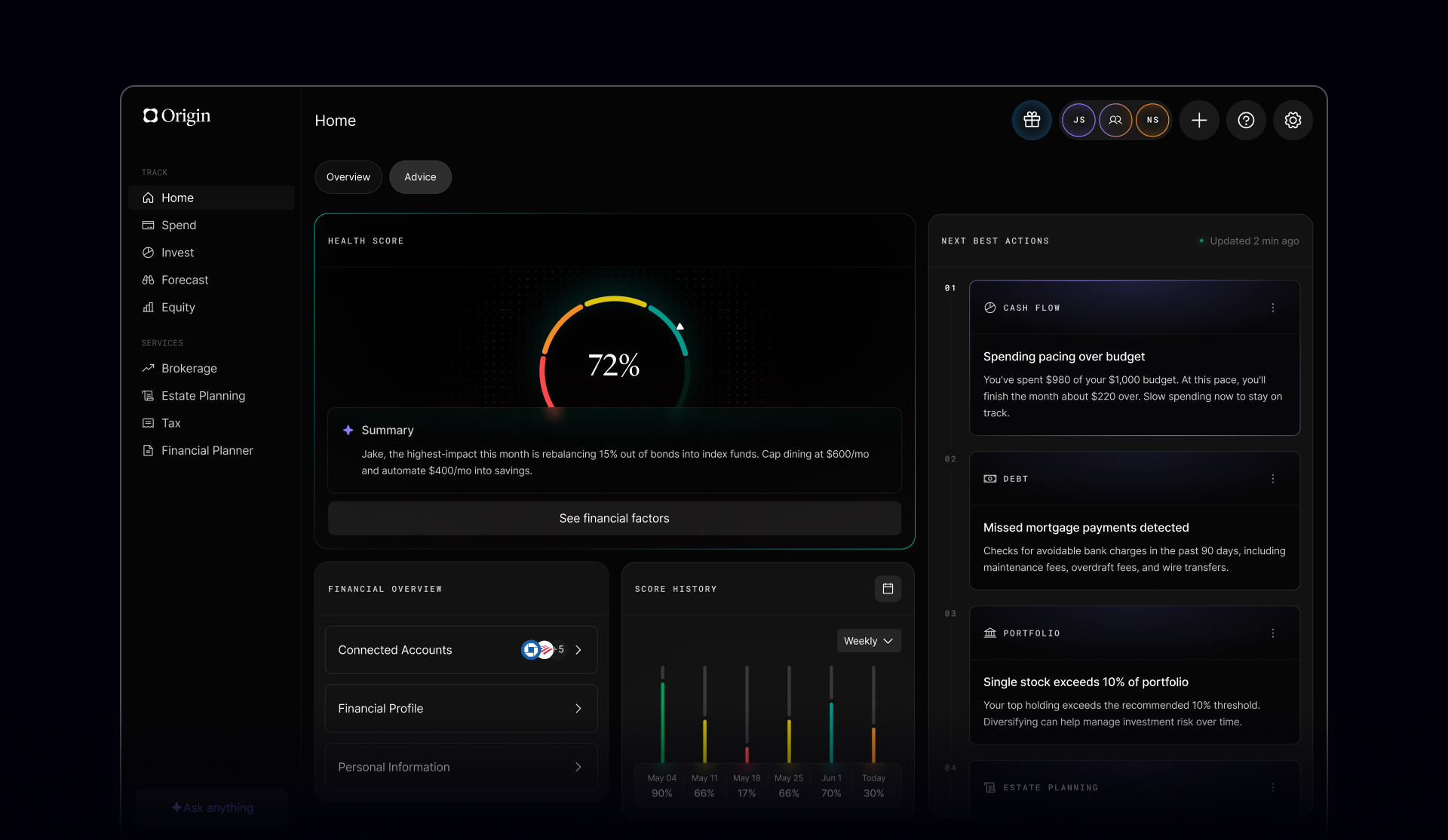
Origin's AI Advisor now runs hundreds of checks against your real financial data, across every major dimension of your financial life: cash flow, retirement readiness, investment risk, credit health, spending patterns, insurance coverage, tax optimization, and estate planning. Not sequentially. Not on a schedule you have to remember. Continuously, in the background, every day.
Each check either clears or surfaces an Action — a specific, prioritized thing to do to save or earn you money, with the reasoning and the data behind it. Those Actions roll up into a single Health Score that reflects the actual state of your finances, updated in real time as your situation changes.
The AI Advisor is still there, still answers questions. But now it has full context — your score, your Actions, your complete financial history — which means the answers it gives are built on a foundation of continuous monitoring, not just whatever you happened to ask about today.

The result is a system that doesn't wait for you to notice something's off. It's already looking.
Why This Is Hard to Build
It's worth explaining why this isn't the default, because "monitor everything and tell users what to do" sounds obvious in retrospect.
The monitoring layer is genuinely complex. Running hundreds of checks across retirement, credit, investments, cash flow, insurance, taxes, and estate planning — at scale, against live account data, with the nuance required to distinguish between a check that's failing and one that's simply not applicable — requires purpose-built infrastructure. The check for single-stock concentration has different logic than the check for credit utilization, which has different data dependencies than the check for savings rate or insurance coverage. None of them are hard individually. Doing all of them reliably, at scale, with the accuracy financial decisions require, is a different problem entirely.
The prioritization layer is harder still. Surfacing everything that's off-track is easy. Surfacing the right things, in the right order, weighted by actual impact on your financial health — that requires a scoring model that's both comprehensive and coherent. A check that's failing by a small margin in a low-stakes domain shouldn't crowd out a more urgent structural issue.
And threading the AI Advisor through all of it — making it actually aware of the monitoring layer, not just adjacent to it — requires architectural decisions that can't be bolted on after the fact. The context has to be real. The Advisor has to know what's been found, what you've already resolved, and what's still open. Otherwise you get two products that happen to live in the same app, and that's not what we built.
The Comparison That Matters
Most personal finance app comparisons focus on features: does it have budgeting, does it track investments, does it have an AI chat? By those measures, the field is increasingly crowded and increasingly similar.
The question worth asking is different: when something important changes in your financial life — your savings rate drops, your portfolio drifts out of alignment, an insurance gap opens up — how long does it take you to find out?
With a reactive tool, the answer is whenever you happen to open the app and look in the right place. Maybe this week. Maybe next quarter. Maybe not until the problem is bigger than it needed to be.
With Origin's proactive monitoring, the answer is as soon as it happens.
What This Looks Like in Practice
A few scenarios that illustrate how this plays out differently than a standard AI finance tool.
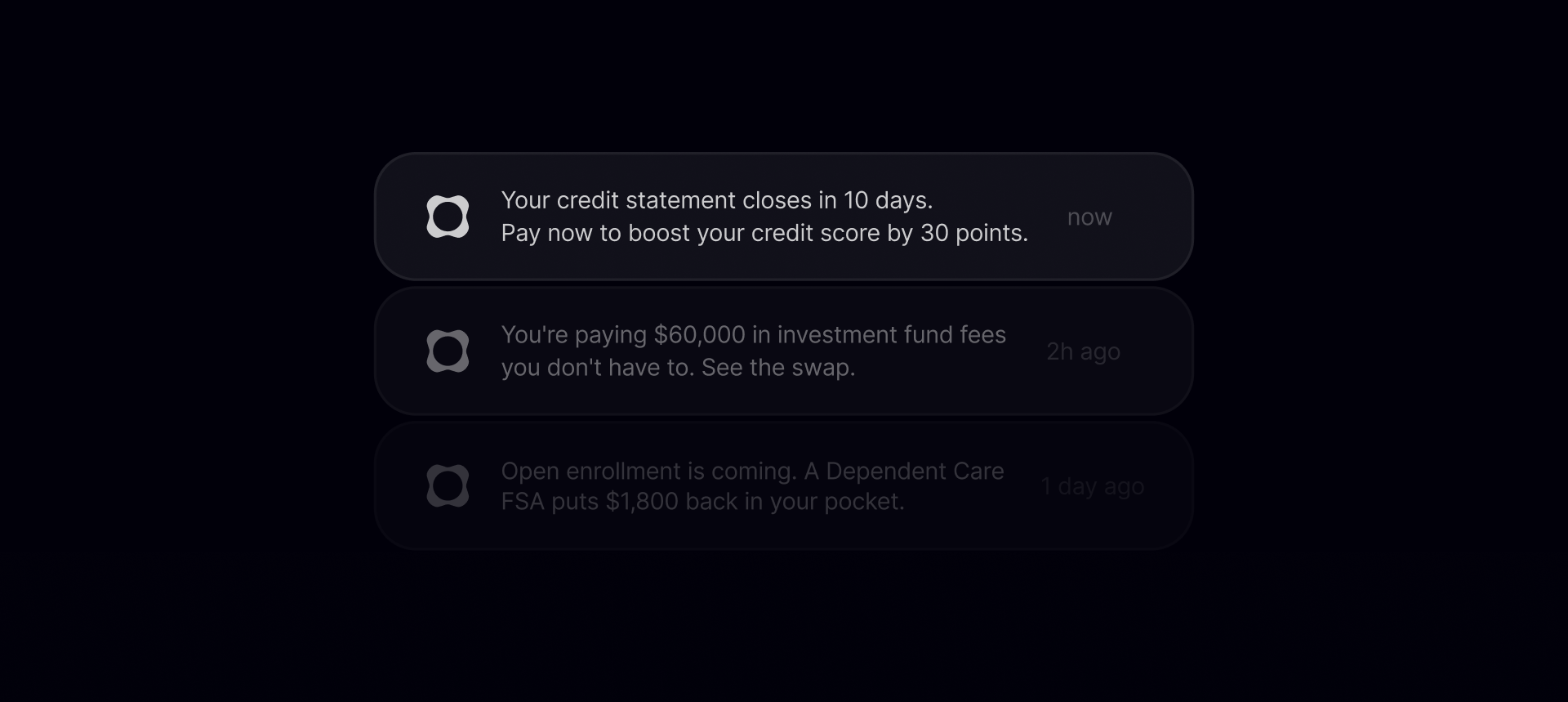
- Your portfolio has drifted. You set a target allocation two years ago, the market has moved, and your equity exposure is now meaningfully higher than your risk profile suggests it should be. A reactive tool surfaces this when you ask about your portfolio. Origin's monitoring layer surfaces it as an Action the next time the investment checks run — before you think to look, with a specific recommendation attached.
- Your savings rate slipped. A rough month, a big expense, whatever the reason — your savings rate dropped below 10% for the first time in six months. A reactive tool tells you this if you pull up your cash flow summary. Origin flags it as an Action, shows you the context of how it compares to your historical rate, and lets you ask the AI Advisor whether it warrants a budget adjustment or is just noise.
- You've never updated your beneficiaries. It's the kind of thing everyone knows they should do and almost no one gets around to. A reactive tool doesn't know you haven't done it. Origin does, because the estate planning checks are running whether you're thinking about estate planning or not. It shows up on your list. It stays there until you handle it.
None of these are exotic scenarios. They're the ordinary ways financial situations quietly deteriorate between the moments people actually pay attention to their money — which, for most people, is most of the time.
The Ultimate Solution
The gap in most people’s personal money management process is that they can't monitor everything at once (no one can), and the things that quietly go wrong tend to go wrong in the gaps between the moments they're paying attention.
AI that answers questions is genuinely useful when you're paying attention. Origin's proactive monitoring is useful the rest of the time — which, for most people, is most of the time.
"Better answers" and "always watching" are two different problems, and solving one doesn't solve the other. Origin solved the second one.
Answers to your questions
Yes. Origin offers partner access so you can manage your finances together at no additional cost. You’ll be able to filter transactions by member—making it easy to see which spending is yours and which belongs to your partner.

Yes. You can edit existing transactions and add new ones directly in Origin, so your records stay accurate and personalized.
Origin connects securely through trusted partners including Plaid, MX, and Mastercard.
Yes. Origin supports CSV uploads. You can upload a .csv file of your transactions, and we’ll import them into your account.
Yes. Your data is protected with bank-level security and advanced encryption. When you connect accounts through Origin, your login credentials are never shared with us. Instead, our partners generate secure tokens that let Origin access only the data you authorize—keeping your personal information private while enabling personalized insights.
Yes. You have full control to organize your spending in Origin. Transactions are automatically categorized by Origin, but you can always edit categories, add your own tags, and filter transactions however you like—so your spending reflects the way you actually manage money.