


Younger Americans are increasingly pessimistic about the job market


For most of modern history, younger people have generally been more optimistic about the job market than older generations. That kind of makes intuitive sense — they’re entering the workforce, starting careers, building toward something.
That dynamic has now completely flipped in the U.S.
A recent Gallup survey found that Americans aged 15–34 are now significantly less optimistic about the labor market than older adults, marking the largest generational confidence gap in the world. Just 43% of younger Americans said it was a good time to find a job locally last year, compared to 64% of Americans aged 55+.
And the drop happened fast. Since 2023, younger Americans’ confidence in the labor market has fallen 27 percentage points — a decline comparable to what we saw during the financial crisis.
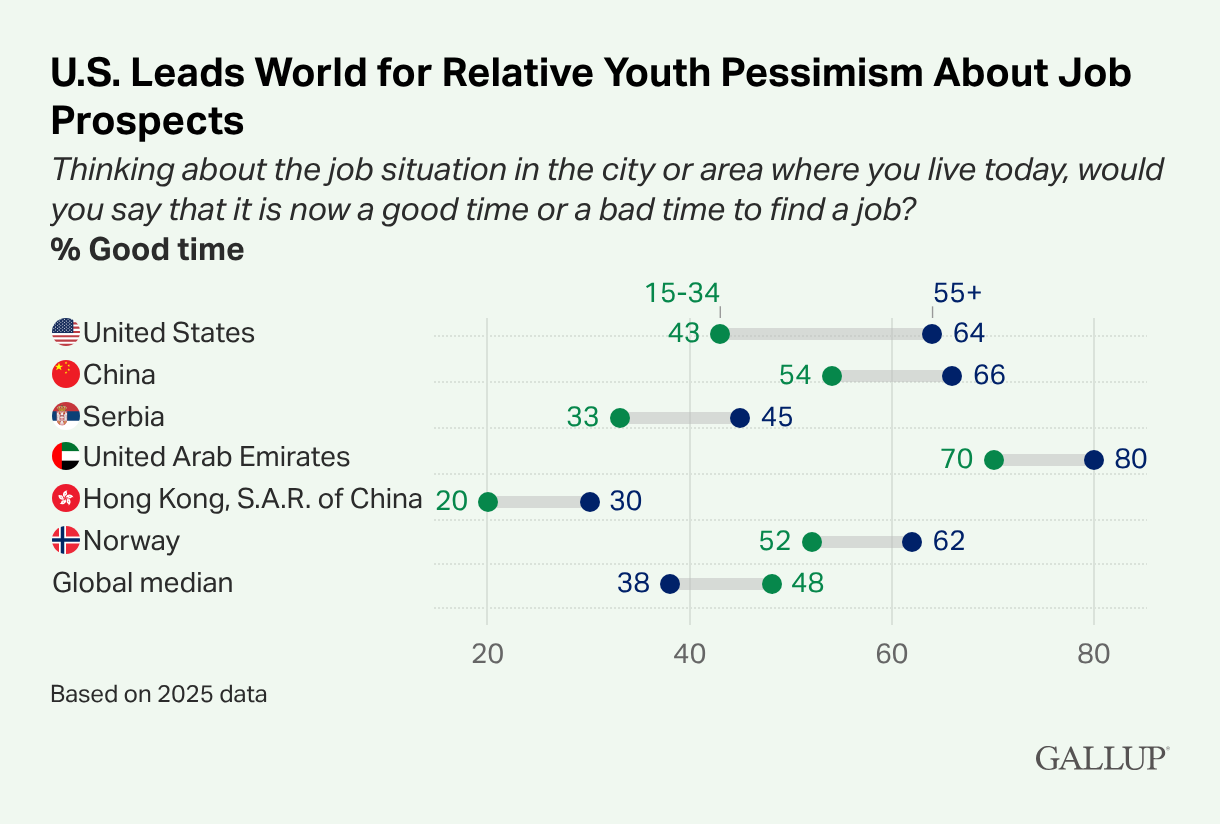
Source: Gallup
This is all unfolding as AI adoption accelerates across white-collar industries, particularly in the exact kinds of entry-level cognitive roles that younger workers traditionally use to get their foot in the door. In fact, nearly half of college students recently said they’re reconsidering their major because of AI’s potential impact on early-career jobs.
And to be fair…the concern isn’t completely irrational. A recent Bank of America report estimated that roughly 24% of jobs globally are now exposed to generative AI, with exposure highest in wealthier economies like the U.S., where more cognitive, non-routine work exists. Clerical support, professional services, tech, customer support, finance, and administrative roles all rank among the most exposed categories. Notably, the report also pointed out that unemployment has remained particularly elevated among younger degree holders entering early- and mid-career positions — the exact cohort most exposed to AI-related efficiency gains in a still-sluggish hiring environment.
Now, to be clear, most economists don’t think we’re heading toward some instant white-collar extinction event. Even the BofA report argues AI is more likely to reshape jobs than outright eliminate them, at least in the near term. But that distinction may not feel especially comforting to someone graduating into a labor market that already feels increasingly difficult to interpret.
Because that’s really the backdrop here: the labor market hasn’t collapsed, but it has become weird.
Hiring has slowed, companies are increasingly obsessed with productivity, entry-level roles feel less secure, and younger workers are simultaneously being told that AI is either:
- a revolutionary productivity tool
- Or the thing that’s about to absorb half the tasks they trained for.
So naturally, confidence is slipping. And even if AI ultimately creates more jobs than it destroys, uncertainty itself changes behavior.
Answers to your questions
Yes. Origin offers partner access so you can manage your finances together at no additional cost. You’ll be able to filter transactions by member—making it easy to see which spending is yours and which belongs to your partner.

Yes. You can edit existing transactions and add new ones directly in Origin, so your records stay accurate and personalized.
Origin connects securely through trusted partners including Plaid, MX, and Mastercard.
Yes. Origin supports CSV uploads. You can upload a .csv file of your transactions, and we’ll import them into your account.
Yes. Your data is protected with bank-level security and advanced encryption. When you connect accounts through Origin, your login credentials are never shared with us. Instead, our partners generate secure tokens that let Origin access only the data you authorize—keeping your personal information private while enabling personalized insights.
Yes. You have full control to organize your spending in Origin. Transactions are automatically categorized by Origin, but you can always edit categories, add your own tags, and filter transactions however you like—so your spending reflects the way you actually manage money.