


Younger Americans are giving up on life’s major milestones


Nearly three in four Gen Z adults (72%) and over half of Millennials (56%) say financial pressure has forced them to delay at least one major life milestone. This corroborates a trend that’s gained momentum for years now — the barriers to entry have risen, and what used to be routinized milestones have become closer to grandiose ambitions.
Some of these cohorts aren’t even thinking about this as a delay; they’re just relinquishing their expectations for these achievements entirely. 71% of Gen Z and 60% of Millennials believe they may never afford at least one of these milestones. Delay implies "eventually," but this is people quietly moving the goalposts to "maybe not." The specifics get granular fast. Among Gen Z: 31% have postponed buying a house, 26% delayed paying for their own college, 24% delayed having kids, 20% put off getting married. And the "never" numbers track almost as high — 34% of Gen Z worry they'll never afford a house.
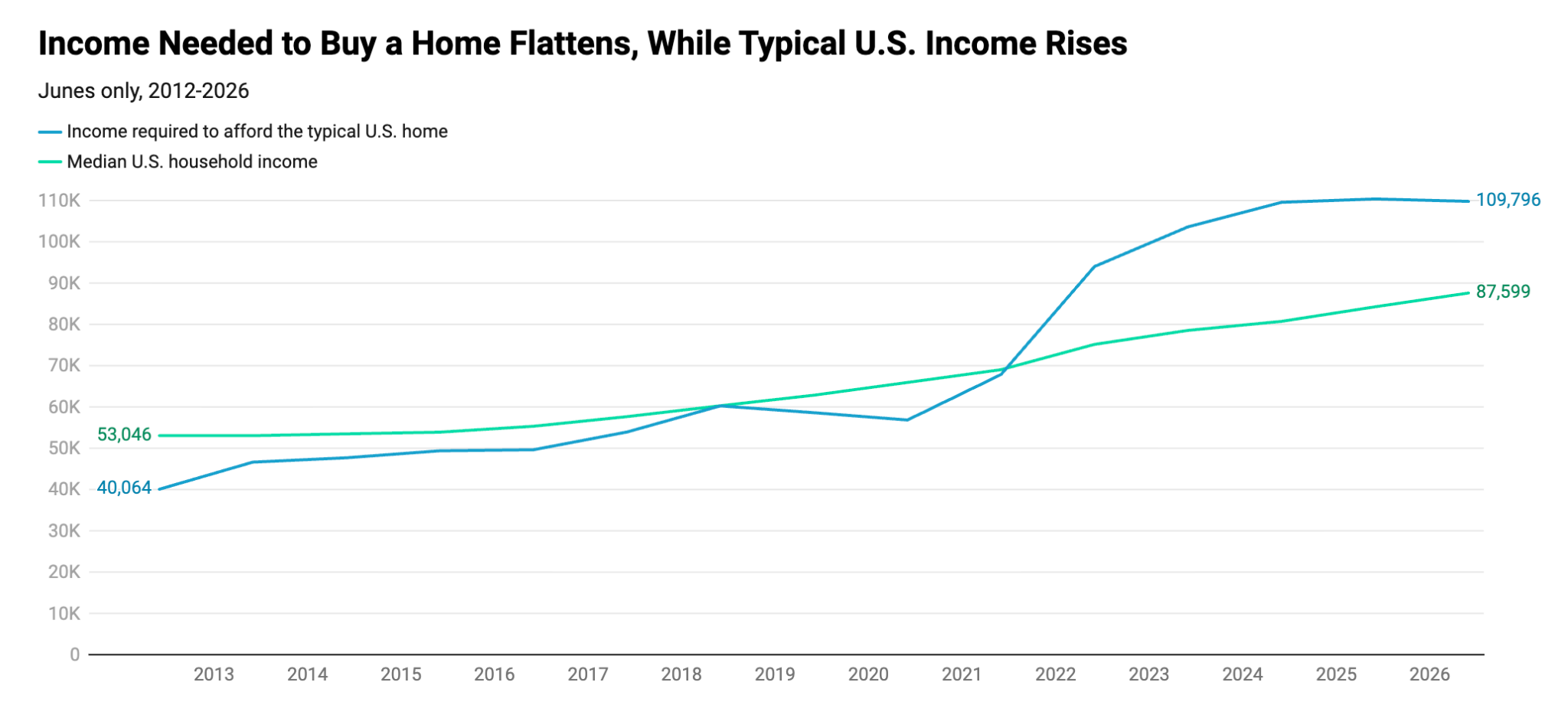
Housing is doing a lot of the heavy lifting here, because once you look at the actual math, it's not hard to see why. You need to earn roughly $110,000 to afford the median home in America. The typical U.S. household earns roughly ~$88,000. That's a $29,000 gap — and the numbers get worse when you strip out the noise: That median buyer would need to spend 40% of their income on housing, pre-tax. Don’t even ask about the percentage post-tax. The standard lending rule of thumb is 30% of gross income. This is how you end up with suggestions like fifty-year mortgages.
Source: Redfin
For young adults specifically, the compounding math of homeownership is brutal. Between 2019 and 2024, home prices for buyers under 40 rose 30% while their incomes rose only 9%. The price-to-income ratio for that group hit 3.5 — nearly matching the 3.6 peak right before the 2006 housing bubble popped. Monthly ownership costs for a young buyer went from $1,689 in 2019 to $2,776 in 2024. And the renters who could actually afford those costs on paper dropped from 56% to just 37% over that same stretch.
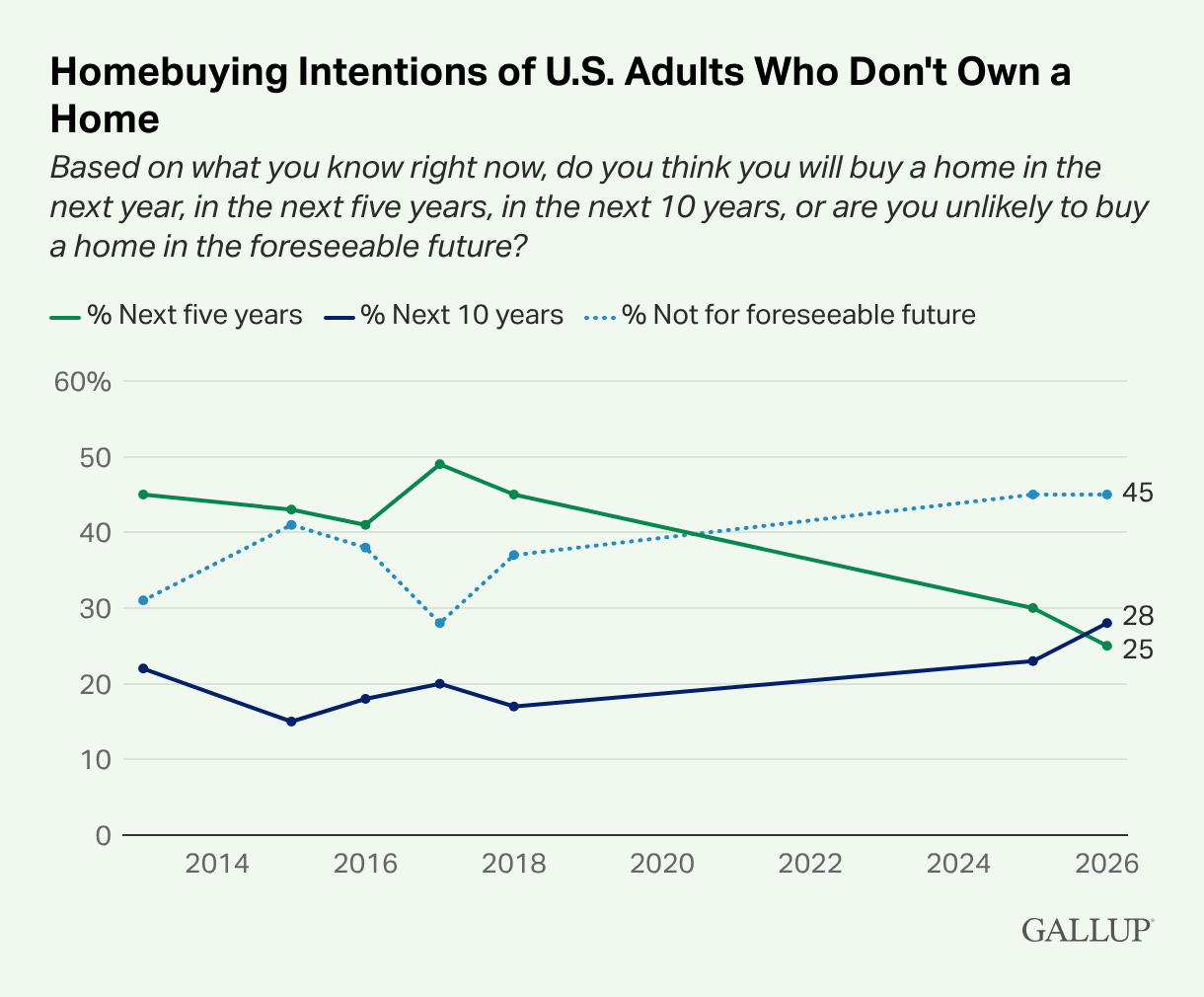
No wonder 89% of young adults say buying a home is harder now than it was for their parents' generation. Only 25% of non-homeowners expect to buy in the next five years — the lowest share Gallup's ever recorded since it started asking in 2013. Among 18-34 year-olds specifically, homebuying intent collapsed from 57% (2013-15) to 29% (2025-26).
Source: Gallup
This all culminates in what’s effectively a genuine crisis of confidence about the future itself. Nearly half of Gen Z (46%) and a third of Millennials (32%) say they're pessimistic specifically about AI's impact on their career prospects in general — so this pessimism expands beyond purchasing power, but the ability to produce income in the first place.
Understandably, this bleeds over into every other aspect of existence. Money underscores every aspect of life, and if you can’t obtain the key components of the “American Dream,” shelter which is also an asset — everything else gets put on the back burner too, because that foundation is a prerequisite.
This exact pessimism is also what has, ironically, fueled younger generations to excel at another specific front — retirement — younger generations are moving faster, not slower. Gen Z started saving for retirement at an average age of 22; Millennials at 28, both dramatically earlier than Gen X or Boomers ever did. Gen Z's target retirement age is 61, three years ahead of Millennials and six ahead of Gen X.
So people aren’t rolling their financial nihilism into complete apathy; they’re triaging. Marriage, kids, and homeownership — the milestones that require a stable partner, a cooperative market, or six figures of household income just to clear a lending threshold — are the ones getting deferred or written off entirely. Retirement, the one milestone you can control through personal discipline regardless of what mortgage rates or the labor market do, is the one they're attacking earlier and harder than any generation before them.
Whether that's resilience or just picking the one fight that's still winnable is a matter of framing. It might also just be that a Roth IRA doesn't require a seller to accept your offer.
Answers to your questions
Yes. Origin offers partner access so you can manage your finances together at no additional cost. You’ll be able to filter transactions by member—making it easy to see which spending is yours and which belongs to your partner.

Yes. You can edit existing transactions and add new ones directly in Origin, so your records stay accurate and personalized.
Origin connects securely through trusted partners including Plaid, MX, and Mastercard.
Yes. Origin supports CSV uploads. You can upload a .csv file of your transactions, and we’ll import them into your account.
Yes. Your data is protected with bank-level security and advanced encryption. When you connect accounts through Origin, your login credentials are never shared with us. Instead, our partners generate secure tokens that let Origin access only the data you authorize—keeping your personal information private while enabling personalized insights.
Yes. You have full control to organize your spending in Origin. Transactions are automatically categorized by Origin, but you can always edit categories, add your own tags, and filter transactions however you like—so your spending reflects the way you actually manage money.