


We lost jobs in July — the stock market liked it


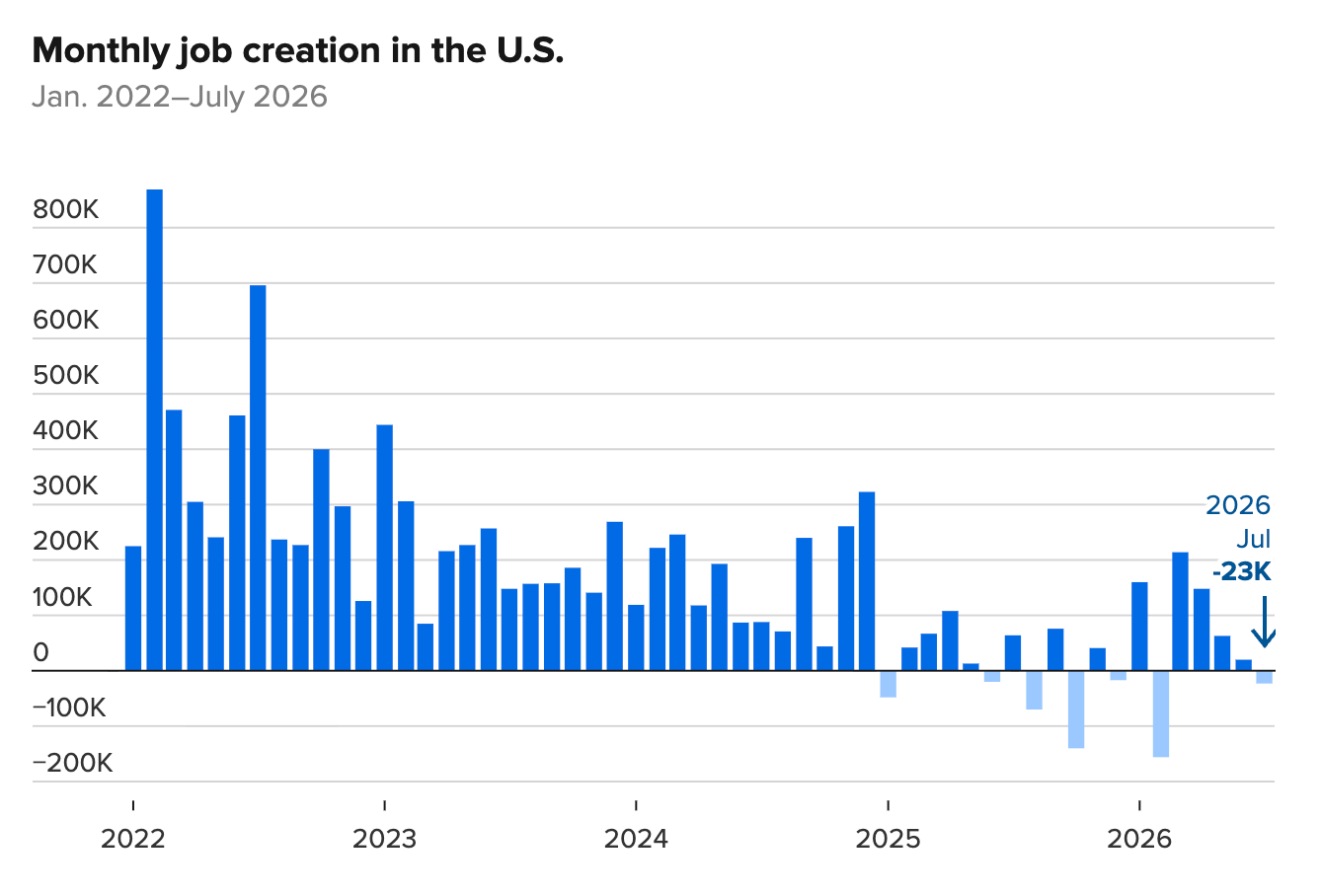
The labor market has now printed back-to-back hiring misses for both June and July. July’s report dropped on Friday, and showed a major downside surprise: The U.S. economy added just ~23,000 jobs during the month; almost a fourth of the ~83k that most forecasts had anticipated. This is a repeat of what happened last month when economists had expected ~115k jobs added for June, only for the report to come in at ~57k.
Now, whiffing on job market estimates isn’t exactly a moral disaster. There’s a reason these things have scheduled retroactive revisions and, more often than not, change drastically after more data comes in. So, the narrative here isn’t really: Wow, the economy is doing much worse than we thought — it’s more so just…difficult to approximate, and the real story will solidify itself in the months to come. A trend is more valuable than a snapshot here.
Source: CNBC
Which leads us directly to the trend materializing in real time. May’s blowout jobs report that beat expectations by a mile originally came in at +172k jobs added. It was later revised down to 129k. The same thing just happened to June’s report: Originally printed at ~57k additions, it was just revised downward in July’s report to just 20k. This is a return to the pattern we had in Q1. For the first few months of 2026, the jobs market looked relatively weak due to several consecutive downward revisions — and inflation hadn’t yet rebelled — so rate cuts were still on the table. That trend was bucked in Q2, after March and April got upwardly revised, and then May came in with a haymaker. The past few months suggest that we’ve now returned to the former.
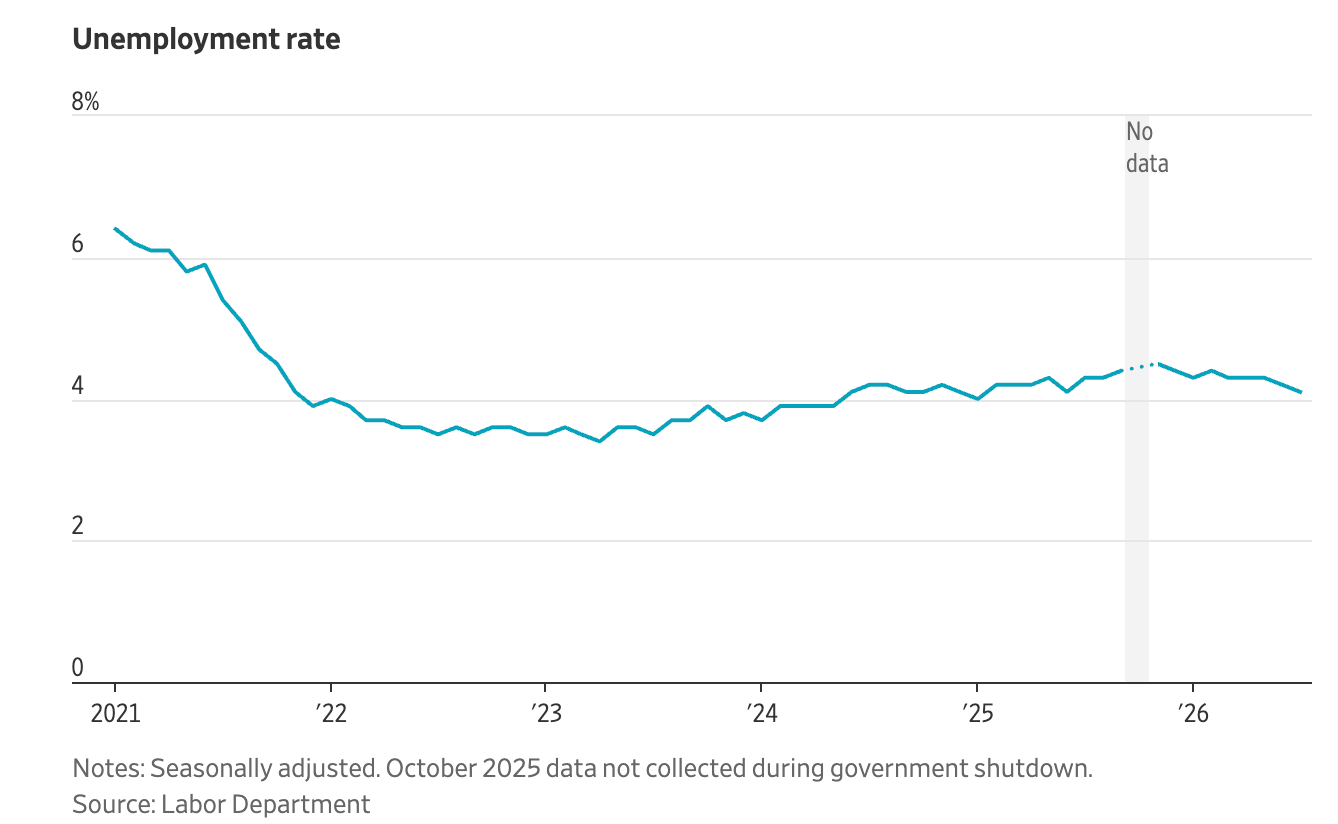
Despite this, the unemployment rate actually declined to 4.1%, which is ironic, but entirely explicable: The labor force participation rate edged down one-tenth of a percent to 61.4% — sounds like nothing, but that's just over a quarter million people no longer in the market for a job or counted as unemployed. This is the lowest level our participation rate has seen in about fifty years, dating back to 1976.
Source: WSJ
Private-sector hiring told its own story of weakness. Employers added just 30,000 jobs total. Construction added 22,000 — the one genuine bright spot, likely riding the data-center buildout. But leisure and hospitality cut 40,000 jobs (after cutting even more in June), and retail shed another 19,000. Government losses (-53,000, mostly local education) pushed the headline number negative on top of that. Wage growth confirms the softness. Average hourly earnings rose just 4 cents, with the 12-month rate slipping to 3.2% — the lowest since May 2021. The Employment Cost Index, a cleaner measure that strips out job-mix shifts, showed compensation costs up 3.4% over the year, still cooling, still consistent with a labor market that's lost its heat.
Underneath all of it, workers don't need a jobs report to tell them something's off. Glassdoor's Employee Confidence Index just hit a record low — 43% of workers report a positive six-month outlook for their employer, down from 53% in 2022. Job postings on Indeed are down 37% since their 2022 peak, now sitting at February 2021 levels. And in a Conference Board survey this month, the gap between people who say jobs are "plentiful" versus "hard to get" is the least favorable it's been since 2021.
All of this data, despite being blatantly negative, was received favorably by both stocks and bonds. The prospect of a rate hike has snuck onto the table over the past several months due to inflation and labor market resilience — so much so that oddsmakers were previously betting it was more likely than a hold in September. But after this weak jobs report, the odds of a hike next month almost immediately dropped to nearly ~40%. That inverted outcome is blatantly good for stocks and anyone borrowing money, so markets rallied accordingly on Friday.
Bonds specifically got a reprieve worth explaining after we just spent an edition last week discussing how brutalized the bond market has been lately — the 30-year hitting levels not seen since 2007, on the back of Warsh's press conference doing the opposite of what a hawkish-sounding Fed is supposed to do to yields. On its face, it's a little counterintuitive: Why would a weak jobs report — usually bad news — send investors into bonds? Because bond prices and yields move in opposite directions, and Fed rate expectations are the thing setting the price. For the moment, investors used this jobs report to assume: New bonds issued in the future will likely carry lower rates. So existing bonds — issued when rates were higher, with their fixed, locked-in payments — suddenly look relatively more attractive by comparison. More buyers want them. Demand pushes their price up. Price up = yield down. This is especially true for longer-dated bonds (10-year, 30-year Treasuries), which are the most sensitive to shifts in expected future Fed policy, since they lock in today's rate for a long stretch.
So, the long and short of this jobs report is simply: Potentially good for rates, potentially indicative of a “low hire, low fire” tightening labor market — both of which will only be confirmed by time itself.
Answers to your questions
Yes. Origin offers partner access so you can manage your finances together at no additional cost. You’ll be able to filter transactions by member—making it easy to see which spending is yours and which belongs to your partner.

Yes. You can edit existing transactions and add new ones directly in Origin, so your records stay accurate and personalized.
Origin connects securely through trusted partners including Plaid, MX, and Mastercard.
Yes. Origin supports CSV uploads. You can upload a .csv file of your transactions, and we’ll import them into your account.
Yes. Your data is protected with bank-level security and advanced encryption. When you connect accounts through Origin, your login credentials are never shared with us. Instead, our partners generate secure tokens that let Origin access only the data you authorize—keeping your personal information private while enabling personalized insights.
Yes. You have full control to organize your spending in Origin. Transactions are automatically categorized by Origin, but you can always edit categories, add your own tags, and filter transactions however you like—so your spending reflects the way you actually manage money.