


Wall Street's Roller Coaster Has Lost Its Safety Bar


Wall Street's post-election day honeymoon came with a 24-hour return policy, and judging by Thursday's market action, investors were lining up for refunds.
Let's appreciate the irony first. On Wednesday, stocks rallied following Democrats' sweeping midterm victories, with the Dow climbing 3%, the S&P 500 gaining 1.6%, and the Nasdaq rising 1.4%. Investors initially welcomed the prospect of divided government and fewer sweeping policy changes, even as semiconductor and AI infrastructure stocks were already flashing warning signs beneath an otherwise “cheerful” market on the surface.
Until yesterday, that footnote was wearing a size 15 and hadn't yet decided to stomp around, but by Thursday, that footnote had eaten the entire textbook.
The Nasdaq plunged (literally) as much as 5% intraday, putting it on course for correction territory, while the S&P 500 suffered its worst daily decline since the April 2025 tariff turmoil. The Philadelphia Semiconductor Index briefly collapsed 11%, its steepest intraday drop since March 2020, with AMD, Micron, Dell, and Marvell among the double-digit casualties. Yesterday's celebration had barely ended before the cleanup crew started assessing structural damage. This trading session was effectively a freefall.
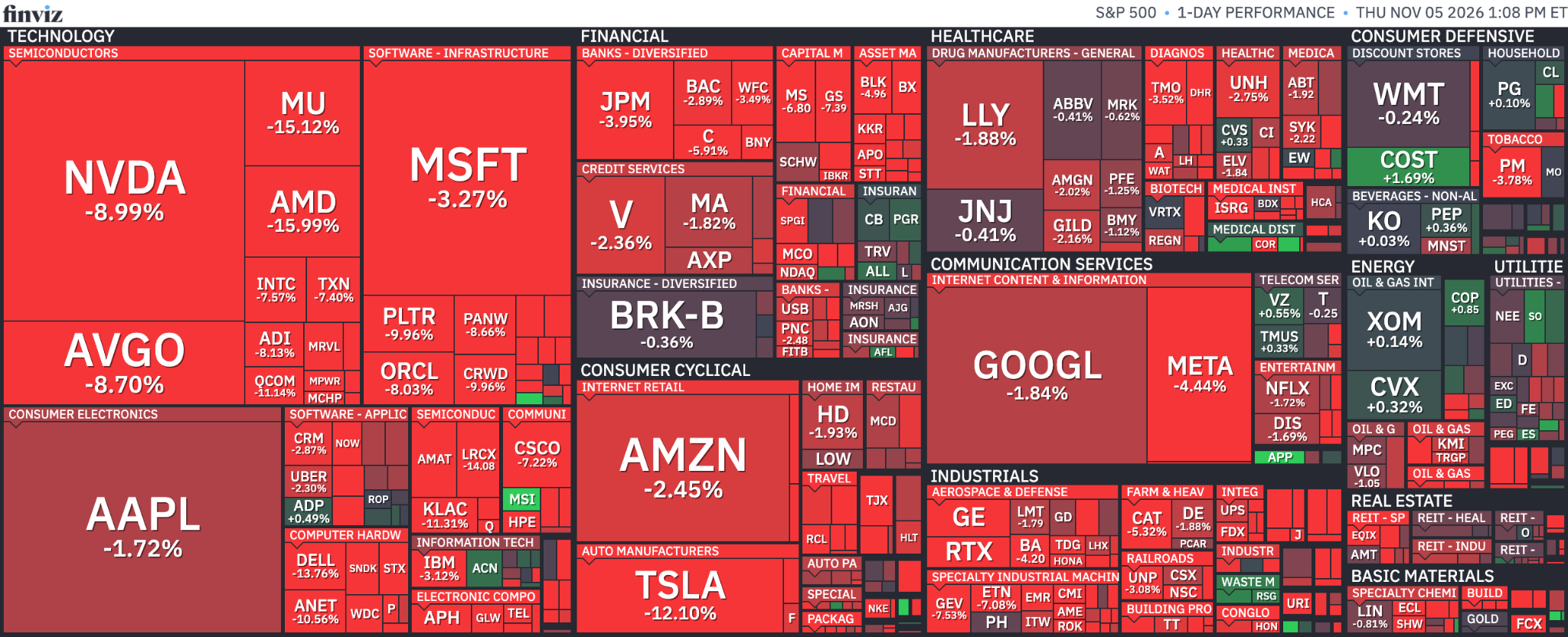
But the market's problems didn't begin with Tuesday's election, and the political fallout may have simply lit a fuse that had been burning for weeks.
Roughly 60% of S&P 500 companies were already trading at least 20% below their all-time highs before the election, and if you’d only looked at your diversified 401k, you’d have no idea. That's a remarkable statistic for an index still hovering near record territory — the headline index had been concealing considerable weakness among its constituents.
History doesn’t always repeat — sometimes it doesn’t even rhyme.
October offered another warning. Despite historically being a positive month, the S&P 500 declined 0.9%, and the Nasdaq shed 5.3%. Meanwhile, the equal-weight S&P 500 actually gained nearly 5%, suggesting investors were increasingly abandoning the enormous technology companies whose valuations had come to dominate the benchmark. October’s historically favorable trend was blatantly bucked, and November’s reputation as the best month for returns is off to an abysmal start.
And here’s where the AI trade and the election results coalesced into today’s implosion.
Last week’s start of earnings season added fuel to the fire; Wall Street began questioning the economics of the AI revolution (again) with considerably less enthusiasm than it had shown for financing it. Alphabet, Meta, and other technology giants faced punishing selloffs as investors scrutinized their enormous infrastructure commitments, rising capital expenditures, and the increasingly uncomfortable question of when all that spending would translate into sufficient profits. The companies building AI infrastructure and the companies purchasing it were suddenly falling together. That's a peculiar arrangement for an industry whose spending has been one of the stock market's strongest growth narratives.
Tuesday's elections introduced another complication: Democratic victories in Congress and key state races have raised concerns about tighter restrictions on data-center development, particularly as communities push back against electricity costs, water consumption, and the extraordinary resources required to support AI infrastructure. Reuters reports that tighter financing conditions were already threatening projects before the election added new regulatory uncertainty.
The irony is that Wednesday's broad rally suggested investors were celebrating the very political outcome that threatened to complicate one of the market's most important growth stories. By Thursday, they seemed to have read the fine print.
And all this arrives in November, historically the S&P 500's strongest month, with average gains of approximately 1.9% since 1950. Seasonality, of course, is a historical tendency rather than a contractual obligation, and Wall Street appears determined to test the distinction.
None of this means AI development is suddenly going into reverse. Demand remains substantial, data-center projects can relocate, and regulatory uncertainty doesn't necessarily translate into permanent restrictions.
But the market is beginning to distinguish between the transformative potential of artificial intelligence and the profitability of spending hundreds of billions of dollars to build it.
If you prefer staying sane, are heavy in tech stocks, or even own the S&P — maybe check your portfolio a bit less this week.
Answers to your questions
Yes. Origin offers partner access so you can manage your finances together at no additional cost. You’ll be able to filter transactions by member—making it easy to see which spending is yours and which belongs to your partner.

Yes. You can edit existing transactions and add new ones directly in Origin, so your records stay accurate and personalized.
Origin connects securely through trusted partners including Plaid, MX, and Mastercard.
Yes. Origin supports CSV uploads. You can upload a .csv file of your transactions, and we’ll import them into your account.
Yes. Your data is protected with bank-level security and advanced encryption. When you connect accounts through Origin, your login credentials are never shared with us. Instead, our partners generate secure tokens that let Origin access only the data you authorize—keeping your personal information private while enabling personalized insights.
Yes. You have full control to organize your spending in Origin. Transactions are automatically categorized by Origin, but you can always edit categories, add your own tags, and filter transactions however you like—so your spending reflects the way you actually manage money.