


The labor market just took a step back


The June jobs report was bad, which…ironically, is kind of good for investors. The past few months have printed employment growth above expectations, signaling a strong labor market, which subsequently translated to: “Not so fast” for hopes for a rate cut any time soon.
Here’s the discrepancy: The U.S. added 57,000 jobs in June, well below the ~115,000 economists expected — and not only that, but April and May got hit with downward revisions. April got revised down by 31,000 and May by 43,000, so the spring hiring streak we've been celebrating was actually 74,000 jobs smaller than advertised. Some have made the case that the spring spike was actually a World Cup hiring spree head fake of sorts, especially after the leisure and hospitality sector added 61,000 fewer jobs in June. But — before we spiral, one honest caveat: 57,000 is a miss relative to expectations, but it's actually above the average monthly gain over the prior 12 months, which was just 36,000. The past few months of 130-180K prints were the anomaly; June is closer to the underlying trend.
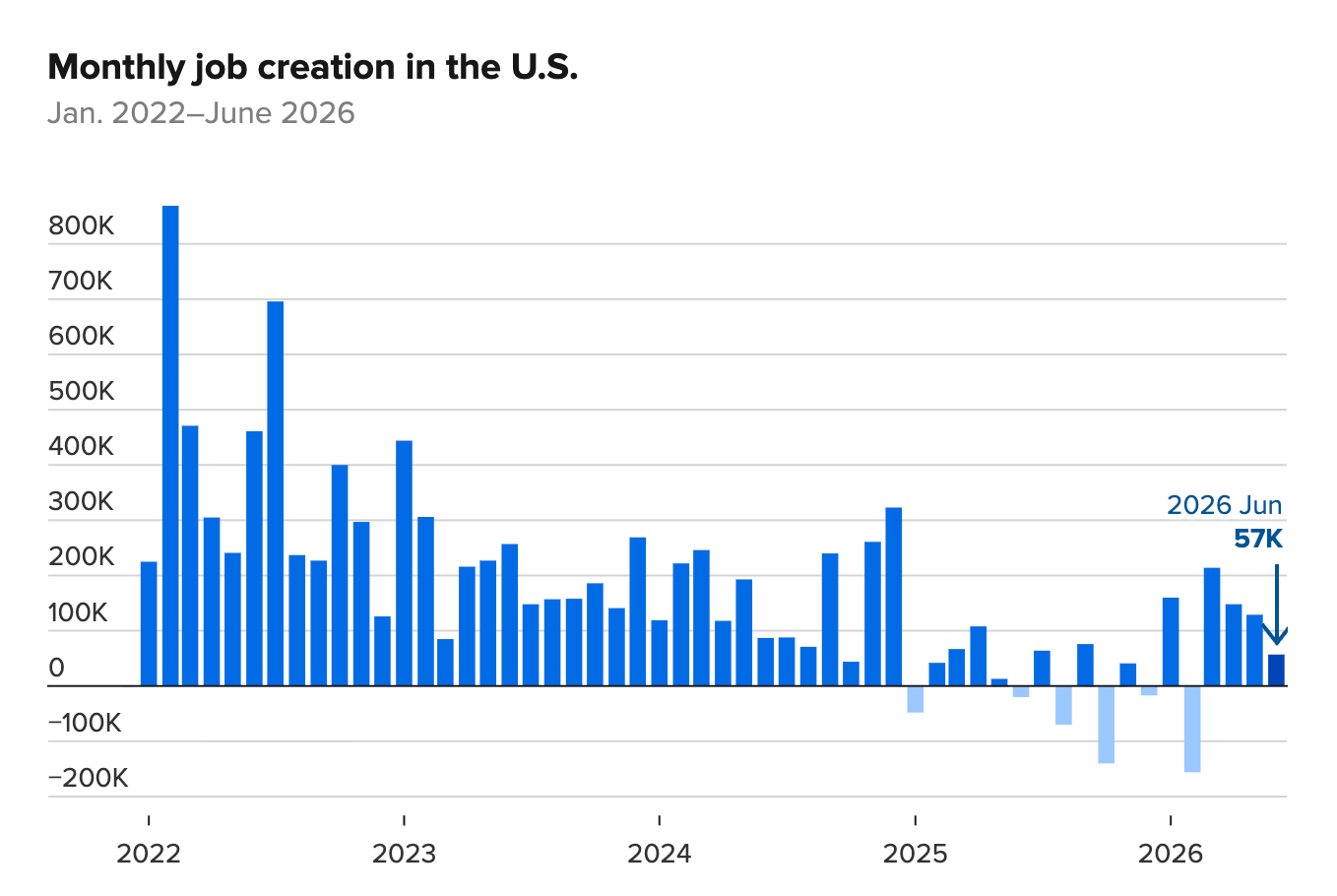
Nevertheless, despite the lower hiring rate, the unemployment rate fell from 4.3% to 4.2%. This economy is full of ironies: A miss on hiring and an improvement in unemployment, in the same report. The explanation resides in the underlying data: The unemployment rate dropped because the labor force participation rate fell 0.3 points to 61.5% — the lowest since 2021. Unemployment is a fraction, and when people stop looking for work entirely, they exit the denominator. Fewer job seekers, better-looking rate. The improvement is a mirage produced by people walking off the field.
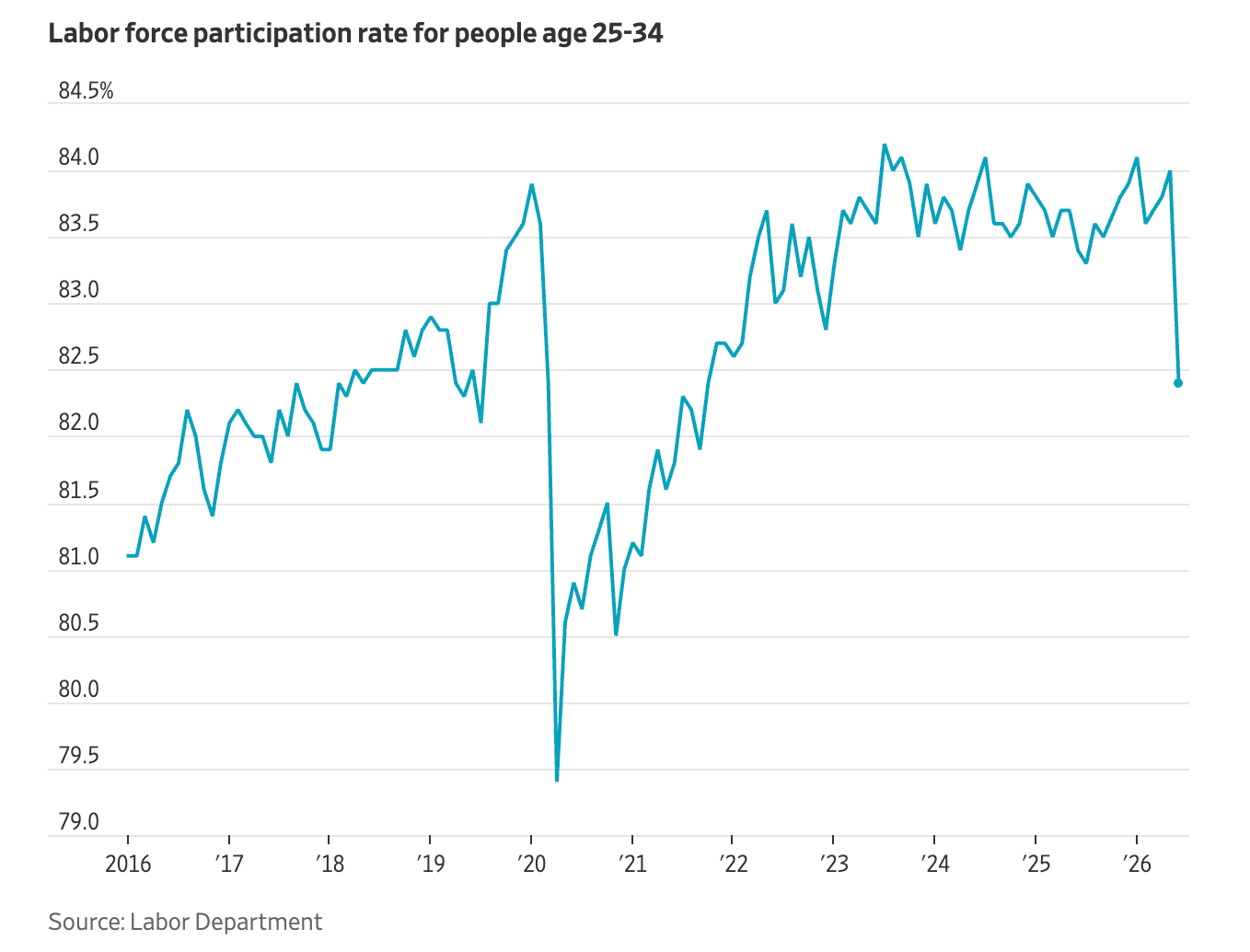
Now, for the past year or so, the narrative around this shrinking participation rate has been: An aging population, fewer young people, retirement, etc., but a deeper dive into the data suggests otherwise. The participation rate for those aged 25-54 dropped by 0.6%, and amongst the youngest cohort — 25 to 34 — it fell by 1.6%, down to 82.4%.
Meanwhile, the long-term unemployed — jobless 27 weeks or more — now number 1.9 million, up 286,000 over the year, and account for 27.3% of everyone unemployed. That's the low-hire, low-fire economy in one stat: if you have a job, you're probably keeping it. If you lost one, you're waiting a long time for the next one. Tuesday's JOLTS showed job openings at a two-year high of 7.6 million, so labor demand exists on paper — it's just not converting into hires at the usual rate.
What this means for interest rates: This print quiets the rate-hike chatter (a little bit) heading into the late-July meeting. A cooling labor market makes it harder to justify tightening, even with inflation still sticky. Not that Warsh will tell us either way — at Sintra this week he explicitly declined to signal a policy path, saying the committee will "have a good debate" and decide on the data.
This is the data. What it means for rates is now a closed-door conversation by design.
So, the TL;DR looks like: Hiring slowed, the spring was weaker than we thought, the unemployment "improvement" is people giving up, and the one strong headline number in this report is the one that means the least. The labor market isn't breaking. It's narrowing — fewer people hired, fewer fired, fewer even looking. Whether that's stability or stagnation depends on how long it lasts.
Answers to your questions
Yes. Origin offers partner access so you can manage your finances together at no additional cost. You’ll be able to filter transactions by member—making it easy to see which spending is yours and which belongs to your partner.

Yes. You can edit existing transactions and add new ones directly in Origin, so your records stay accurate and personalized.
Origin connects securely through trusted partners including Plaid, MX, and Mastercard.
Yes. Origin supports CSV uploads. You can upload a .csv file of your transactions, and we’ll import them into your account.
Yes. Your data is protected with bank-level security and advanced encryption. When you connect accounts through Origin, your login credentials are never shared with us. Instead, our partners generate secure tokens that let Origin access only the data you authorize—keeping your personal information private while enabling personalized insights.
Yes. You have full control to organize your spending in Origin. Transactions are automatically categorized by Origin, but you can always edit categories, add your own tags, and filter transactions however you like—so your spending reflects the way you actually manage money.