


The good, the bad, and the complicated.


Economic data reports have habitualized their pattern of delivering mixed signals this year, and yesterday was no exception.
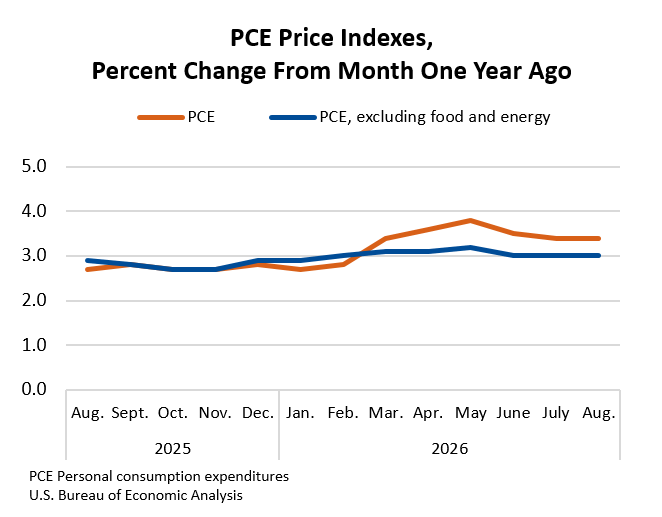
The Federal Reserve’s preferred measure of inflation — PCE, which usually gets less fanfare than its more prominent cousin, CPI — fell yesterday, coming in 0.3% lower than most economists expected at 3.4%, down from 3.7% last month. That’s the year-over-year metric, anyway, meaning relative to last August, prices of goods and services in this basket are roughly 3.4% higher than they were then, down from last month’s 3.7% July-to-July comparison. That sounds like good news, and relative to the recent context, it is. PCE has been elevated into the upper 3% range since the onset of the Iran war back in March. So, a drawdown is nice, but it’s still nowhere near the “almost on target” 2% range it lived in last year.
Source: BEA
PCE is a little different from CPI — but they want both as close to 2% as we can get — it covers a broader range of spending, including some purchases made on consumers’ behalf, and adjusts its weights more readily as people change what they buy, which is part of why the Fed prefers it. But there’s an extra wrinkle this month: BEA also completed its annual revisions, which brought July headline PCE down from 3.7% to 3.4% and core PCE from 3.3% to 3.0%. And some of that change came from the methodology itself. BEA changed how it measures portfolio-management fees, software and legal services and revised those series back several years. So the recent inflation picture improved, but not all of that improvement reflects prices actually cooling in the economy.
There’s also the usual inflation-language problem: lower inflation doesn’t mean lower prices — it’s a lagging indicator and often not reflective of real life, but it does impact interest rates and the cost of money for you and me. Gas, groceries, rent, and plenty of other things can remain painfully expensive — or even continue getting more expensive — while the overall inflation rate declines if their prices aren’t rising as quickly, or if slower increases elsewhere offset them. And because the 3.4% figure is year-over-year, what happened to prices last summer matters too. Consumers experience the price level; inflation reports measure how fast that level is changing.
The inflation half of this report was clearly positive for the Fed; rate-hike odds for October fell even further on the news.
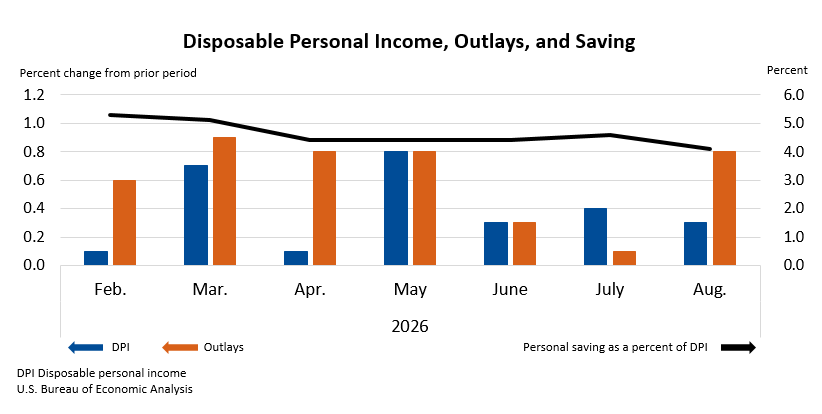
The personal savings rate also held steadily low at 4.1%, a sign that consumers are still spending a relatively large share of their disposable income despite elevated prices. Again, a sign of a little weakness that bodes well for skipping next month’s previously expected rate hike.
Source: BEA
But, unfortunately, there’s more to complicate the picture as usual.
This report delivered the BEA’s third and final estimate of Q2 GDP growth. The second estimate, delivered last month, pegged America’s economic engine at a 1.5% annualized growth rate — not negative, but not exactly “booming” either. Yesterday’s report revised that number upward to 2.2%, and also enhanced Q1 to 2.5%, up from the previous final estimate of 2.1%. The Gist of this is: Economy might be stronger than we expected, which lines up perfectly with the low unemployment rate and resilient consumer spending we’ve seen sustained for months. All of this puts upward pressure on inflation — from a different, genuinely positive angle, but upward pressure on the geopolitical-induced inflation problem nonetheless. That is the kind of dynamic that gives the Fed credence to consider another hike.
If you put it all together: Inflation gave the Fed some room to wait — but it’s from a month where already high energy prices just held steady — and almost everything else gave it very little reason to hurry in the opposite direction. Economic growth was revised considerably higher, consumer spending remains strong, unemployment is still just 4.1%, and JOLTS showed little evidence that employers are pulling back aggressively. None of that necessarily demands another rate hike, but it does weaken the argument that high rates are doing serious damage to the economy.
How does it trickle down to your finances? Mortgage rates remain annoyingly high because the bond market is having its own crisis, and rate hikes don’t help that trend. Same goes for credit cards, auto loans, personal loans, you name it — money is both expensive to get and expensive to spend, right now. On the flip side: Savings rates on high-yield savings accounts will remain higher, bond yields are currently offering a very nice return, and the stock market could seemingly care less on the whole — the S&P 500 is still up 12% this year despite everything.
The biggest burden here is simply the uncertainty created by all of the mixed signals.
Answers to your questions
Yes. Origin offers partner access so you can manage your finances together at no additional cost. You’ll be able to filter transactions by member—making it easy to see which spending is yours and which belongs to your partner.

Yes. You can edit existing transactions and add new ones directly in Origin, so your records stay accurate and personalized.
Origin connects securely through trusted partners including Plaid, MX, and Mastercard.
Yes. Origin supports CSV uploads. You can upload a .csv file of your transactions, and we’ll import them into your account.
Yes. Your data is protected with bank-level security and advanced encryption. When you connect accounts through Origin, your login credentials are never shared with us. Instead, our partners generate secure tokens that let Origin access only the data you authorize—keeping your personal information private while enabling personalized insights.
Yes. You have full control to organize your spending in Origin. Transactions are automatically categorized by Origin, but you can always edit categories, add your own tags, and filter transactions however you like—so your spending reflects the way you actually manage money.