


The gap between income and GDP growth is wider than ever before


Worker compensation grew by roughly 0.8% in the first quarter, and corporate profits jumped 2.7% in the same quarter — this is a snapshot, but when we zoom out, the gap is actually much wider than that.
Gross domestic income (GDI) is a GDP derivative that essentially measures the total amount of actual “income” generated by an economy. GDP adds up: Consumer spending + Business investment + Government spending + Net exports. Basically: "How much stuff did people buy?" GDI, on the other hand, is measuring: Wages + Corporate profits + Rent + Interest + Proprietors' income + Depreciation. Basically: "Who got paid and how much?"
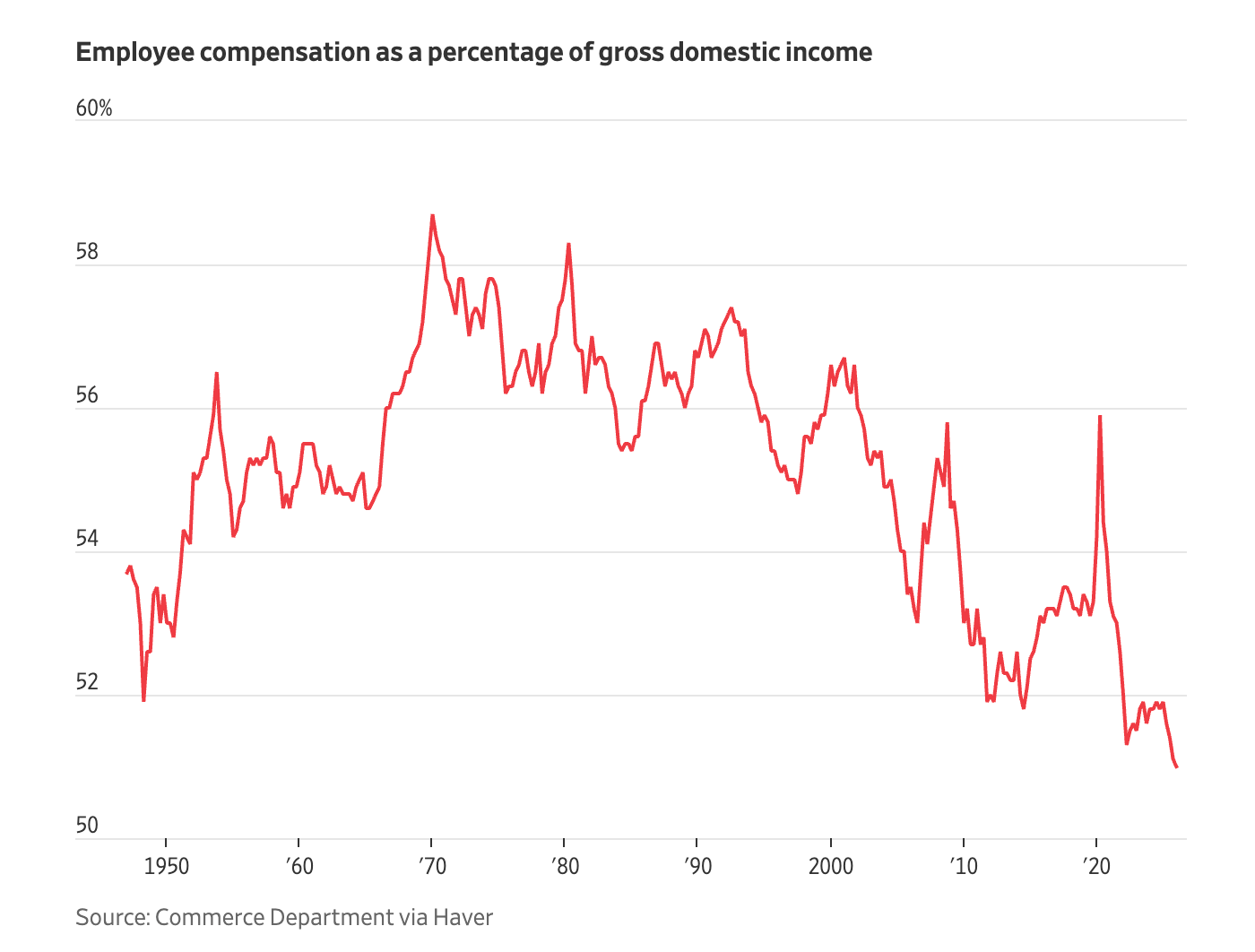
The labor market’s actual share of that metric (wages and benefits) just hit a record low of 51% — the lowest ever since we started tracking this back in 1947. Historically, that number has hovered in the upper 50% range, but it declined precipitously again in 2025, down to where we are now. The TL;DR on what this actually means is that: Workers are getting a smaller share of the pie they helped bake.
Source: WSJ
And, adjusted for inflation since the end of 2019, hourly wages are up 3% while profits are up about 50%, which means this divergence predates the AI boom — the trend became pronounced in the 2000s, picked up speed after the pandemic, and is now accelerating.
The latest driver is obvious: AI. Micron Technology, for example, was once a boring chip manufacturer, now boasts a 75% gross margin and a valuation topping $1 trillion because data centers can't get enough memory. The Magnificent 7 saw profits jump 63% year-over-year in Q1, while the rest of the S&P 500 was up a "hefty" 17%. Even outside the superstar tech companies, capital is winning. Meanwhile, energy company profits in the S&P 500 are expected to double this quarter from a year earlier, even as consumers' after-tax disposable income is lower in April than in December because energy prices are up.
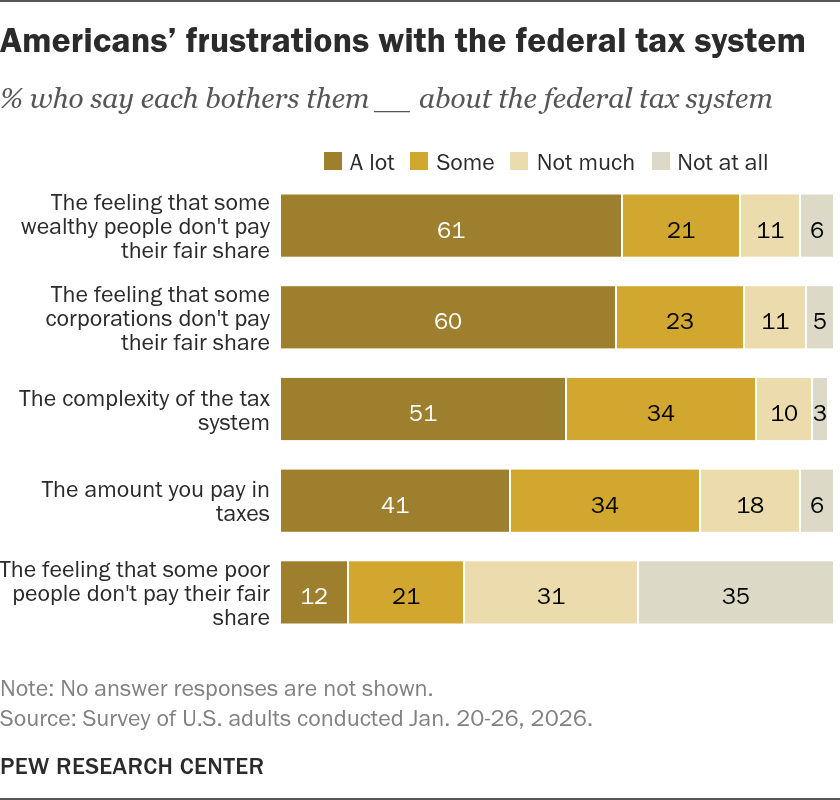
The general public is aware of this; it’s a very well-studied, well-documented observation. 61% of Americans say wealthy people don't pay their fair share, and 60% say corporations don't. And here's the thing: 60% of Americans now say they personally pay more than their fair share in taxes given what they get from the federal government, up from 56% in 2023.
Source: Pew Research
Even the Pope noticed. Pope Leo XIV released an encyclical this week on AI and wrote: "The pursuit of greater profits cannot justify choices that systematically sacrifice jobs, because the human person is an end, not a means”. When the Vatican is concerned about your profit margins, you've hit a cultural inflection point.
The policy responses are getting creative. California voters will probably vote on a 5% one-time wealth tax on billionaires in November. Progressive Democrats are pushing a "compute tax" on AI. And Bernie Sanders just proposed something that's actually interesting: an American AI Sovereign Wealth Fund Act that would give the public a 50% ownership stake in major AI companies through a one-time tax paid in stock, not cash. Interestingly, President Trump (obviously not in the same party as someone like Sanders) also suggested a similar idea soon thereafter, suggesting the government may begin taking stakes in these companies. OpenAI recently proposed creating a "public wealth fund that provides every citizen with a stake in AI-driven economic growth." Anthropic proposed "national sovereign wealth funds with stakes in A.I." Even Musk wrote that "Universal HIGH INCOME via checks issued by the Federal government is the best way to deal with unemployment caused by AI."
So you've got: a historic gap between labor and profit, public frustration at all-time highs, and even the tech kingpins acknowledging that something needs to shift. Whether any of these proposals ever actually pass is a different, philosophical, and political question wrapped up into one. But the gap is real, it's widening, and even billionaires are starting to pretend they want to fix it.
Answers to your questions
Yes. Origin offers partner access so you can manage your finances together at no additional cost. You’ll be able to filter transactions by member—making it easy to see which spending is yours and which belongs to your partner.

Yes. You can edit existing transactions and add new ones directly in Origin, so your records stay accurate and personalized.
Origin connects securely through trusted partners including Plaid, MX, and Mastercard.
Yes. Origin supports CSV uploads. You can upload a .csv file of your transactions, and we’ll import them into your account.
Yes. Your data is protected with bank-level security and advanced encryption. When you connect accounts through Origin, your login credentials are never shared with us. Instead, our partners generate secure tokens that let Origin access only the data you authorize—keeping your personal information private while enabling personalized insights.
Yes. You have full control to organize your spending in Origin. Transactions are automatically categorized by Origin, but you can always edit categories, add your own tags, and filter transactions however you like—so your spending reflects the way you actually manage money.