


The Fed finally hiked rates — and it might not be done


After spending most of 2026 staring at inflation like a suspicious package and hoping someone else would deal with it, the Federal Reserve finally opened that box yesterday.
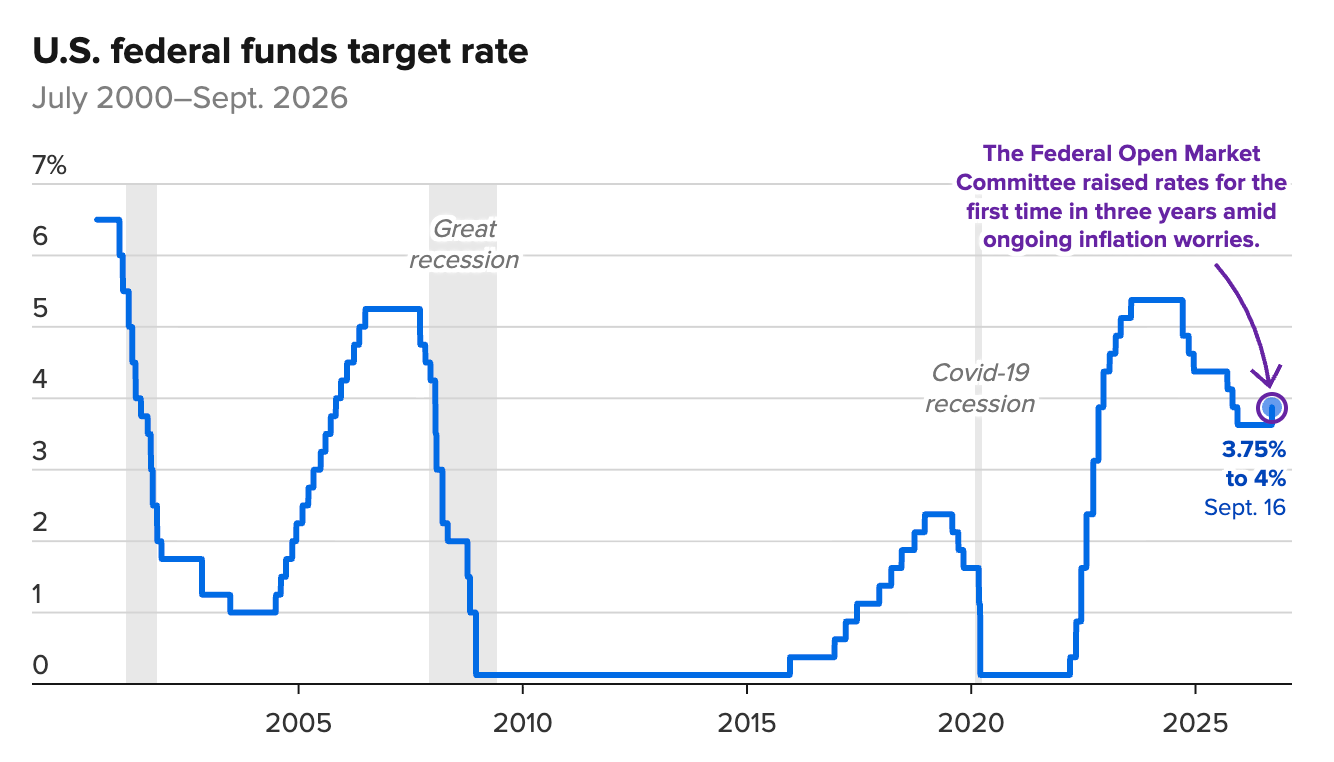
The Fed raised interest rates by 0.25 percentage points Wednesday, bringing its benchmark range to 3.75%–4% and marking its first rate hike since July 2023.
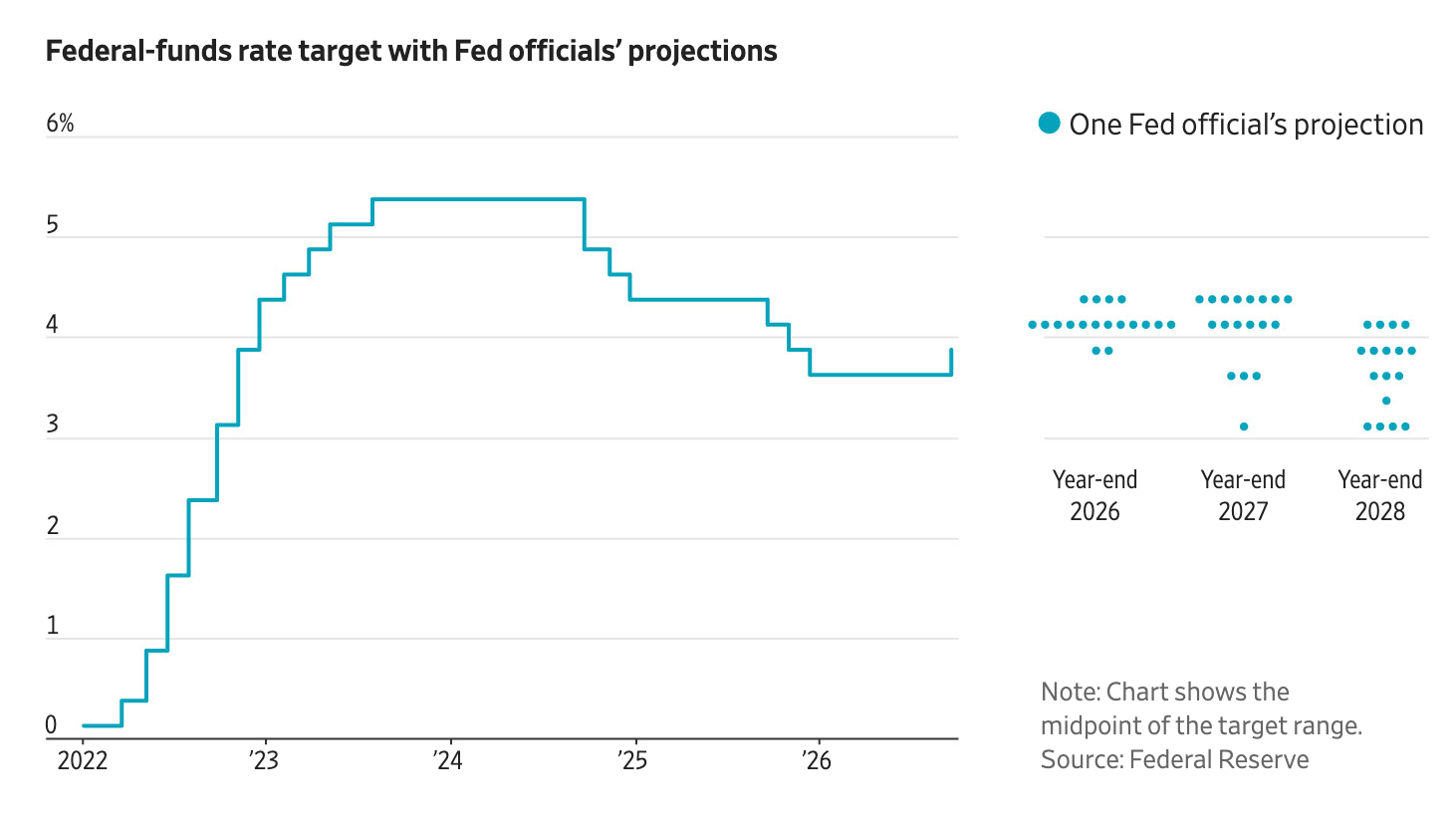
The decision was unanimous, which is meaningful, but the more consequential part came right underneath it: Fed officials now project rates ending 2026 around 4.1%, meaning the median policymaker expects another hike before the year is over. In June, that same projection was 3.8%. So much for one and done.
If you’re not a finance nerd obsessing over the news, an update like this might not have even crossed your desk this week — and that may be healthy, honestly; wouldn’t recommend the fixation. For the connoisseurs, though, finance media is fixating on this incremental increase for a reason. Though it may seem like another fleeting news cycle on the surface, this interest rate decision has real implications for your money.
ICYMI: Let’s get one thing straight: “rates” in this context means the federal funds rate — basically, the overnight interest rate banks charge each other. The Fed sets the neighborhood; everything else, from credit cards to mortgages, takes the hint to varying degrees.
Visual: CNBC
Here’s how they came to the decision: Last week's Consumer Price Index showed inflation holding at 3.4% annually, with gasoline prices up 27.4% from a year ago. A week earlier, the August jobs report unexpectedly added 162,000 jobs, unemployment held at 4.1%, and the labor force expanded rather than deteriorated. Then, approximately five and a half hours before Wednesday's rate decision, retail sales arrived with another inconvenient update: Americans are still spending money as if nobody told them we're trying to cool the economy. Retail sales rose 1.2% in August, considerably stronger than economists expected. This is nominal data, meaning higher prices helped the headline, but the underlying figures were strong enough that gasoline can't take the entire rap. Meanwhile, import prices rose sharply as well. Put everything together, and the Fed entered Wednesday with a fairly straightforward problem: Inflation is still too high, the labor market isn't falling apart, consumers are still consuming, and the economy has repeatedly declined invitations to die.
Warsh’s concise commentary reflected this. The Fed says domestic spending has been “resilient,” capital investment is “robust,” productivity growth is strong, and job gains have kept pace with the workforce. More tellingly, the language blaming elevated inflation partly on sector-specific supply shocks — present in July's statement — is gone. Instead, the Fed simply says inflation “remains elevated” and that Wednesday's hike should support a “timelier return” to 2%. So this rate hike comes into an economy the Fed doesn’t believe is tapering any time soon. Warsh already noted he “doesn’t see financial conditions as restrictive” (unless, of course, you’d like to buy a house).
Growth projections match this. Officials now expect the economy to grow 2.3% this year and 2.4% next year, both slightly higher than their June forecasts. Meanwhile, the projected 2026 unemployment rate was lowered from 4.3% to 4.1%. Unfortunately, the Fed also raised its inflation forecasts: headline PCE inflation is now expected to finish 2026 at 3.7%, with core inflation at 3.4%. In other words, the Fed looked at the economy and concluded: Oh, excellent. It's stronger than we thought. Also, inflation is worse than we thought.
Hence the rate hike, and subsequently, Fed officials are currently projecting at least one more hike in 2026. And the actual dot plot makes clear this isn't necessarily an emergency tap on the brakes. The median projection has rates at 4.1% at the end of both 2026 and 2027, compared with June projections of 3.8% and 3.6%, respectively. Rates don't fall below 4% in the median forecast until 2028.
Visual: WSJ
How this impacts your money.
The thing is, interest rates were already rising without any Fed intervention, mostly because the bond market has been Unruly. The bond market, particularly the 10-year Treasury yield, has an enormous influence on mortgage rates, which have been creeping higher as investors demand more compensation to lend money over longer periods due to inflation, government debt, and attractive corporate bond alternatives — this is why mortgage rates have been rising.
This rate hike isn't bad news for mortgages in isolation. You would think: Higher rates, investors demand higher bond yields, 10Y rises, mortgages do too. That happened yesterday, but today markets seem to be fine-tuning their interpretation of this hike. Instead of being pessimistic, yields actually fell across the board — meaning investors were buying bonds. Why? Why? Because another lens to view it from is: the Fed getting more aggressive today means inflation gets crushed sooner and the economy slows; they may expect lower rates later.
So for now, this is not inherently bad news for homebuyers.
This contributed to today’s market rebound, and oil prices also declined today, which didn’t hurt either.
Elsewhere, for other borrowers: Credit cards and other shorter-term loans are more closely tethered to the Fed’s benchmark rate, so those borrowing costs may tick a bit higher in the near term. But with rates already historically expensive, another quarter-point is more insult than injury.
Oh, and on the bright side: If you’ve got a high-yield savings account, your interest rate may eventually go up, meaning more passive income on your idle cash.
Answers to your questions
Yes. Origin offers partner access so you can manage your finances together at no additional cost. You’ll be able to filter transactions by member—making it easy to see which spending is yours and which belongs to your partner.

Yes. You can edit existing transactions and add new ones directly in Origin, so your records stay accurate and personalized.
Origin connects securely through trusted partners including Plaid, MX, and Mastercard.
Yes. Origin supports CSV uploads. You can upload a .csv file of your transactions, and we’ll import them into your account.
Yes. Your data is protected with bank-level security and advanced encryption. When you connect accounts through Origin, your login credentials are never shared with us. Instead, our partners generate secure tokens that let Origin access only the data you authorize—keeping your personal information private while enabling personalized insights.
Yes. You have full control to organize your spending in Origin. Transactions are automatically categorized by Origin, but you can always edit categories, add your own tags, and filter transactions however you like—so your spending reflects the way you actually manage money.