


The bond market would like a word


For better and for worse, the economy relies pretty heavily on American-made debt; i.e., bonds. Bonds have long since been mostly ignored by the average person — in a good way.
We know what they are; they’ve just never required much maintenance. They’re a stoic little hedge sitting in the corner of millions of portfolios — both individual and institutional. A boring, guaranteed payback from the United States government, or…are they? That’s what Bonds have been for centuries, but right now, they’re creating real problems for the broader economy.
Mortgage rates just hit 6.66% — a one-year high, and the fourth straight week of increases, and some daily readings have pushed even higher, into the 6.85% range. Subsequently, pending home sales just fell to their lowest level since early April, dropping 1.7% in the last week alone.
The proximate cause is: Mortgage rates track the 10-year Treasury yield, and that yield just hit levels not seen since January 2025. You could posit that this is simply because rates are “still high,” and were just left unchanged again, but they’re still lower than they were the last time the 10-year was this high. And that’s really just the top layer: The 30-year Treasury hit 5.21% last Thursday, which was also the highest since 2007, meaning prospective bond buyers are becoming increasingly skittish of good, old-fashioned, long-term American debt. Because of that, the scope of this trend expands beyond a simple "rates are high" story and starts resembling something a bit more concerning.
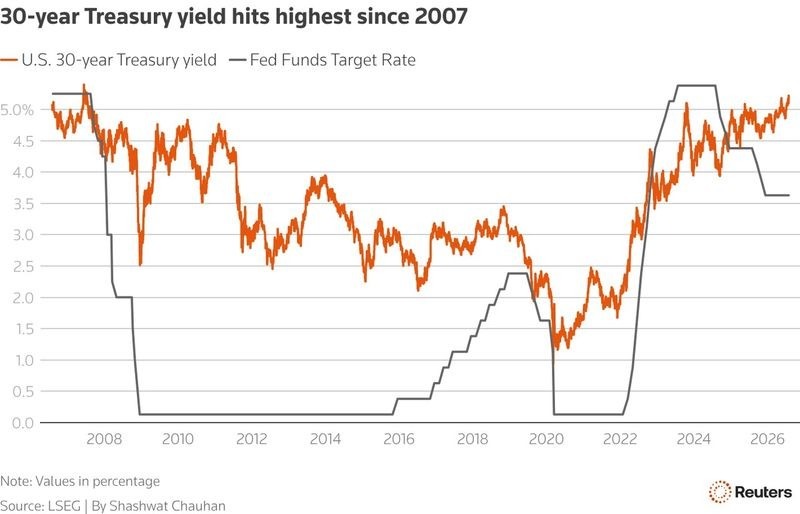
Firstly, we have the Warsh problem — if you want to call it that. Last Wednesday's Fed meeting should have been pretty boring given the outcome of: Hold rates, reassert the inflation mandate, move on. Instead, three officials dissented in favor of a hike, and Fed Chair Kevin Warsh's press conference did something central bankers are specifically trained not to do: He repeatedly declined to connect his own "we will not waver on 2% inflation" rhetoric to any actual mechanism for getting there. Asked point-blank whether rate hikes are the standard remedy for stubborn inflation, he offered: "Is that the dominant remedy?... I wouldn't say it's in isolation." He even cast doubt on whether PCE stays the Fed's target measure "after January."
That's the opposite of reassuring, and bond investors treated it that way. As JPMorgan's Michael Feroli put it: Warsh "failed to specify how he intended to achieve his stridently asserted inflation resolve," which "raise[s] questions about the new chair's credibility." The result was a genuine paradox — a Fed that sounds hawkish but won't commit to action reads as less trustworthy, not more, so long as bonds sold off hard.
Dig a little deeper, and the narrative gets a bit more ominous. Foreign investors have also been restructuring what they own in America, and it's not in Washington's favor. Foreigners now hold $24.5 trillion in US equities against just $9.3 trillion in Treasuries — more than 2.6 times as much. The foreign share of publicly held federal debt has fallen from 49% in 2008 to roughly 30% today. In a way, the world has kind of metered its lending to Washington and started buying Silicon Valley instead.
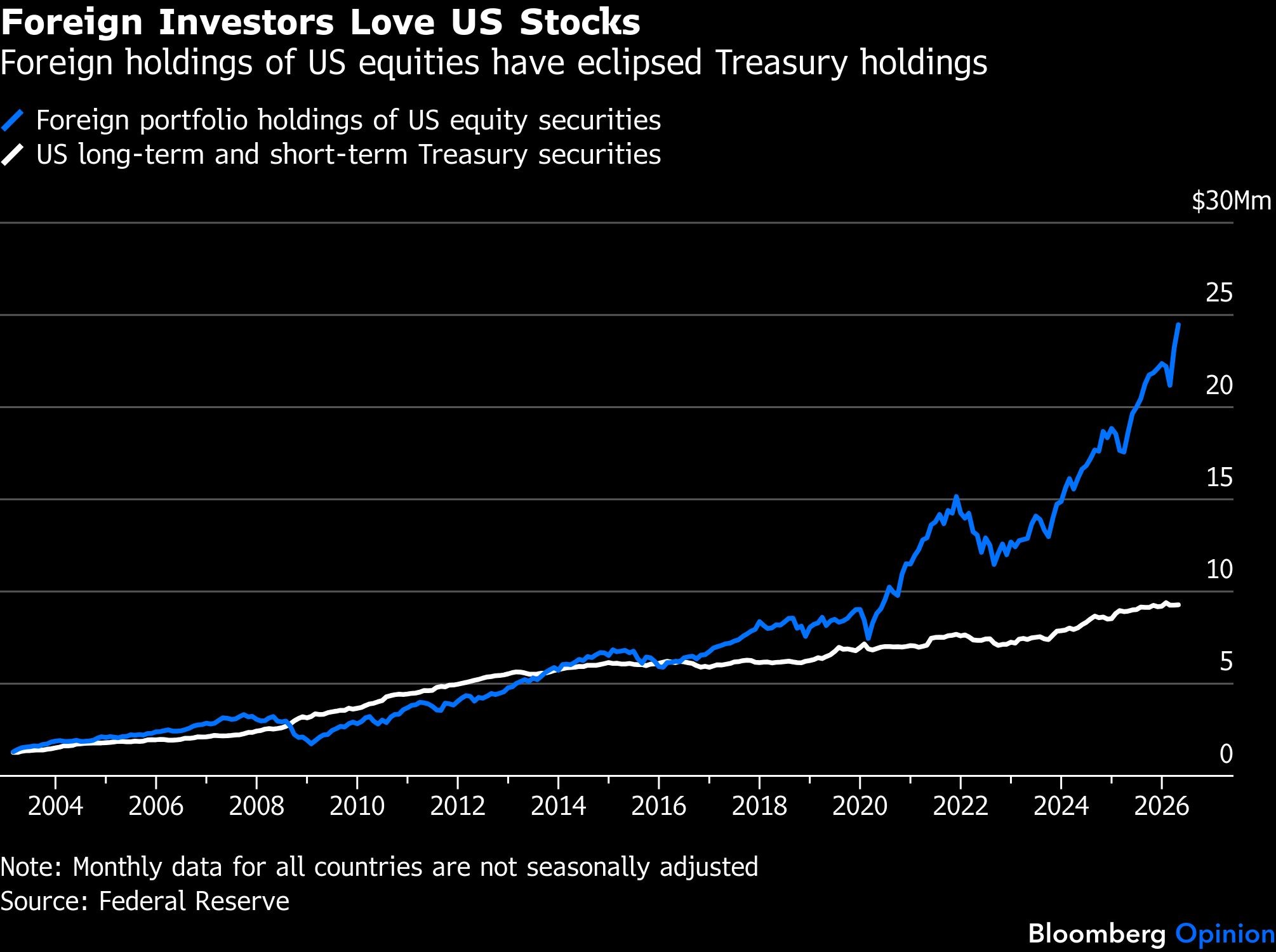
That threatens to break a mechanism that used to protect the dollar. Historically, when stocks fell, foreign money fled into Treasuries for safety, and the dollar held steady or gained. That doesn't work the same way anymore, because the marginal foreign dollar today seems to be chasing AI-driven equity returns instead. We already got a preview of that in April 2025: stocks, bonds, and the dollar all fell together in the same week, something the old system wasn't supposed to allow.
So this is the actual national debt problem, and it's not the one people have been debating since 1971. It's not "can we ever pay this off" — nobody credible thinks that's the mechanism that breaks. It's "can we keep selling it at rates we're willing to pay, when the people who used to reliably buy it have found something they'd rather own instead." Net interest on the debt is now pushing toward $1 trillion a year, already exceeding the defense budget, and Washington is still selling roughly $2 trillion in net new debt annually — increasingly to domestic buyers like hedge funds and banks, who do demand compensation for the risk. That's the number actually worth watching going forward: the extra yield those domestic buyers demand, not the dollar index or the deficit-as-percent-of-GDP framing everyone defaults to.
None of this is a crisis; not today at least. Equity funding, unlike debt, doesn't have refinancing risk — if stocks crater, nothing needs to be rolled over, no auction fails. But it does mean the comfortable old assumption — that foreign capital would always show up to buy America's debt because there was nowhere else attractive to put it — stopped being true a few years ago, and this week's mortgage-rate spike is one small, very real consequence of that shift finally showing up in your monthly payment.
What this means for your actual money: In practical terms, the economics of this are a layer removed from the everyday world you and I live in, at least for now. If you’re not watching finance news, you aren’t thinking about the composition of America’s bond buyers, our national debt, and the subsequent current bond yields — and rightfully so; I don’t recommend it. But eventually, this could have real implications for personal finances. The lead-off of this story — mortgage rates — is just the first layer that bond market problems can metastasize onto. In the near term: It means upward pressure on already high interest rates, and something to think about. On a longer horizon, it’s difficult to say, but the impacts could expand.
Answers to your questions
Yes. Origin offers partner access so you can manage your finances together at no additional cost. You’ll be able to filter transactions by member—making it easy to see which spending is yours and which belongs to your partner.

Yes. You can edit existing transactions and add new ones directly in Origin, so your records stay accurate and personalized.
Origin connects securely through trusted partners including Plaid, MX, and Mastercard.
Yes. Origin supports CSV uploads. You can upload a .csv file of your transactions, and we’ll import them into your account.
Yes. Your data is protected with bank-level security and advanced encryption. When you connect accounts through Origin, your login credentials are never shared with us. Instead, our partners generate secure tokens that let Origin access only the data you authorize—keeping your personal information private while enabling personalized insights.
Yes. You have full control to organize your spending in Origin. Transactions are automatically categorized by Origin, but you can always edit categories, add your own tags, and filter transactions however you like—so your spending reflects the way you actually manage money.