


September's Labor Market Was Lackluster — Which Might Not Be a Bad Thing


2026’s labor market has been better than last year, when the U.S. economy averaged just 15,000 jobs added per month — the weakest year for job creation since 2003. This year, that average is up to roughly 68,000 jobs added every month; still historically low, but an uptick during a volatile year for job seekers.
September’s jobs report just hit on Friday, and it continued that trend. After a surprise beat of 162,000 jobs added in August, September returned to the same pattern of oscillation. Economists expected about 90,000 jobs added, but the report showed less than a third of that: The U.S. economy added just 29,000 jobs last month.
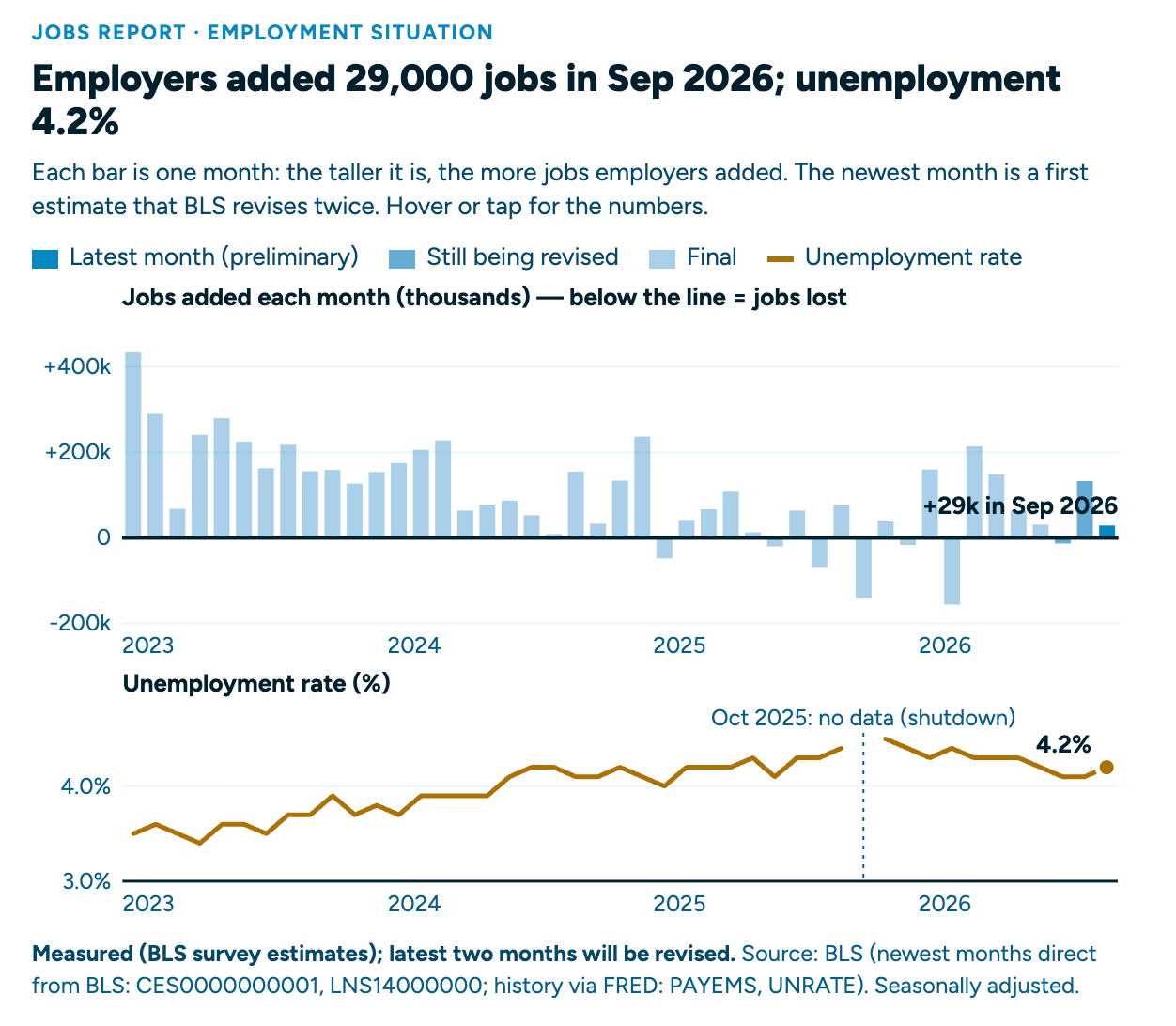
Visual source: CNBC
And not only was September weaker, but in true BLS fashion, August’s blowout report also got slightly tapered, adjusted downward to 133,000. Unemployment ticked up slightly to 4.2%, but that’s largely because more people were looking for work. For the past two months, and after a year of declines, the labor force participation rate ticked up again to 61.8% — still lower than a year ago, but some proof that more people are, in fact, still interested in making money.
The latest JOLTS report provides some context for the hiring slowdown. During the post-pandemic labor shortage in 2022, there were roughly two job openings for every unemployed American. Today, that relationship is closer to one-to-one, with vacancies falling to approximately 7.1 million in August. Employers have largely stopped competing for additional workers, although layoffs remain relatively low. And with labor-force participation rising for a second consecutive month, more Americans are entering a job market that's offering considerably fewer opportunities than it did a few years ago. Low hire, low fire indeed.
Overall, the labor market is simply in a weird position. Not only is it still recalibrating after the Pandemic, but last year a lot of decision-making was stuck in limbo as businesses navigated a lot of uncertainty. Tariffs, immigration changes, still pretty high borrowing costs (rate cuts didn’t begin until September last year). And AI was becoming a real consideration — and it still is. As much progress as the revolution has made, we still cannot confirm with certainty how AI will impact the labor market, and the reality is that it will likely remain unevenly distributed, with very individual implications — for now — and that’s likely contributing to this year’s choppy market behavior.
On interest rates, this report matters for the Fed’s next meeting later this month. They’ll get a headline inflation report next week to pair with this, but the existing backdrop contains conflicting narratives already. Slightly cooler PCE last week = argues against another hike. Odds nudged down. GDP growth revised upward? Makes a bit of a case for another hike. Consumer spending resilient? Also contributed to a hike case. This weak September jobs report does the opposite on the surface, but it also shows a relatively stable economy underneath with low unemployment and reasonably good job stability. This all combines to paint a pretty messy mosaic for the Fed, but as of right now, bettors are making a vibes-based assessment on the odds of another hike, and the verdict, for now, is Just a 23% chance of another hike this month.
The stock market liked that, and all three major indices rallied to end the first week of the month. Historically, October marks the start of a consistent bull rally that runs through December — unlike last month, it’s usually one of the best months for returns — we’ll see if that trend holds this year.
Answers to your questions
Yes. Origin offers partner access so you can manage your finances together at no additional cost. You’ll be able to filter transactions by member—making it easy to see which spending is yours and which belongs to your partner.

Yes. You can edit existing transactions and add new ones directly in Origin, so your records stay accurate and personalized.
Origin connects securely through trusted partners including Plaid, MX, and Mastercard.
Yes. Origin supports CSV uploads. You can upload a .csv file of your transactions, and we’ll import them into your account.
Yes. Your data is protected with bank-level security and advanced encryption. When you connect accounts through Origin, your login credentials are never shared with us. Instead, our partners generate secure tokens that let Origin access only the data you authorize—keeping your personal information private while enabling personalized insights.
Yes. You have full control to organize your spending in Origin. Transactions are automatically categorized by Origin, but you can always edit categories, add your own tags, and filter transactions however you like—so your spending reflects the way you actually manage money.