


“My finances are fine, but the economy isn’t.”


So…let’s just start off with the straight paradox. 73% of Americans say their personal finances are doing okay, but also…75% think the economy is a disaster. This simultaneously makes complete sense and none whatsoever.
The Federal Reserve recently released its most comprehensive annual look at how American households are actually doing — and the headline number is, genuinely, fine. 73% of adults say they're either doing okay or living comfortably financially — unchanged from 2024.
And yet: Only 1 in 4 Americans rates the national economy as "good" or "excellent." That's actually down 24 points from pre-pandemic levels. So people feel okay about their own money, but are convinced the broader economy is broken. That gap is wider than it's ever been, and it's been sitting there, largely unexplained, for a few years now.
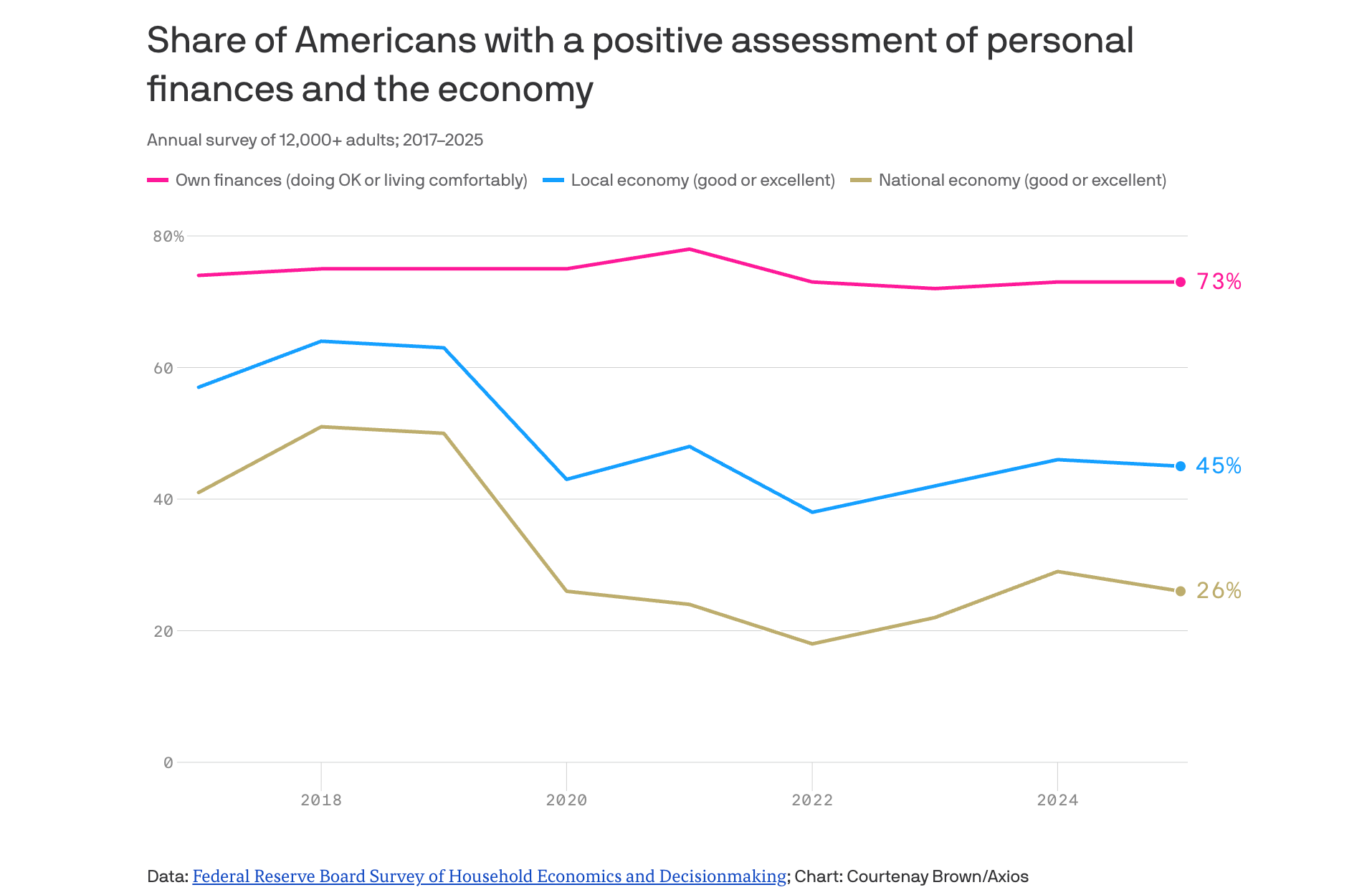
The Fed's SHED survey (Survey of Household Economics and Decisionmaking) is worth paying attention to for exactly this reason — it's not exactly a vibes check or an approximation. It's fielded across a much broader, more detailed sample than your standard sentiment survey, making it a better signal of how people are actually navigating their finances rather than how they feel about the news.
What it found: people are managing. 63% say they could cover a $400 emergency expense in cash — unchanged from last year. Price increases remain the #1 financial concern, cited by 9 in 10 adults, though the share calling it a major concern ticked down slightly to 53%. Job anxiety, meanwhile, is climbing — 42% of adults worry about finding or keeping work, up from 37% in 2024, and that increase cuts across every income level and age group. Not just the bottom.
The finding that'll actually matter going forward: For the first time, the Fed asked about AI at work. One in four workers used generative AI at work last month, and 81% said it saves them time. Active AI users were also significantly more likely to see the technology as a career asset than a threat. Non-users, on the other hand, saw it very differently. The fear of AI replacement is most concentrated among people who haven't used it yet — which is either a reason for optimism or a preview of a coming divide, depending on how you look at it.
The broader picture here isn't that Americans are lying about being okay. It's that "okay" is load-bearing right now. People are holding it together personally while watching something they don't fully trust unfold around them. Consumer spending has continued — not because confidence is high, but because most people haven't hit the wall yet.
Answers to your questions
Yes. Origin offers partner access so you can manage your finances together at no additional cost. You’ll be able to filter transactions by member—making it easy to see which spending is yours and which belongs to your partner.

Yes. You can edit existing transactions and add new ones directly in Origin, so your records stay accurate and personalized.
Origin connects securely through trusted partners including Plaid, MX, and Mastercard.
Yes. Origin supports CSV uploads. You can upload a .csv file of your transactions, and we’ll import them into your account.
Yes. Your data is protected with bank-level security and advanced encryption. When you connect accounts through Origin, your login credentials are never shared with us. Instead, our partners generate secure tokens that let Origin access only the data you authorize—keeping your personal information private while enabling personalized insights.
Yes. You have full control to organize your spending in Origin. Transactions are automatically categorized by Origin, but you can always edit categories, add your own tags, and filter transactions however you like—so your spending reflects the way you actually manage money.