


June's inflation report was too good to be true


Literally, perhaps the most awkwardly timed inflation improvement we’ve seen in recent years.
CPI fell 0.4% in June — which is the biggest monthly drop since April 2020 — bringing headline inflation down to 3.5% from May's 4.2%. Economists had expected an 0.2% decline and a 3.8% annual rate, but the actual number blew past that on the downside. We can thank the energy index for this. It had risen precipitously in March (10.9%), April (3.9%), and May (3.9%), and then subsequently fell by 5.7% in June as tensions with Iran seemed to ease, delivering relief to oil prices.
Core CPI, which strips out food and energy, came in flat for the month, cooling to 2.6% annually from 2.9%.
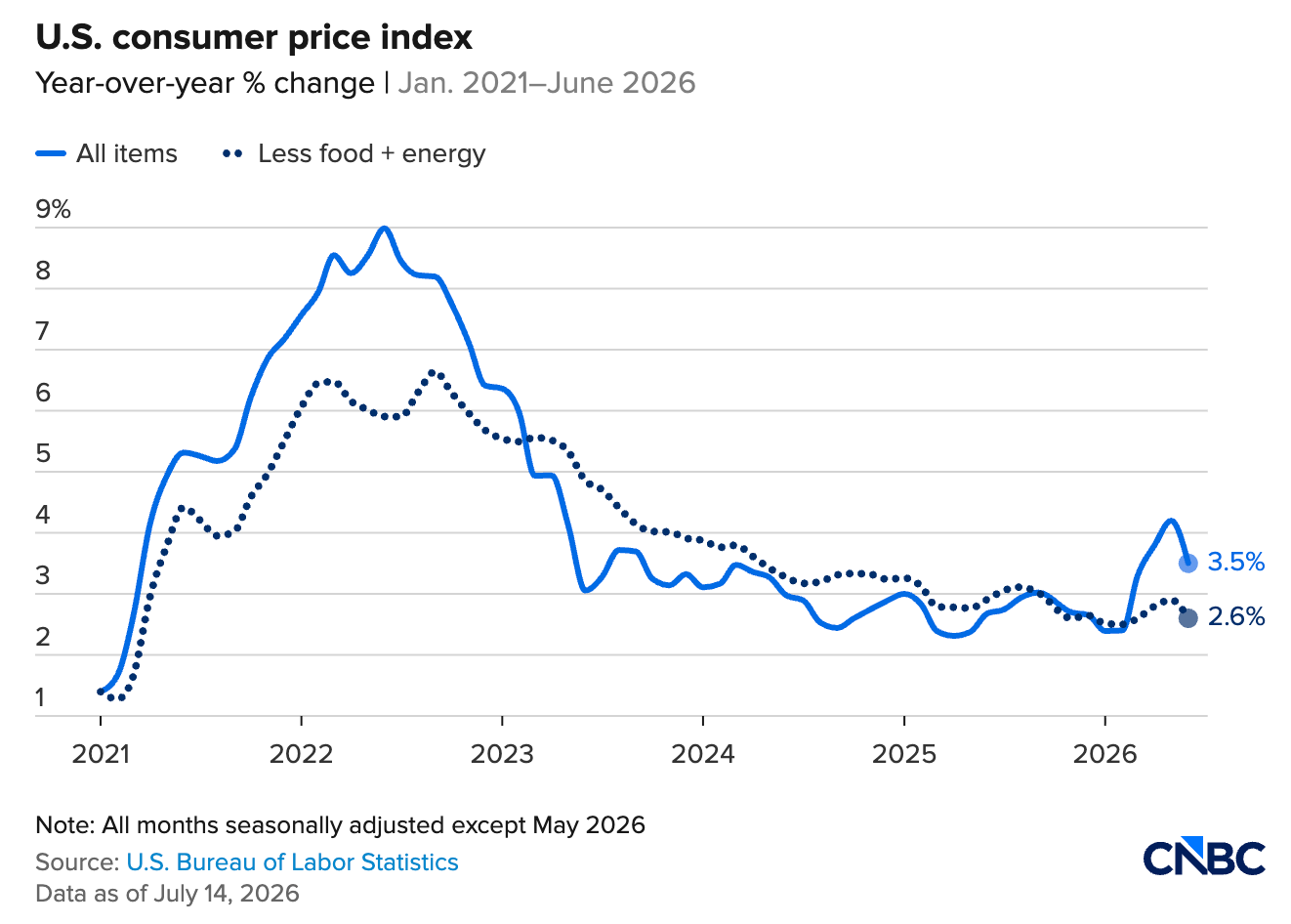
Source: CNBC
Sounds like good news on all fronts, but instead it’s more like a reprieve with a catch. The energy relief came from a lull in the Iran conflict — a temporary de-escalation drove oil prices down roughly 25% during June. Except…last week, tensions re-flared, and Trump declared that ceasefire over. Both sides exchanged attacks; oil predictably spiked on Monday and then rose again on Tuesday — the same day this report dropped.
Another catch here is that the entire inflation regression arc we’ve endured throughout the first half of the year is driven by energy prices. It’s not like we’re dealing with broad-based, systemic inflation in the aftermath of Covid like it’s 2022 all over again — no, this spike comes back to one thing — and whether or not progress is made depends almost entirely on what happens overseas.
And the exact mechanism that produced this "better" CPI print is actively reversing as you read this sentence.
The Fed isn't taking the bait, for what it's worth. Governor Christopher Waller said Monday it would take several months of positive readings before he's convinced inflation is heading back to target. New Fed Chair Kevin Warsh also said today: “There might be some who look at this morning’s data and say, ‘Well, mission accomplished, everything is swell.’ That is not my view,” and reiterated that the committee will have “no tolerance for persistently elevated inflation.”
The FOMC's language after their June meeting was blunt as well: they'll "deliver price stability," full stop — and the broad market expectation is still a rate hike in September, not a cut. One good month doesn't undo a mandate.
That's the whole piece, really. One month of relief, entirely explained by an energy price collapse tied to a ceasefire that's already broken. Shelter and food didn't cool — they kept grinding higher underneath the headline number. And the Fed, which has seen enough head-fakes from this economy to know better, is treating this as one data point, not a trend.
If oil prices follow the geopolitical trajectory instead of the June trajectory, July's CPI could look completely different. We'll find out August 12.
Answers to your questions
Yes. Origin offers partner access so you can manage your finances together at no additional cost. You’ll be able to filter transactions by member—making it easy to see which spending is yours and which belongs to your partner.

Yes. You can edit existing transactions and add new ones directly in Origin, so your records stay accurate and personalized.
Origin connects securely through trusted partners including Plaid, MX, and Mastercard.
Yes. Origin supports CSV uploads. You can upload a .csv file of your transactions, and we’ll import them into your account.
Yes. Your data is protected with bank-level security and advanced encryption. When you connect accounts through Origin, your login credentials are never shared with us. Instead, our partners generate secure tokens that let Origin access only the data you authorize—keeping your personal information private while enabling personalized insights.
Yes. You have full control to organize your spending in Origin. Transactions are automatically categorized by Origin, but you can always edit categories, add your own tags, and filter transactions however you like—so your spending reflects the way you actually manage money.