


It's a buyer's market, but mortgage rates stamp it out


On paper, buyers have never had more leverage. Our most recent data from August shows sellers outnumbering buyers by 58% — the widest gap ever recorded — with roughly 1.46 million people trying to sell and only 967,000 looking to buy. That buyer count is the lowest Redfin has ever recorded.
Nearly 80% of the major metros it tracks now qualify as buyer's markets, 34 of 39 got friendlier to buyers in a single month, and Miami alone has 138% more sellers than buyers.
On the surface, this would be good news for prospective homebuyers who’ve been sidelined for years by a combination of home prices and rates, but unfortunately, the reason for sellers’ loss of leverage this go-round is simply because fewer buyers qualify.
Hence, this “buyer’s market” is kind of self-defeating. A buyer's market only helps people who can actually close the deal, and what stands between them and that leverage is the same thing making headlines on the other side of the market: mortgage rates.
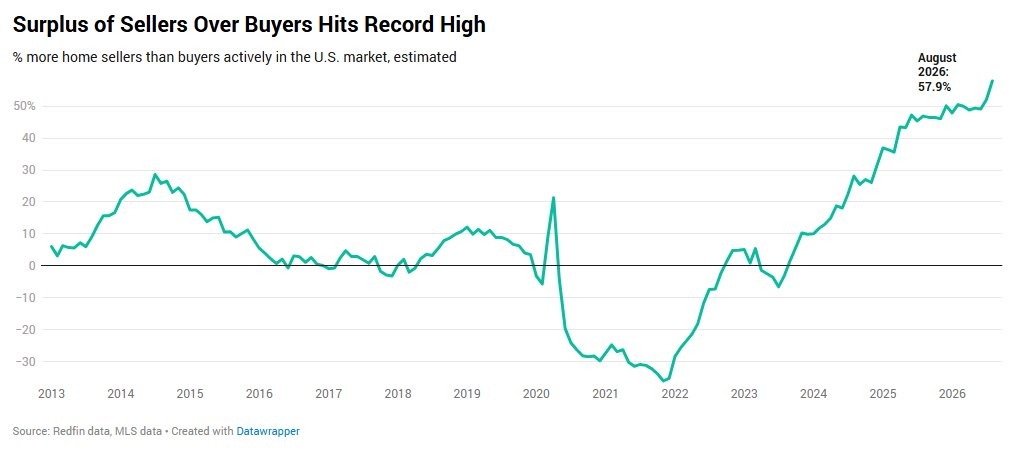
Visual source: Redfin
The seller surplus grew because buyers vanished faster than sellers did. Listings actually thinned out — active supply hit its lowest level in a year — but demand thinned out faster. Mortgage rates climbed to a one-year high, and would-be buyers decided to wait. A market can be stuffed with motivated sellers and still feel out of reach if the monthly payment doesn't work.
So two things are true at once: Sellers have less leverage, but buyers' actual buying power remains pretty much unchanged — because rates haven’t changed. Inflation remains a concern, and interest rates remain elevated after the Fed’s first rate hike since 2023.
And the bond market is keeping proxy rates high because of its own crisis. Mortgage rates don't move on their own; they shadow the 10-year Treasury. And Treasury yields are climbing as investors demand more compensation for inflation, long-term risk, and financing a government that keeps borrowing more. The latest 30-year auction cleared at 5.308%, while the 10-year cleared at 4.834% — up from already eye-watering August auctions that marked the highest borrowing costs at those maturities since 2001 and 2007, respectively. During the 2020 pandemic, comparable auctions went off below 2%.
Subsequently, the actual math of the mortgage is getting destroyed. The median new home sold for $410,700 in Q2; at a roughly 7.2% mortgage rate, even putting 18% down leaves a buyer with a monthly housing payment around $3,350 once taxes, insurance, and PMI are included. That’s about 46% of the median household’s gross income going toward one bill, before the car, credit cards, groceries, or the irritating requirement to continue being alive. To get that payment down to the old 30%-of-income affordability benchmark, the household would need to earn roughly $134,000 a year — about $46,000 more than the median household actually makes. And that’s household income. Against the median individual income of roughly $45,000, the mortgage alone would consume nearly 90% of gross pay.
So the leverage buyers supposedly hold is being canceled out by the bond market. The deficit pushes yields up, yields drag mortgage rates with them, and higher rates thin the buyer pool — which is exactly what produced the seller surplus everyone's calling a buyer's market. The imbalance and the reason no one can act on it trace back to the same place.
Redfin's economist framed the late-summer stretch as a sweet spot: Buyers have options, motivated sellers might negotiate before the fall rush. True enough, for the sliver of people who can absorb today's payment. For everyone else, "buyer's market" is a technicality — a house full of leverage and a financing cost that keeps the door locked.
Answers to your questions
Yes. Origin offers partner access so you can manage your finances together at no additional cost. You’ll be able to filter transactions by member—making it easy to see which spending is yours and which belongs to your partner.

Yes. You can edit existing transactions and add new ones directly in Origin, so your records stay accurate and personalized.
Origin connects securely through trusted partners including Plaid, MX, and Mastercard.
Yes. Origin supports CSV uploads. You can upload a .csv file of your transactions, and we’ll import them into your account.
Yes. Your data is protected with bank-level security and advanced encryption. When you connect accounts through Origin, your login credentials are never shared with us. Instead, our partners generate secure tokens that let Origin access only the data you authorize—keeping your personal information private while enabling personalized insights.
Yes. You have full control to organize your spending in Origin. Transactions are automatically categorized by Origin, but you can always edit categories, add your own tags, and filter transactions however you like—so your spending reflects the way you actually manage money.