


Is ChatGPT Good at Financial Advice? The Numbers Tell a Different Story


Summary: ChatGPT has become legitimately useful for personal finance. More than 200 million people were already using it for financial questions each month before OpenAI launched ChatGPT Finance, which can now connect directly to financial accounts and credit data. But access to financial data and financial expertise aren't quite the same thing. On the same 6,000 CFP® sample questions, Origin AI Advisor scored 98.3% versus 93.8% for GPT-5. Origin also uses deterministic calculation engines, specialized AI agents, 138 automated validation and compliance checks on every AI Advisor response, and proactive monitoring across a member's broader financial life. ChatGPT Finance is an impressive general-purpose AI financial tool. Origin was built specifically to provide financial guidance.
ChatGPT had a fairly substantial personal finance business before OpenAI technically had a personal finance product.
More than 200 million people were already coming to ChatGPT each month for help with budgeting, investments, financial decisions, and future goals when OpenAI launched its dedicated personal finance experience in May 2026.
The appeal isn't difficult to understand. ChatGPT is remarkably good at explaining complicated things, reasoning through tradeoffs, and turning the sort of question that would previously require 45 minutes of Googling into a conversation.
Now it can see the numbers, too.
ChatGPT Finance can connect financial accounts through Plaid and credit information through Experian. It can analyze spending, find subscriptions and recurring bills, track investments and net worth, monitor credit, and answer questions using someone's actual financial context. OpenAI has since expanded the product to Free, Go, Plus, and Pro users in the U.S.
For a general-purpose chatbot, this is an extraordinary amount of financial capability to acquire in a few months.
It also creates a useful question for anyone considering using AI to make financial decisions: How good is ChatGPT at financial advice once you move beyond simply giving it access to the data?
There are now enough numbers to make that question considerably less philosophical.
ChatGPT's Own Personal Finance Benchmark: 79 to 82.5 Out of 100
OpenAI has tested this itself.
For the launch of ChatGPT Finance, OpenAI worked with more than 50 financial professionals to build an internal benchmark for challenging personal finance tasks. The score combines expert-rated response quality with answer accuracy.
The default GPT-5.5 Thinking model used in ChatGPT Finance scored 79 out of 100.
GPT-5.5 Pro scored 82.5 out of 100.
Those are good results, particularly given the complexity of the problems OpenAI says the benchmark evaluates.
They're also worth understanding correctly.
OpenAI's benchmark is proprietary and designed specifically to evaluate its personal finance experience. Origin's benchmark uses a different test entirely, so putting 82.5% beside Origin's 98.3% and calling it a 15.8-point victory would make for a lovely chart and some rather questionable statistics.
Fortunately, there's an apples-to-apples comparison.
Origin AI Advisor Scored 98.3% vs. GPT-5's 93.8% on the Same CFP® Questions
Origin tested AI Advisor using 6,000 CFP® sample exam questions over 432 hours.
The Certified Financial Planner™ exam is the professional standard designed to assess the knowledge required of human financial planners. Rather than building a benchmark around Origin's own strengths, the test used an existing external standard and administered the same questions under controlled conditions to each AI system.
The results:
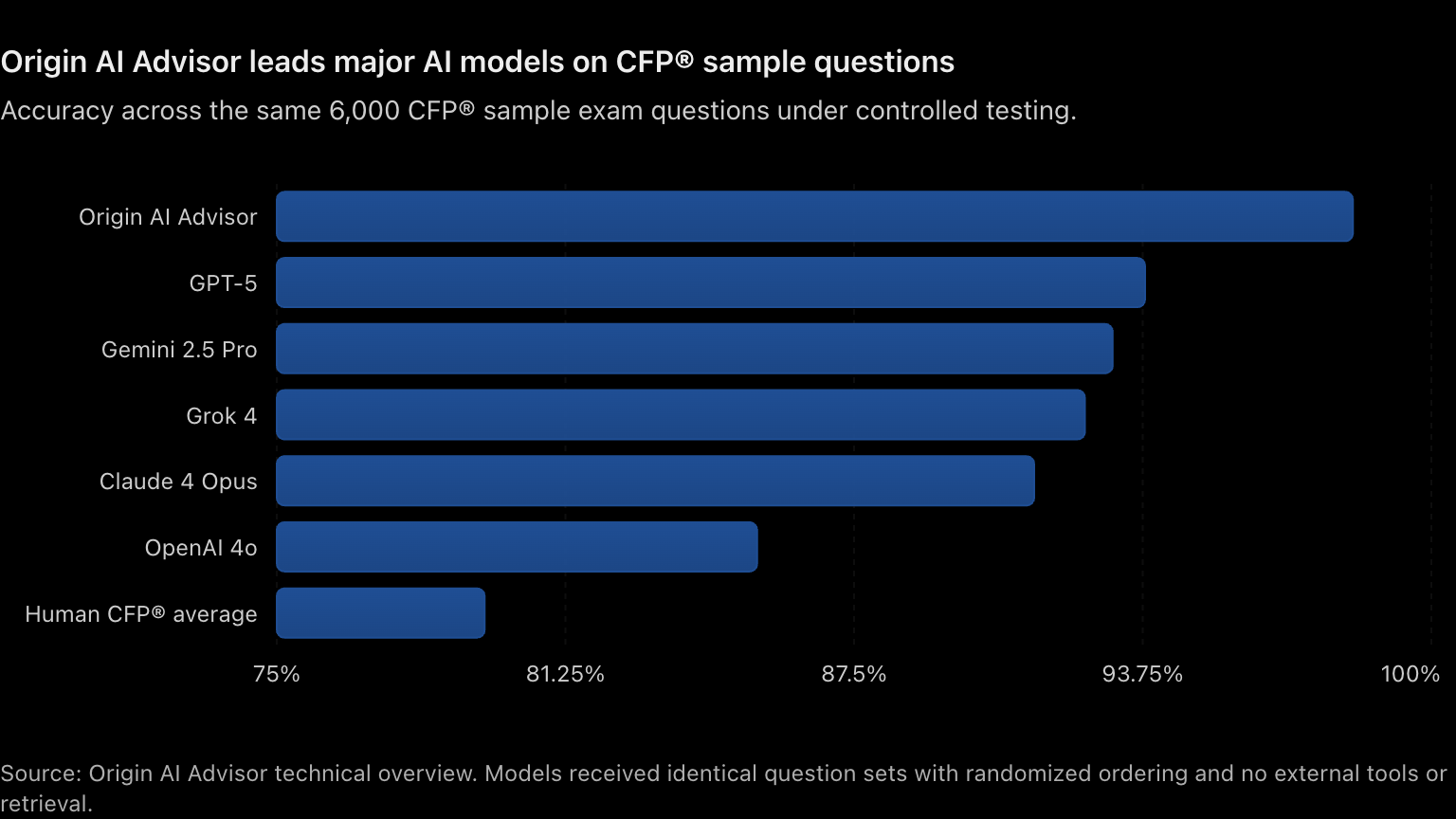
The models received identical question sets with randomized ordering and no access to external tools or retrieval. Origin scored highest overall and above 98% in investment planning and 99% in estate planning.
GPT-5 scoring 93.8% deserves some emphasis here.
That is not bad.
That is not even remotely bad.
One of the world's best general-purpose AI models scored nearly 94% on thousands of questions drawn from the professional standard used to test financial planners. Anyone arguing that ChatGPT knows nothing about finance has a rather difficult number to explain.
Origin scored 98.3%.
The difference between those numbers becomes more interesting when you look under the hood.
ChatGPT Has an Excellent Financial Brain. Origin Built a Financial System Around One.
A language model can know the correct formula for compound growth and still occasionally perform the arithmetic incorrectly.
This is an awkward characteristic for software being asked how much money someone needs to retire.
Origin's architecture separates the jobs.
The language-model layer interprets questions, reasons through financial situations, and decides which tools and specialized agents should handle a problem. The underlying calculations can then run through deterministic computational engines rather than relying on an LLM to generate arithmetic probabilistically.
In other words, the AI can do the thinking without also being asked to cosplay as a calculator.
Origin also isn't built around a single model. AI Advisor uses a heterogeneous ensemble of models and specialized systems, with different components handling reasoning, tool execution, real-time grounding, retrieval, and financial calculations. Relevant financial context is selectively retrieved rather than indiscriminately dumping everything into one enormous prompt.
That's a considerably more elaborate architecture than simply putting a clever chatbot on top of connected bank accounts.
It exists because finance has a particularly annoying combination of requirements: the answer needs to understand language, understand context, reason correctly, calculate correctly, use current information, and remain appropriate for the person asking.
Missing any one of those can turn a beautifully written answer into an expensive mistake.
Every Origin AI Advisor Response Goes Through 138 Automated Checks
This is probably the least glamorous number in this article.
It may also be one of the most important.
Before an AI Advisor response reaches an Origin member, it passes through a compliance gateway containing 138 automated checks covering numerical accuracy, suitability, required disclosures, and privacy. Origin also maintains audit logging around the system's inputs, data access, model usage, and validation outcomes.
The architecture includes several additional safeguards against common AI failure modes: selective context retrieval to reduce context degradation, multiple models cross-validating outputs, real-time grounding for current information, and structured memory intended to preserve financial context across sessions.
None of this makes hallucinations mathematically impossible. Origin explicitly says AI Advisor remains an AI system, that recommendations can contain errors, and that complex or high-risk decisions may warrant speaking with a qualified human professional.
That's important because the useful comparison isn't between fallible ChatGPT and magically infallible financial software.
No such software exists.
The question is what infrastructure gets built around the fallible AI when its answers start influencing real financial decisions.
Origin's answer currently involves 138 checks.
ChatGPT Finance Still Draws a Line at Financial Advice
OpenAI is unusually clear about this distinction itself.
Its Financial Services Terms say OpenAI does not provide financial or investment advice through its financial products and that outputs are intended as information and tools rather than substitutes for independent professional judgment.
ChatGPT Finance can still be extraordinarily useful.
It can analyze financial tradeoffs, help users think through debt, emergency savings, retirement contributions, idle cash, spending, investments, and major financial decisions. OpenAI's product documentation explicitly describes these kinds of uses.
But OpenAI has deliberately stopped short of positioning ChatGPT itself as someone's financial adviser.
Origin operates under a different framework.
Origin Investment Advisory LLC is a Registered Investment Adviser, and AI Advisor was designed to operate inside that regulated environment. Personalized advice requires members to complete a suitability questionnaire, and recommendations are non-discretionary: the member ultimately decides whether to act.
This distinction sounds like legal minutiae until the questions become personal.
“What's a Roth IRA?” requires information.
“Given my income, investments, risk tolerance, retirement timeline, debt, and goals, what should I do?” requires something rather closer to advice.
ChatGPT can help someone think through the latter.
Origin was explicitly built to provide personalized guidance around it.
Origin Also Checks Your Finances Before You Ask
There is another limitation that has nothing to do with benchmark scores.
The best answer in the world is useless if nobody asks the question.
OpenAI has made ChatGPT Finance increasingly good at connecting the dots across financial accounts, goals, memories, and other context. Its Finance experience can help users spot patterns and understand financial tradeoffs rather than treating every question as an isolated prompt.
Origin adds a monitoring layer on top of that model.
Its Proactive AI Advisor continuously analyzes the financial information available inside Origin and runs expert-built checks across areas including:
- Spending and cash flow
- Savings
- Credit
- Investments
- Retirement
- Financial protection
- Housing
- Education
- Estate planning
- And other areas of a member's financial picture
Those checks feed into a Financial Health Score and prioritized Actions. When Origin identifies something that may deserve attention, the Action explains what it found, why it matters, and what the member may want to do next.
That changes the role of the AI.
Someone can ask ChatGPT Finance whether they're saving enough for retirement.
Origin can analyze retirement alongside the rest of the financial picture and surface an issue before the member happens to wonder about it.
The difference isn't intelligence so much as responsibility for starting the conversation.
ChatGPT Has Distribution Origin Could Only Dream About
There is one comparison Origin loses so catastrophically that pretending otherwise would be funny.
Distribution.
Again: more than 200 million people per month were already asking ChatGPT about budgeting, investments, financial choices, and future goals when OpenAI announced ChatGPT Finance.
Origin is not going to out-distribute ChatGPT.
Neither is basically anyone else.
And OpenAI has now made Finance available to U.S. users across Free, Go, Plus, and Pro plans. Someone already using ChatGPT can connect financial accounts and start asking questions without adopting an entirely new product.
That's an enormous advantage.
It also makes the comparison unusually revealing.
ChatGPT Finance doesn't need to be the world's most specialized financial system to become one of the world's most widely used financial tools. It already has the audience, the interface, the models, and increasingly the financial context.
Origin has to win somewhere else.
Specialization is that somewhere else.
What Does a Purpose-Built Financial AI Actually Buy You?
Strip away the branding and the comparison comes down to a handful of fairly concrete differences.
ChatGPT Finance gives one of the world's most capable general-purpose AI systems access to financial context.
Origin starts with financial context and builds a specialized system around what needs to happen next.
That system has produced a 98.3% score across 6,000 CFP® sample questions, compared with 93.8% for GPT-5 on the same questions.
Its responses pass through 138 automated validation and compliance checks.
Its math can run through deterministic computational engines instead of relying on language-model arithmetic.
Its proactive layer runs financial checks across at least nine explicitly documented areas of a member's financial life, from cash flow and investments to retirement, credit, housing, protection, education, and estate planning.
And its personalized financial guidance operates inside a registered investment adviser with suitability requirements rather than a general-purpose information product.
None of those facts makes ChatGPT Finance useless.
Quite the opposite: the fact that ChatGPT is this good makes them worth measuring.
Is ChatGPT Good at Financial Advice?
Yes — with an asterisk that OpenAI itself puts there.
ChatGPT is exceptionally knowledgeable about finance. GPT-5 scored 93.8% on the same CFP® sample questions used to evaluate Origin. OpenAI's newer GPT-5.5 models are explicitly optimized further for complex personal-finance reasoning, and ChatGPT Finance can now combine that intelligence with connected accounts, credit information, financial memories, and other personal context.
For understanding spending, exploring financial tradeoffs, learning financial concepts, analyzing investments, planning goals, and thinking through decisions, that's an extraordinary amount of capability sitting inside a product millions of people already use.
Origin's argument isn't that ChatGPT doesn't understand finance.
The numbers make that argument increasingly difficult to sustain.
The argument is that understanding finance is one component of giving financial guidance.
The rest involves reliable calculations, appropriate context, suitability, compliance, proactive monitoring, persistent financial infrastructure, and knowing when the system shouldn't simply generate the next plausible sentence.
OpenAI has built one of the world's best general-purpose AI systems and given it access to your financial life.
Origin built the system around the financial life first.
The numbers suggest specialization still buys something.
Frequently Asked Questions
Is ChatGPT good for financial advice?
ChatGPT is highly capable at financial reasoning and can help users understand spending, investments, debt, savings, goals, and financial tradeoffs. GPT-5 scored 93.8% on the same 6,000 CFP® sample questions used to benchmark Origin AI Advisor. However, OpenAI explicitly states that its Financial Services products provide information and tools rather than financial or investment advice.
What did ChatGPT score on OpenAI's personal finance benchmark?
OpenAI's default GPT-5.5 Thinking model for ChatGPT Finance scored 79 out of 100 on its internal personal finance benchmark, while GPT-5.5 Pro scored 82.5. OpenAI developed the benchmark with input from more than 50 financial professionals and says it combines expert-rated response quality with accuracy.
What did Origin AI Advisor score on the CFP® benchmark?
Origin AI Advisor scored 98.3% across 6,000 CFP® sample exam questions administered over 432 hours. GPT-5 scored 93.8%, Gemini 2.5 Pro scored 93.1%, Grok 4 scored 92.5%, Claude 4 Opus scored 91.4%, and OpenAI 4o scored 85.4% on the same questions.
Is OpenAI's 82.5 score comparable with Origin's 98.3% score?
No. They come from different benchmarks and shouldn't be directly compared as though they're percentages from the same exam. The cleaner comparison is Origin's 98.3% versus GPT-5's 93.8%, because both systems answered the same CFP® sample questions under the same controlled testing conditions.
Can ChatGPT Finance access my real financial accounts?
Yes. Eligible U.S. users can connect financial accounts through Plaid and credit information through Experian. ChatGPT Finance can then use that context to analyze areas including spending, subscriptions, bills, net worth, investments, and credit.
Is Origin AI Advisor a human financial advisor?
No. AI Advisor is an AI system and Origin explicitly warns that it can make errors. Origin Investment Advisory LLC is a Registered Investment Adviser, however, and AI Advisor operates within that framework. Personalized advice requires completion of Origin's suitability questionnaire, and users remain responsible for deciding whether to act on recommendations.
How does Origin reduce AI hallucinations and financial errors?
Origin uses multiple layers of validation, including deterministic computational engines for underlying calculations, selective context retrieval, multiple AI models that can cross-check outputs, real-time grounding, structured memory, and a compliance gateway that performs 138 automated checks covering areas including numerical accuracy, suitability, disclosures, and privacy.
Which is better for personal finance: ChatGPT or Origin?
ChatGPT Finance is compelling for people who already use ChatGPT and want a powerful conversational tool for understanding their finances. Origin is designed for people who want specialized financial reasoning, personalized guidance, deterministic financial calculations, proactive monitoring, and broader financial-planning infrastructure built around their connected financial life.
Answers to your questions
Yes. Origin offers partner access so you can manage your finances together at no additional cost. You’ll be able to filter transactions by member—making it easy to see which spending is yours and which belongs to your partner.

Yes. You can edit existing transactions and add new ones directly in Origin, so your records stay accurate and personalized.
Origin connects securely through trusted partners including Plaid, MX, and Mastercard.
Yes. Origin supports CSV uploads. You can upload a .csv file of your transactions, and we’ll import them into your account.
Yes. Your data is protected with bank-level security and advanced encryption. When you connect accounts through Origin, your login credentials are never shared with us. Instead, our partners generate secure tokens that let Origin access only the data you authorize—keeping your personal information private while enabling personalized insights.
Yes. You have full control to organize your spending in Origin. Transactions are automatically categorized by Origin, but you can always edit categories, add your own tags, and filter transactions however you like—so your spending reflects the way you actually manage money.