


Inflation’s Optical illusions


June’s headline inflation report gave us a head fake when prices declined 0.4% during the month, largely due to some temporary reprieve from higher fuel prices. That reprieve was short-lived, though — as has been the up-and-down nature of the Iran conflict, tensions have re-flared over the past month, putting oil prices through the wringer again, and dragging energy prices up along with it.
The Fed’s preferred inflation report — the Personal Consumption Expenditures Index — which lags CPI by a few weeks, just dropped today to add some color commentary to the June report, and it mostly corroborated it. June PCE came in at 3.7% year-over-year, which is a decline from May’s 4.1% YoY increase (a three-year high), and also dropped 0.1% on the month-to-month time frame. Core PCE, which strips out the choppy categories of energy and food prices entirely, again came in at 3.3%, pretty much exactly where it’s been for the past four months.
But, as you know, this relief is currently a lagging indicator, driven by a lull in a very fluid geopolitical situation — gasoline and energy prices dropped 9.2% last month, which was the largest decline since 2022. So, this "cooling" last month is almost entirely an energy story, same as the CPI surprise a few weeks back. Oil prices fell through June, and that flowed straight into the headline number.
This report also provided our first snapshot of overall economic growth during the last quarter. The final estimate for Q1 was that the economy (GDP) was growing at roughly a ~2.1% annualized rate, which is…yeah, pretty average. Thumbs up. This one delivered the first estimate (of three total) on where it was tracking in Q2, and it came in about ~25% lower at 1.5%. This was below estimates and largely dragged down by fuel and AI-related imports, which weigh on domestic growth metrics. But the underlying consumer picture looked resilient, with overall spending growth ticking up 3.2% in Q2, up from just 0.5% in Q1.
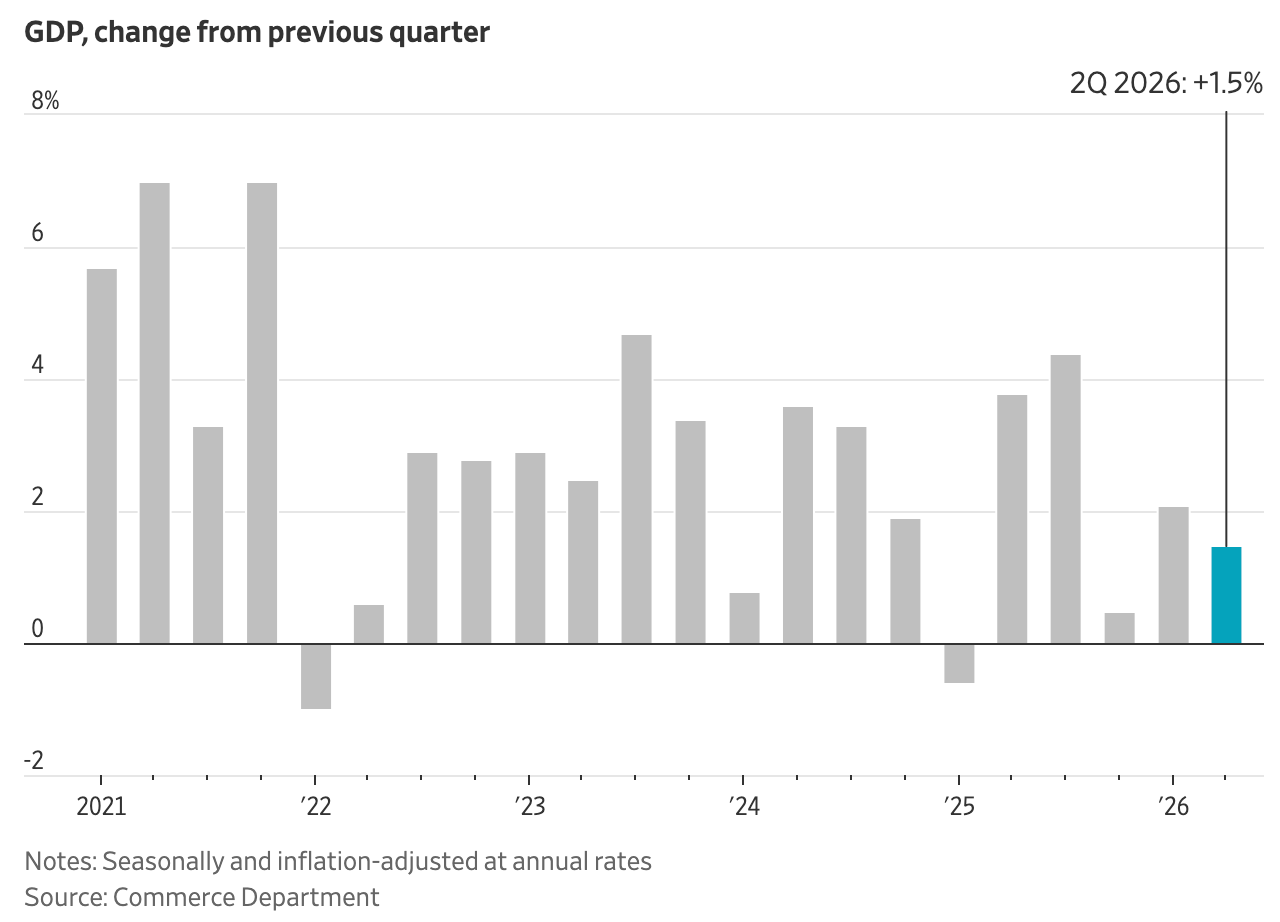
Source: WSJ
This report lands one day after the Fed held rates steady at 3.50%–3.75% for a fifth straight meeting — Warsh's second meeting as chair, with no new dot plot (projections) this round, so the statement language carried more weight than usual. And that June dot plot is still hanging over everything: Nine of eighteen officials penciled in at least one hike before year-end, with the median 2026 rate projection jumping from 3.4% to 3.8% in a single meeting. That’s a 180 from early 2026; a flip from expected cut to expected hike. The Fed and its new Chairman won’t meet again until Mid-September, and the Board of Governors will have two new inflation reports plus 6 weeks of new information to mull over by then.
So, overall, an explicable but underwhelming GDP print paired with a likely ephemeral inflation dip is the "temporary energy distortion, stay the course" story. A weaker GDP number paired with sticky core services inflation is a much uglier combination — stagflation-adjacent, and exactly the scenario that makes Warsh's June hike signal look premature rather than prescient.
Both narratives are going to find something to point to in this release. Growth bears get their slowdown confirmation, and inflation hawks will get to reaffirm that June’s cooling was a blip on the radar. Whether the Fed's next move in September is a hike, a hold, or a walk-back depends almost entirely on what happens with the conflict and whether that services-inflation subcategory actually moved.
Answers to your questions
Yes. Origin offers partner access so you can manage your finances together at no additional cost. You’ll be able to filter transactions by member—making it easy to see which spending is yours and which belongs to your partner.

Yes. You can edit existing transactions and add new ones directly in Origin, so your records stay accurate and personalized.
Origin connects securely through trusted partners including Plaid, MX, and Mastercard.
Yes. Origin supports CSV uploads. You can upload a .csv file of your transactions, and we’ll import them into your account.
Yes. Your data is protected with bank-level security and advanced encryption. When you connect accounts through Origin, your login credentials are never shared with us. Instead, our partners generate secure tokens that let Origin access only the data you authorize—keeping your personal information private while enabling personalized insights.
Yes. You have full control to organize your spending in Origin. Transactions are automatically categorized by Origin, but you can always edit categories, add your own tags, and filter transactions however you like—so your spending reflects the way you actually manage money.