


Inflation just got more problematic


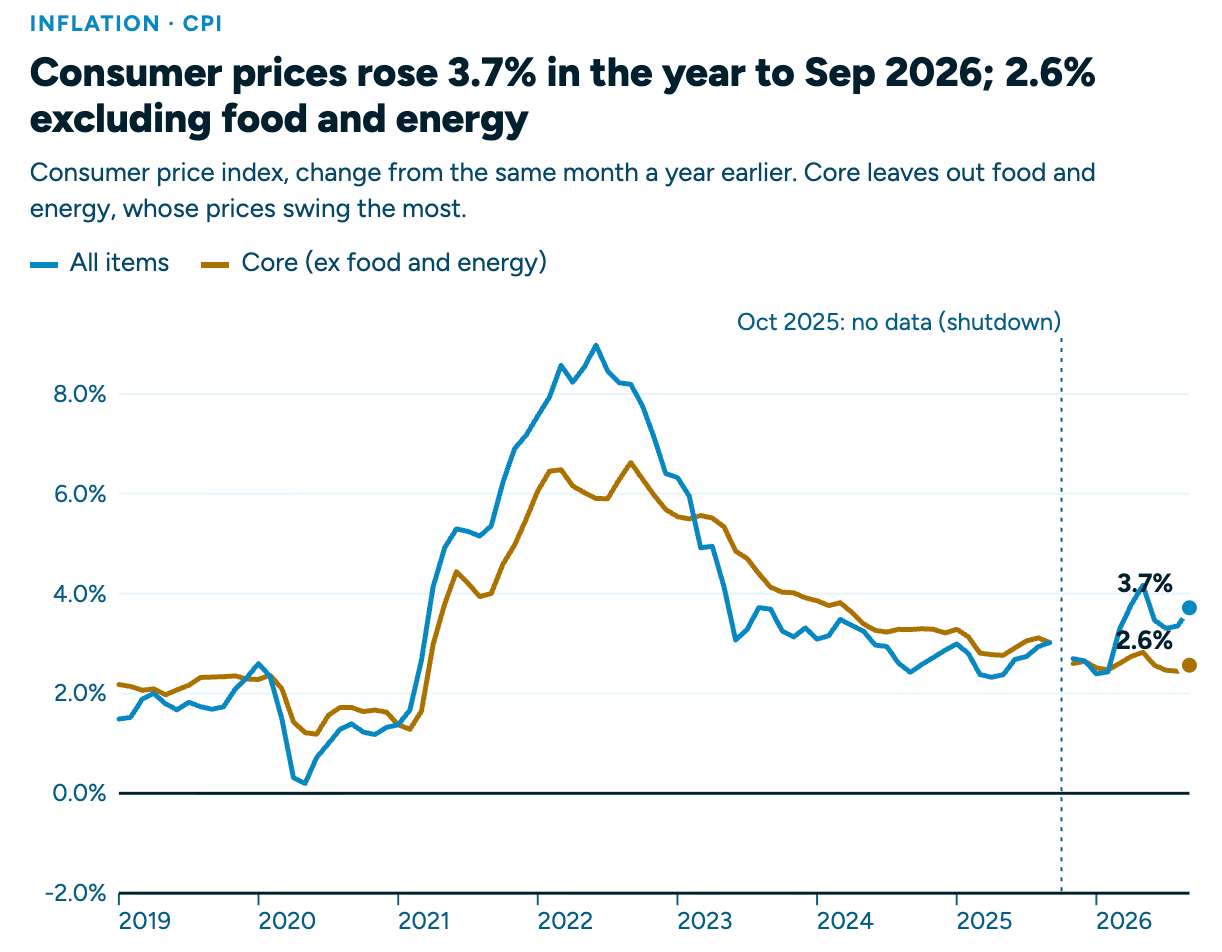
September's inflation report arrived yesterday morning, and the numbers weren't particularly encouraging. Economists largely expected this report to tick up (specifically to 3.6%) as persistently higher energy prices continue to creep into other parts of the economy.
Unfortunately, this inflation report beat even that bleak outlook. Consumer prices jumped 0.6% in September, pushing annual inflation to 3.7%, up from 3.4% in August and the highest since May. Gasoline was the obvious offender: Prices surged 9.1% in a single month and are now 34.2% higher than a year ago, accounting for more than half of September's overall inflation increase. Energy prices broadly rose 5.2%, while food prices were unchanged and grocery prices actually fell 0.1%. So, yes, much of the headline acceleration is an energy story. Unfortunately, the rest of the report doesn't exactly inspire confidence, either.
Core inflation, which excludes food and energy, rose 0.3% for the second consecutive month, bringing its annual rate from 2.4% to 2.6%. This is further proof that price pressures are no longer confined to just pain at the pump — though that is still the primary offender. Shelter inflation accelerated from 0.3% to 0.4%, services excluding energy rose 0.4%, and core goods prices increased 0.3%. Used vehicles, airfare, recreation, education, and medical services all became more expensive. There is some nuance here — rent itself rose just 0.2%, and services excluding rent of shelter held at 0.3% — but the underlying inflation problem clearly hasn't disappeared.
Source: CNBC
The bigger problem is what happened to wages
The accompanying Real Earnings report paints an arguably more troubling picture. Average hourly earnings increased just 0.1% in September, while consumer prices rose 0.6%. Adjusted for inflation, real hourly and weekly earnings both fell 0.5% in a single month. Over the past year, real hourly earnings have declined 0.7%, meaning the average hour of work buys less than it did last September — as if that wasn’t obvious enough, we have plenty more proof to add to that stack. For production and nonsupervisory employees, real hourly earnings fell 0.6% last month. The economy might still be expanding, but that doesn't mean the average paycheck is keeping up.
And this comes against another awkward consumer backdrop. The BEA's latest PCE report, covering August (which we covered a couple of weeks ago), showed headline inflation at 3.4% annually and core PCE at 3.0%. More interestingly, real consumer spending increased 0.6% that month while real disposable income went nowhere, leaving the personal saving rate at 4.1%. Americans were still spending, but their inflation-adjusted income wasn't growing alongside it.
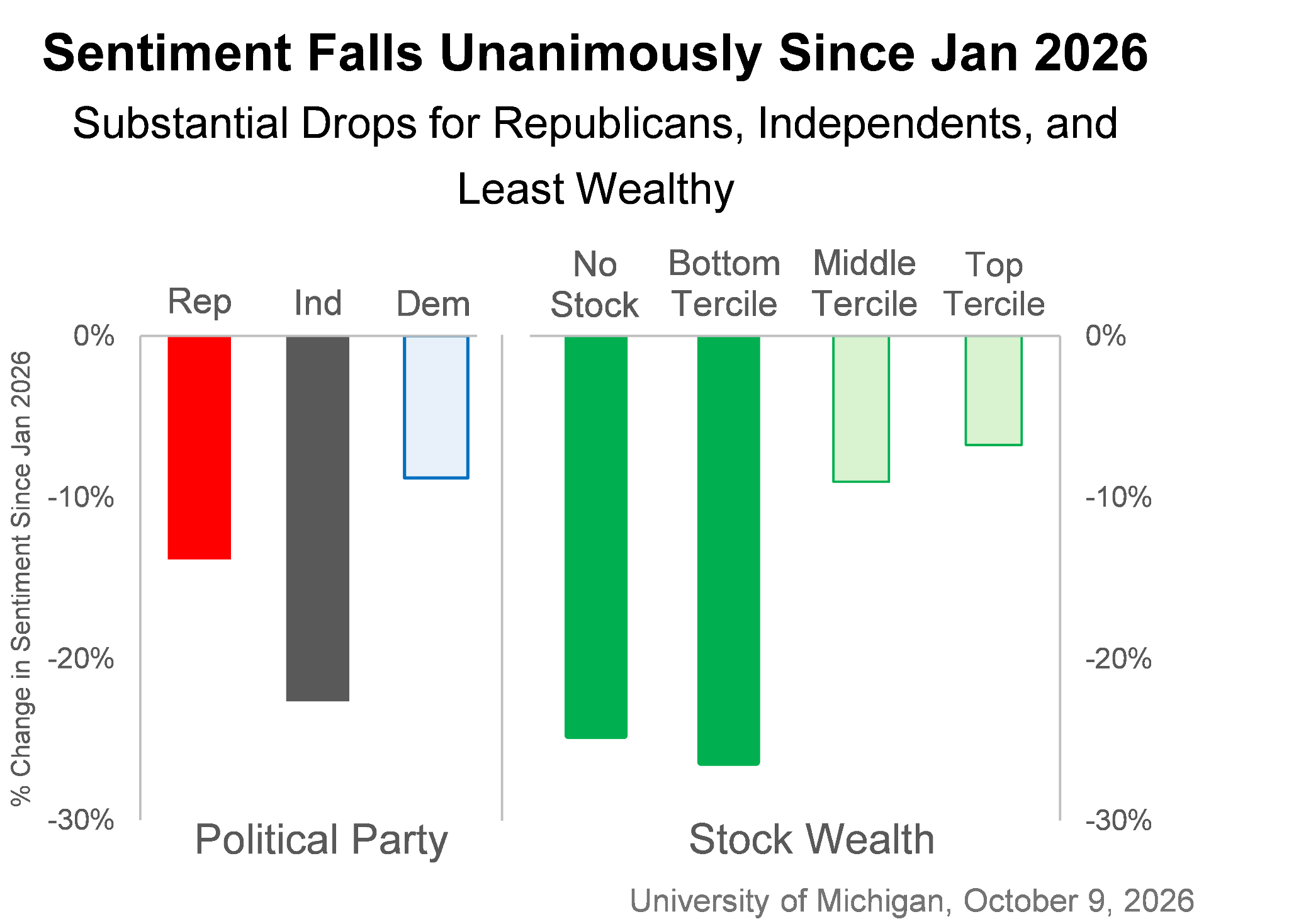
Meanwhile, the University of Michigan's preliminary October survey showed consumer sentiment falling from 48.1 to 46.3, with assessments of current economic conditions reaching a record low. Expected inflation also increased: 4.7% over the next year and 3.5% over the longer term.
Source: UMich
So, what does this mean for the Fed?
The Fed already raised rates in September, and today's report gives policymakers another reason to remain cautious. Energy shocks can fade, and a single CPI reading doesn't establish a lasting inflation trend. But persistent underlying price pressures, weakening real wages, and rising consumer inflation expectations are a particularly unpleasant combination.
The odds of another hike at the Fed’s meeting later this month had dwindled in recent weeks, mostly because a lot of Fed officials' quotes, anecdotes, and general vibes suggested: We might not be about to enact a rushed tightening phase, especially after last week’s lackluster jobs report.
This inflation report confounds that, though, and oddsmakers instantly took heed. The chance of another hike later this month doubled from below 20% to almost 40% after this CPI printout.
Overall, the stock market did not take kindly to any of this during the week. Rate worries have once again combined with AI jitters — sending the tech sector to its worst overall day in almost three months as investors wonder whether tech giants are actually revolutionizing global productivity, or just building the world's most expensive calculators on a credit card. Yet, in a classic display of Wall Street irony, this tech panic re-triggered a massive flight to safety, sending bond yields plummeting. Investors rushed into U.S. Treasurys for cover, briefly cooling off a year-long bond crisis driven by the exact same debt and inflation fears that everyone suddenly chose to ignore for the afternoon.
Have a good weekend — or at least try to.
Answers to your questions
Yes. Origin offers partner access so you can manage your finances together at no additional cost. You’ll be able to filter transactions by member—making it easy to see which spending is yours and which belongs to your partner.

Yes. You can edit existing transactions and add new ones directly in Origin, so your records stay accurate and personalized.
Origin connects securely through trusted partners including Plaid, MX, and Mastercard.
Yes. Origin supports CSV uploads. You can upload a .csv file of your transactions, and we’ll import them into your account.
Yes. Your data is protected with bank-level security and advanced encryption. When you connect accounts through Origin, your login credentials are never shared with us. Instead, our partners generate secure tokens that let Origin access only the data you authorize—keeping your personal information private while enabling personalized insights.
Yes. You have full control to organize your spending in Origin. Transactions are automatically categorized by Origin, but you can always edit categories, add your own tags, and filter transactions however you like—so your spending reflects the way you actually manage money.