


Inflation cooled again — but that may not mean much


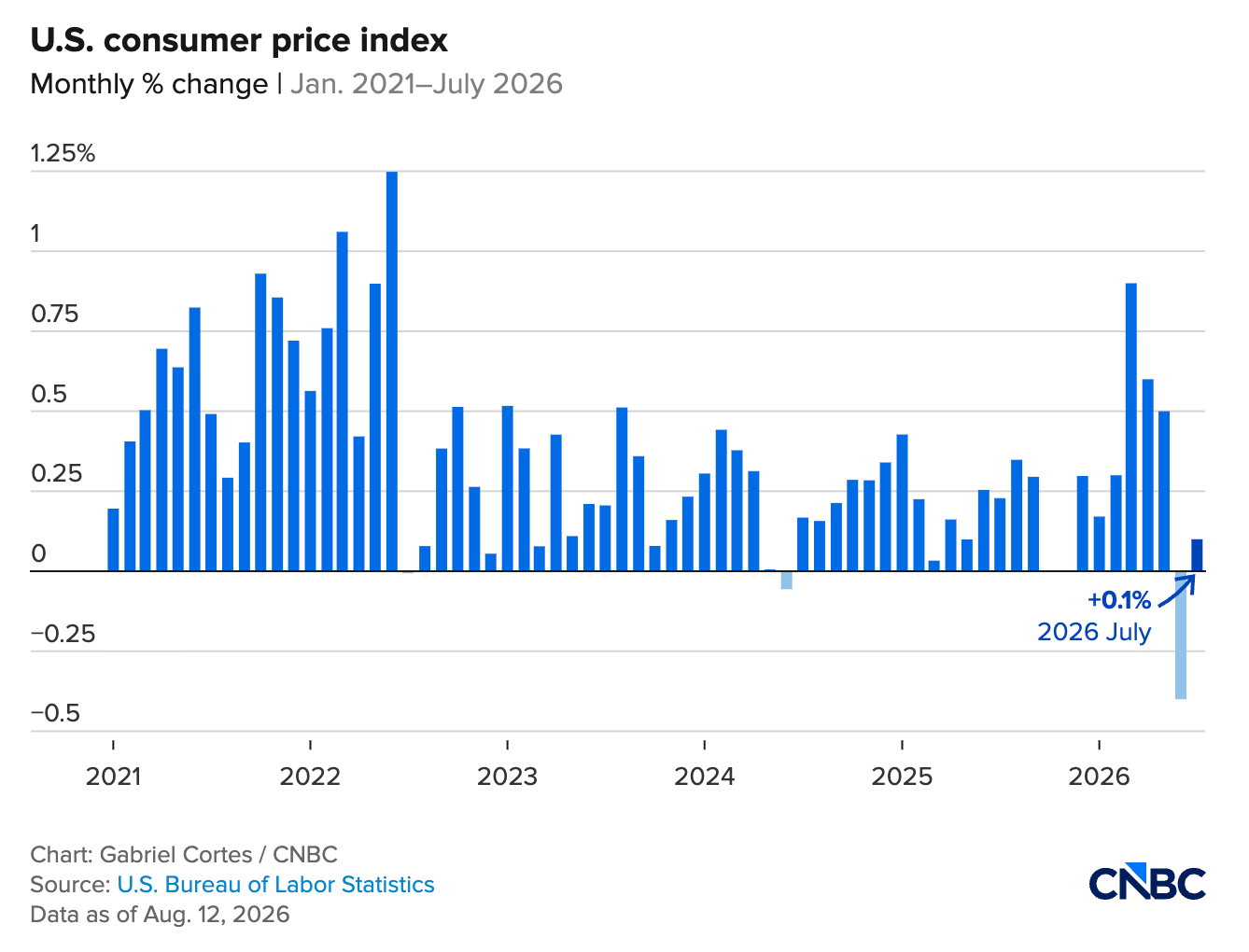
July’s inflation report just dropped yesterday, and it may have given the Fed another alibi to avoid a rate hike next month. July’s year-over-year inflation rate came in at 3.4%, continuing the downward trend from the prior month (June), when it came in at 3.5%. To put this into perspective, CPI had spiked over the spring months because of the Iran conflict, and subsequently higher fuel prices — the Fed (and consumers) had gotten used to monthly readings in the 2% range for quite some time now, but all of that progress started to unravel in March, April, and May, with inflation hitting 4.2% before June’s report arrived.
Source: CNBC
Core inflation, meanwhile — which strips out those volatile food and energy sectors — remained at 2.5%, also down a tenth of a percentage point from June.
These last two months of slight reprieve have been the downstream effects of a perpetually looming peace deal in the Middle East. Whether we call it de-escalation or ambiguity, it’s really been an oscillation between both — and it bled over into lower fuel and oil prices nonetheless.
On an actual month-to-month basis, headline CPI ticked up 0.1% last month, and core up 0.2%. Both of these stand in contrast to June’s 0.4% decline in headline CPI, and core remaining flat last month. Shelter is largely to blame for this: It accounts for roughly two-thirds of the entire headline move, because shelter carries such enormous weight in the basket. Owners' equivalent rent, the stickiest and most stubborn subcomponent, rose 0.3%. That got partially offset by a 2.8% drop in lodging away from home, which is doing a lot of quiet work keeping the topline number this soft.
The short synopsis of inflation right now is this: It was already above the Fed’s ideal 2% target coming into the year; we were still working on getting it back down from the post-Covid spike. Then, this geopolitical conflict came along and complicated that ongoing effort. The last six inflation reports this year represent what is, effectively, a detour from that prerogative — or at least, we hope. Until some form of a more final resolution is reached, these 2026 inflation reports are likely to remain choppy, noisy, and wildly unpredictable until further notice.
Nevertheless, the markets liked it — for now. Stocks were responsibly green on Wednesday in the aftermath. Increased odds of lower rates or simply lower odds of a rate hike = more favorable borrowing/growth conditions: Good for the rally. Bond yields also declined — a more complex mechanism because it seems counterintuitive, but actually mates perfectly. A cooling inflation report (like this one) makes the market think the Fed is less likely to need a rate hike, and more likely to eventually cut. That means newly issued bonds going forward will likely carry lower interest rates than they would have if inflation stayed hot. So existing bonds — already circulating, locked into whatever rate they were issued at — become relatively more attractive by comparison, since they're paying more than what's coming down the pipe. Demand for those existing bonds rises. Price goes up. Since price and yield move inversely, yield falls.
The Fed will reconvene in exactly five weeks from now — at the time of writing. Oddsmakers are now pricing in just a ~40% chance of a rate hike during this September meeting, the rest wagering on a cut. Neither of which means a hike is off the table; there are still several hawkish Federal Reserve Governors vying for a hike to get ahead of potential inflation headwinds. In the meantime, borrowing rates remain expensive across mortgages, credit cards, and more — navigate accordingly.
Answers to your questions
Yes. Origin offers partner access so you can manage your finances together at no additional cost. You’ll be able to filter transactions by member—making it easy to see which spending is yours and which belongs to your partner.

Yes. You can edit existing transactions and add new ones directly in Origin, so your records stay accurate and personalized.
Origin connects securely through trusted partners including Plaid, MX, and Mastercard.
Yes. Origin supports CSV uploads. You can upload a .csv file of your transactions, and we’ll import them into your account.
Yes. Your data is protected with bank-level security and advanced encryption. When you connect accounts through Origin, your login credentials are never shared with us. Instead, our partners generate secure tokens that let Origin access only the data you authorize—keeping your personal information private while enabling personalized insights.
Yes. You have full control to organize your spending in Origin. Transactions are automatically categorized by Origin, but you can always edit categories, add your own tags, and filter transactions however you like—so your spending reflects the way you actually manage money.