


Inflation comes in as expected — now we wait


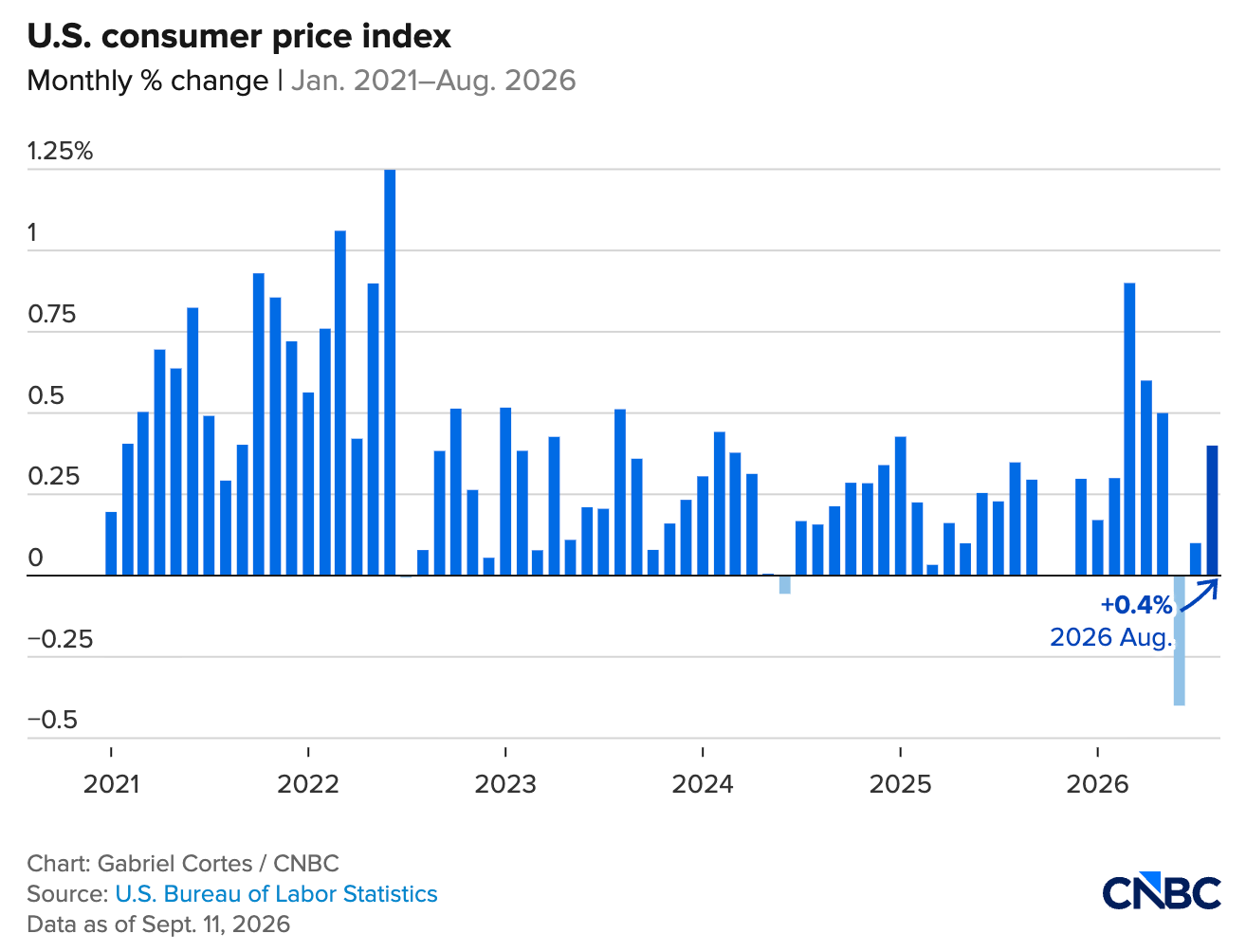
Markets have spent the better part of the last month lamenting the prospect of a rate hike and getting spooked into a sell-off pretty much any time the odds increased. That logic actually tracks — tighter financing conditions are usually considered bearish — and then, on Friday, another elevated inflation report flipped the script, and for a day, markets actually celebrated it. More on that below, but as for the inflation report itself — as expected: The Consumer Price Index rose 0.4% in August and 3.4% from a year earlier, while core inflation, which excludes food and energy, rose 0.3% during the month and 2.4% annually (down slightly on the year-over-year lens). The headline annual figure matched economists' expectations.
Visual: CNBC
Subsequently, the odds of a rate hike during this week’s upcoming Federal Reserve session spiked to almost 90% in the aftermath of the report — and up to 92% today. Nothing had materially changed, but inflation holding steady at a problematic number and bond yields rising and tensions with Iran increasing again and oil prices rising is a disastrous cocktail. The CPI print is just a headline number, but the underlying arrows are pointing in the wrong direction — result: Markets now expect a hike.
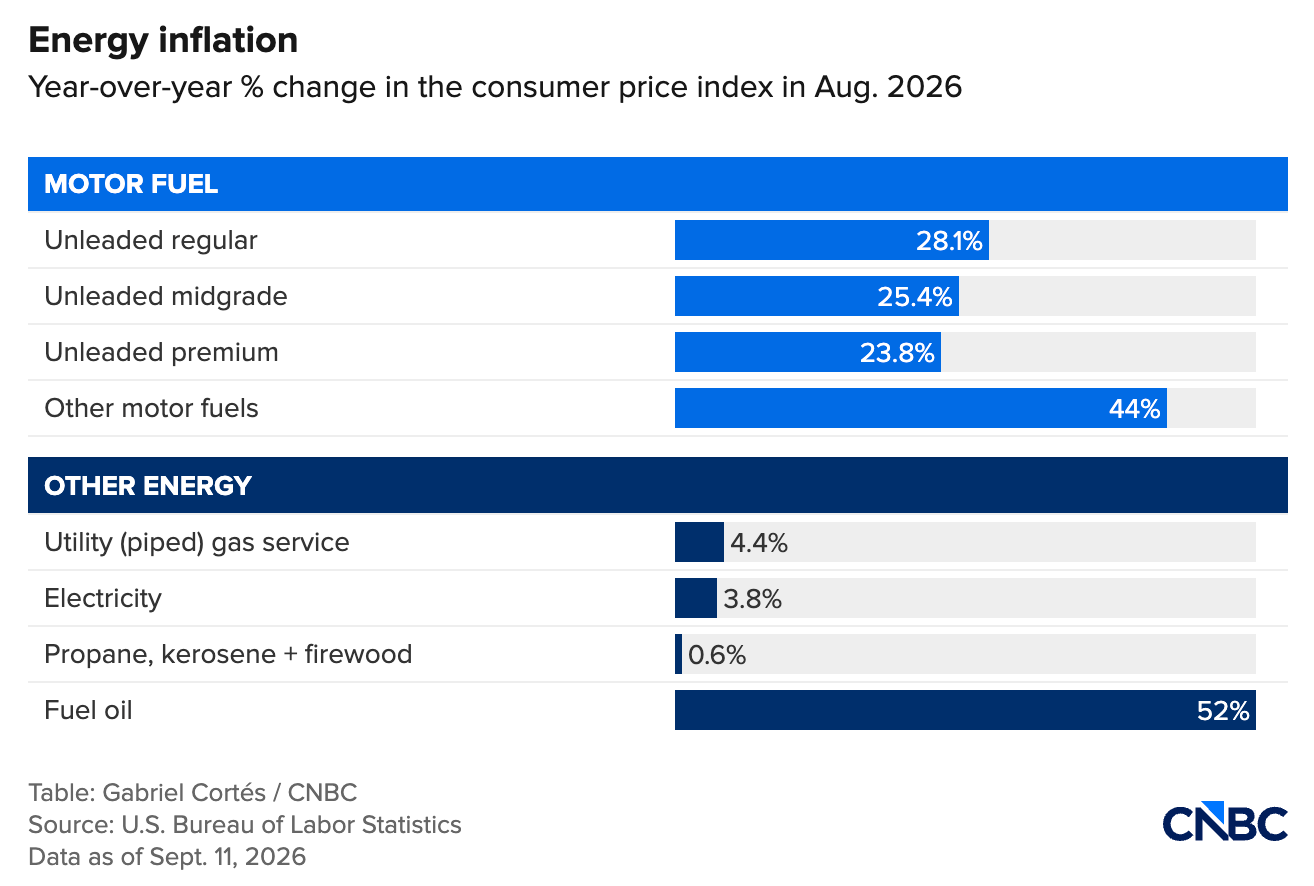
Looking more closely at the inflation report itself, the case for a rate hike keeps getting more compelling. Gasoline prices rose 3.9% in August alone and accounted for more than one-third of the entire monthly increase in inflation. Energy prices rose 2.1% and are now 16.3% higher than a year ago, while gasoline is up a fairly disgusting 27.4%. Average hourly wages are up 3.1% from a year ago. Consumer prices are 3.4% higher. Adjust those wages for inflation, and real average hourly earnings are actually down 0.3% over the past year. Real weekly earnings are technically up 0.3%, but largely because Americans are working slightly longer hours.
Visual: CNBC
That's a pretty clear explanation for why an economy with solid employment and rising nominal wages can still feel irritatingly expensive. Workers don't consume nominal salary growth. They spend it on groceries, gasoline, housing, insurance, and everything else those salaries have to buy. This also makes the latest energy shock considerably more consequential than its exclusion from “core” inflation might suggest. Economists exclude gasoline when they're trying to identify persistent underlying price trends because energy is volatile. Your checking account, regrettably, doesn't make this adjustment.
Interest rate implications: So, the Fed now walks into Wednesday with almost the exact opposite problem it appeared to have a few months ago. The labor market has strengthened enough to reduce concerns about immediate economic deterioration. Core inflation is still gradually improving. But headline inflation is stuck at 3.4%, energy costs are surging, real hourly earnings are negative again, and long-term borrowing costs have already climbed enough to put mortgage rates back near 7%.
There isn't a particularly clean policy answer hiding inside that combination. When you combine this with the context of Warsh’s comments late last month, denoting that “We must be sure inflation is moving to our instruction,” and the fact that the European Central Bank also just conducted a rate hike, the pressure is increasingly mounting for the new Federal Reserve Chairman to pick a position and set precedent.
Markets' initial reaction: Normally, a CPI print that raises the odds of a rate hike would fuel a broad sell-off in a month that has already favored a bearish narrative, but markets instead rallied on Friday. Why? Because you can retroactively justify any move if you choose the right aperture. If stocks had sold off on Friday, pundits would’ve had mechanisms to justify it — instead, they did the opposite, and despite seeming contradictory, there's an explanation. Bond yields have been rocketing lately as investors sell them because of inflation, government debt, and attractive corporate alternatives. Eventually, though, if you go far enough right, you end up left — that same sentiment can form a circle, and that’s what happened on Friday. The 10-year yield actually fell a noteworthy amount after the inflation report. Again, that seems contradictory, but it was really bond buyers saying: Okay, the Fed might actually hike, which decreases the odds of more restrictive rates down the road if that helps stamp out inflation. Result: Buy the 10Y, yields decline, and markets get a glimmer of hope that the restrictive, disciplined rate-hike route might actually be a net positive in the long term. Oil prices also declined initially on Friday on new headlines about “arrangements” for the Strait of Hormuz — that helped on Friday, but it had the shelf life of milk, and oil prices rebounded by yesterday.
Ultimately, this is where the usual market postmortem becomes borderline performance art. Last week's stocks sold off because strong labor data increased the odds of higher rates. On Friday, stocks rose even as inflation data increased the odds of higher rates. Depending on which day you opened Bloomberg, apparently a more hawkish Fed was either bad for stocks or something investors were delighted to have “confirmed.”
This is, of course, completely irrespective of whatever the heck happened between the inflation report’s release and today. Over the weekend and Monday, tensions with Iran continued to flare, oil prices rebounded, bonds resumed their sell-off — oh, and more AI doomsday warnings made the headlines. AI + absurd growth and momentum have arguably been the primary contributors to the 2026 stock market’s ability to not only stay afloat, but actually gain ground amid what’s otherwise been a year of geopolitical conflict, inflation re-flaring, national debt concerns, and a panicking bond market.
If this were 2022 all over again, this would likely be a bear market. If investors and AI-adjacent companies heed the warnings of multiple industry leaders, you’re suddenly left with a complete loss of thrust in the engine that has powered this stock market, not to mention all the bearish macro detractors mentioned above.
That caveat has come home to roost this week, with markets doing a complete U-turn on Friday’s ironic rally. What happens next will hinge almost entirely on this week’s Fed decision and how markets take it, the subsequent bond market reaction, and whether anything else improves elsewhere.
Answers to your questions
Yes. Origin offers partner access so you can manage your finances together at no additional cost. You’ll be able to filter transactions by member—making it easy to see which spending is yours and which belongs to your partner.

Yes. You can edit existing transactions and add new ones directly in Origin, so your records stay accurate and personalized.
Origin connects securely through trusted partners including Plaid, MX, and Mastercard.
Yes. Origin supports CSV uploads. You can upload a .csv file of your transactions, and we’ll import them into your account.
Yes. Your data is protected with bank-level security and advanced encryption. When you connect accounts through Origin, your login credentials are never shared with us. Instead, our partners generate secure tokens that let Origin access only the data you authorize—keeping your personal information private while enabling personalized insights.
Yes. You have full control to organize your spending in Origin. Transactions are automatically categorized by Origin, but you can always edit categories, add your own tags, and filter transactions however you like—so your spending reflects the way you actually manage money.