


In defense of Americans’ debt


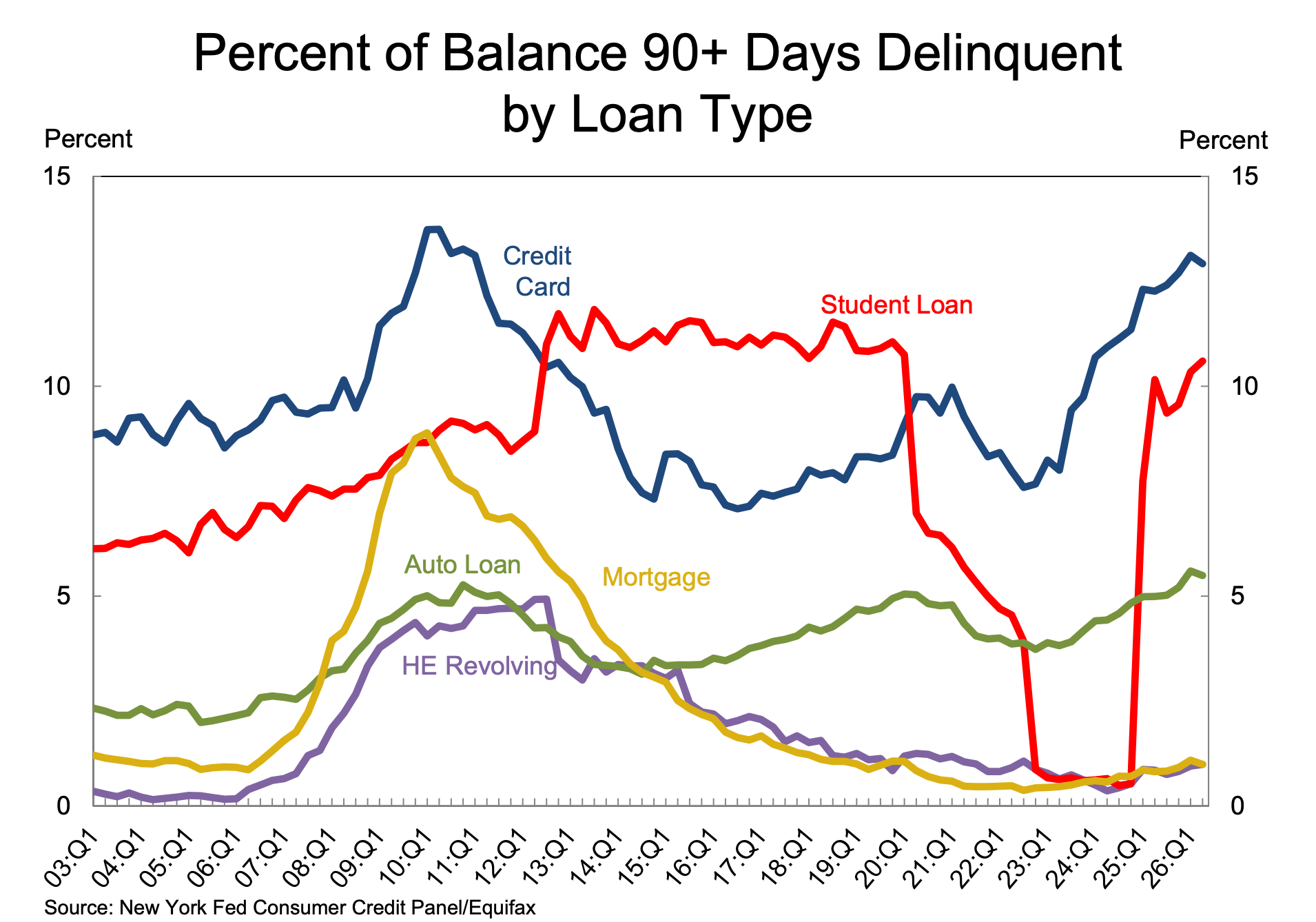
Credit card debt just hit $1.26 trillion in the second quarter, up $21 billion from Q1 and closing in on last year's all-time high of $1.28 trillion. The share of that debt considered seriously delinquent — 90 or more days past due — climbed to 12.9%, which is the second-highest reading since Q1 2011, trailing only the 13.7% peak recorded in the aftermath of the 2008 financial crisis.
That sounds pretty ominous, but the comparison is doing a lot of narrative work in how this story gets told, and it's worth slowing down on before accepting it at face value.
Source: NY Fed
The New York Fed's own researchers flagged the primary caveat: This is a lagging indicator, and it "reflects past charge-off debts that are sticking around on credit reports," not necessarily a fresh wave of people falling behind. Now, why is that? Why are lenders suddenly punishing delinquent borrowers even harder? Federal law caps how long a charged-off account can appear on a credit report — seven years plus 180 days from the original delinquency date, full stop, regardless of what a lender or bureau might prefer. That ceiling hasn't moved, but what has moved (apparently) is how close accounts are now staying to that ceiling before they age off or get updated. Between 2004 and 2012, about 40% of charged-off debts were still being reported a year later. By 2024, that figure had doubled to roughly 80%.
The Fed researchers didn't have a definitive explanation for why. Their best guess was that lenders may have changed their reporting practices, but they were explicit that this remains an open question rather than a settled answer.
So in the headlines we’ve seen the past few weeks, it looks like Americans are concerningly behind on their payments, but that distinction changes the vantage. When the researchers stripped out these older, severely derogatory balances and instead looked at the flow of loans newly transitioning into 90-day delinquency, that measure had actually stabilized since 2024. In other words, the stock of bad debt on the books kept climbing because old debt wasn't aging off the way it used to — but the rate at which new people are falling behind hasn't meaningfully worsened. PNC's head of economic analysis, Brian LeBlanc, put it bluntly: the New York Fed's headline delinquency figure is "incongruent with everything else," pointing to other measures of credit-card performance that look stable or improving.
You’ve likely also seen some buzz about student loans lately too — and yeah, their delinquency rate has increased as well. Serious student loan delinquencies rose 0.3 percentage points in Q2, to 10.6% — the highest since Q1 2020, and the third consecutive quarterly increase. This isn't really a surprise at all, though, once you consider the context: Borrowers have spent years navigating repayment-plan litigation, restarts and re-stops after the pandemic pause, policy changes, a new administration, and shifting rules around income-driven repayment options. The delinquency rate here reflects policy limbo more than it reflects a sudden inability to pay.
Source: NY Fed
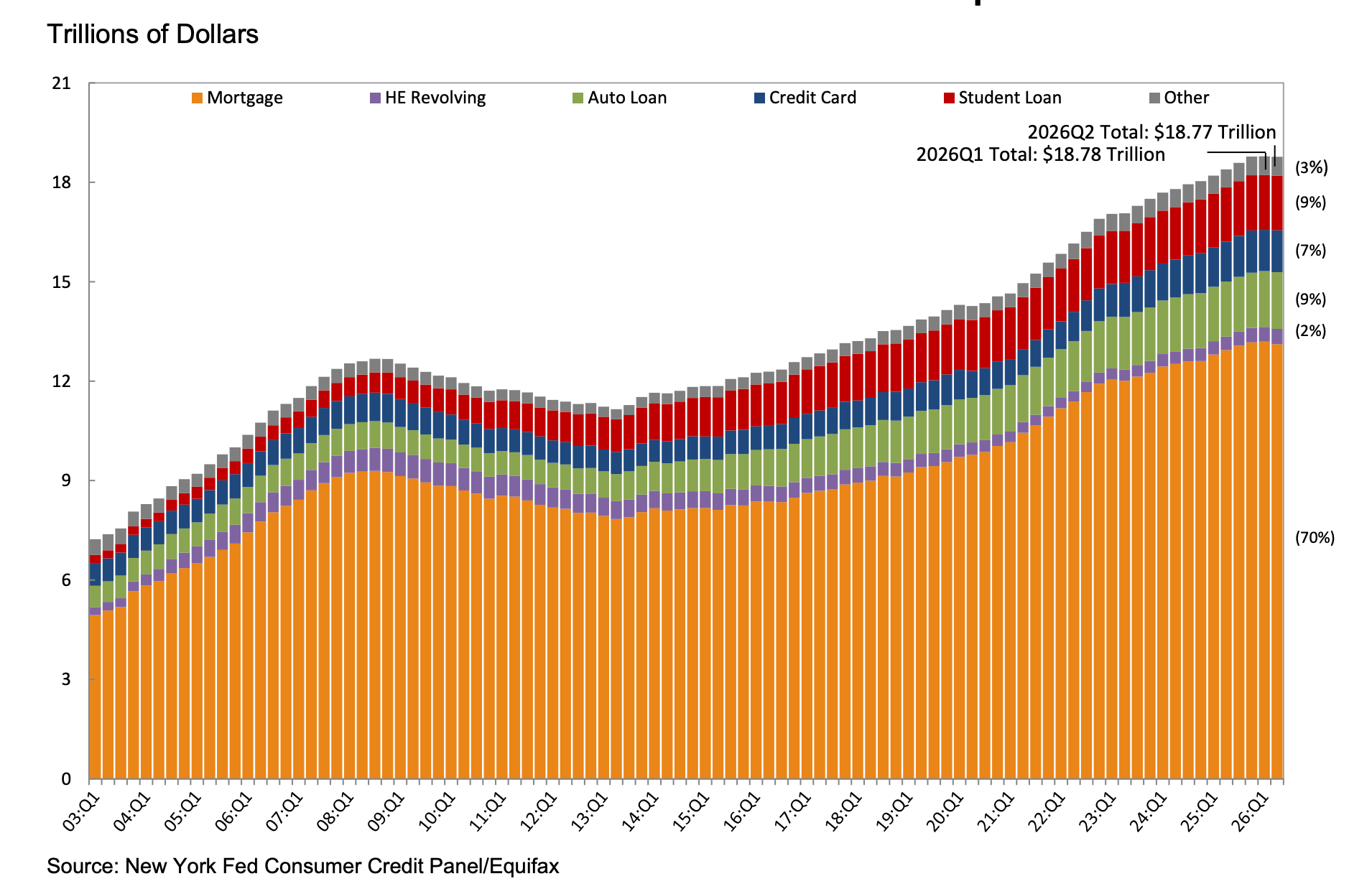
A couple of other anecdotes also support some consumer strength here. Total household debt actually fell $13 billion in Q2 — the first quarterly decline since the pandemic. Is that a meaningful deleveraging from a grand total standing at $18 trillion? Not at all; but it’s also not an increase. Bank of America also recently printed a batch of Consumer Checkpoint data that reinforces the calmer read. The share of households paying off their full credit card balance each month has risen across every income tier. Savings and deposit balances remain elevated relative to 2019 levels, with no sign of an accelerating drawdown. And critically, after-tax wage growth for lower-income households surpassed that of higher-income households in July for the first time since December 2024 — the exact demographic most associated with revolving credit-card stress is also seeing the strongest recent wage gains.
None of this vindicates the other harsh truths underlying the landscape — 60% of the roughly 175 million Americans who carry a credit card revolve a balance month to month, and average credit card APRs remain punishing, sitting near 21% across all accounts. Debt management firm Achieve found that 55% of consumers use credit cards to cover essential expenses, and 56% of borrowers say it will take six months or longer to pay off their current balance. That's a real burden, and it isn't going away, no matter how the delinquency headline gets sliced.
Overall, consumers' relationship status with debt remains: It’s complicated — but that’s much better than: It’s over, we’re all broke, wrap it up.
Answers to your questions
Yes. Origin offers partner access so you can manage your finances together at no additional cost. You’ll be able to filter transactions by member—making it easy to see which spending is yours and which belongs to your partner.

Yes. You can edit existing transactions and add new ones directly in Origin, so your records stay accurate and personalized.
Origin connects securely through trusted partners including Plaid, MX, and Mastercard.
Yes. Origin supports CSV uploads. You can upload a .csv file of your transactions, and we’ll import them into your account.
Yes. Your data is protected with bank-level security and advanced encryption. When you connect accounts through Origin, your login credentials are never shared with us. Instead, our partners generate secure tokens that let Origin access only the data you authorize—keeping your personal information private while enabling personalized insights.
Yes. You have full control to organize your spending in Origin. Transactions are automatically categorized by Origin, but you can always edit categories, add your own tags, and filter transactions however you like—so your spending reflects the way you actually manage money.