


How much are Americans spending on Halloween this year?


Halloween is routinely one of Americans' most expensive holidays each year, and arguably has the scariest implications for your personal finances (ha ha, good one, I know) if you overdo it.
So, how much is everyone else allocating to costumes, sugar, and apparently…greeting cards too?
Americans are preparing to spend a record $13.5 billion on Halloween this year, up from last year's record of $13.1 billion, according to the National Retail Federation. That's roughly $115 per person, almost identical to last year. So, despite another year of elevated prices and general economic uncertainty, Americans have collectively decided that Halloween is a nonnegotiable expense.
Although they're getting a little more strategic about financing their commitment to the supernatural.
Nearly half of consumers (49%) started Halloween shopping in September or earlier, up from 34% a decade ago. Some are simply enthusiastic about the season, but almost a quarter of early shoppers say they're spreading out purchases to manage their budgets. And if prices turn out to be higher than expected, 31% plan to comparison shop, 26% will hunt for discounts, and 34% are looking for decorations or other purchases they can reuse in future years.
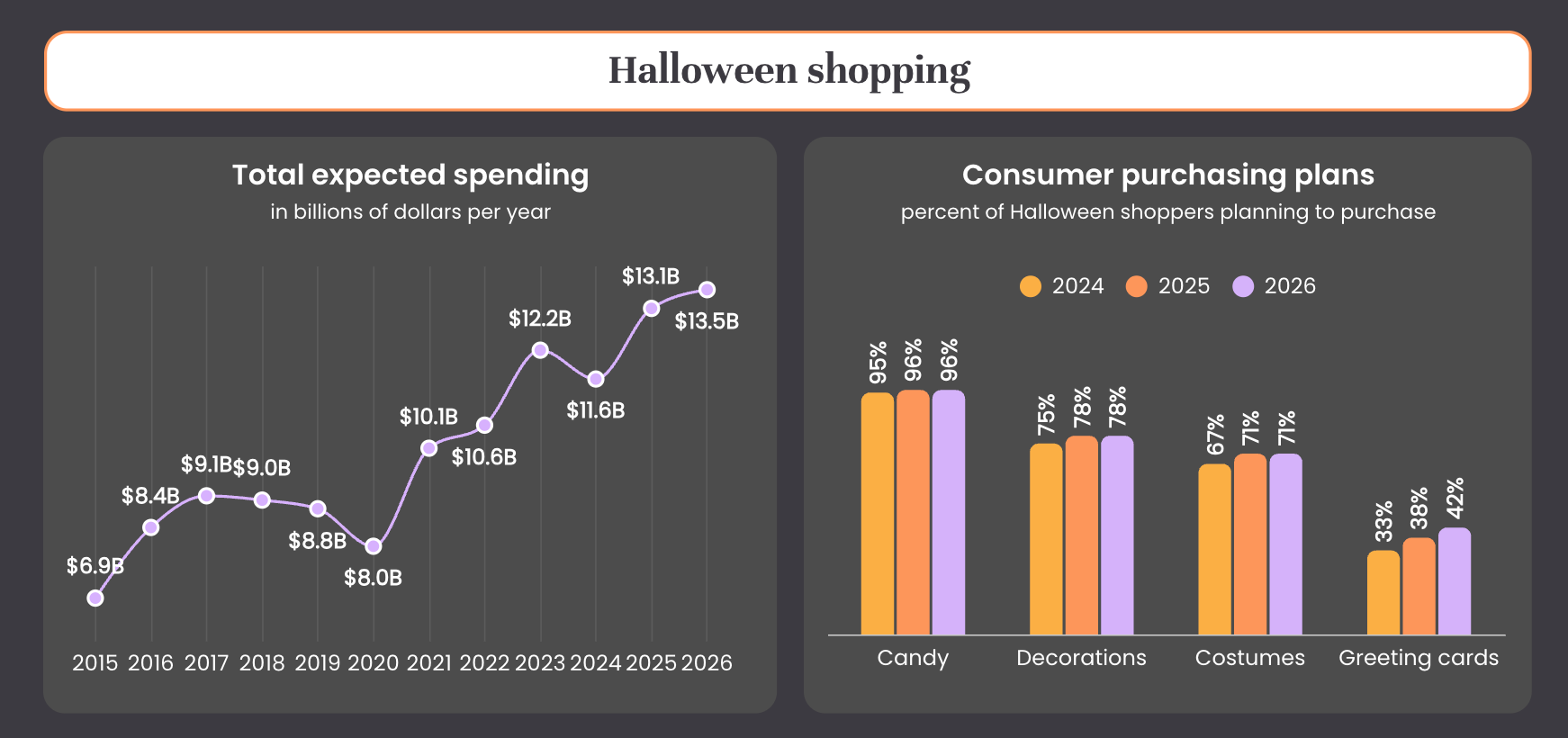
Visual source: NRF
Halloween has effectively become a two-month shopping season, complete with its own little exercise in household financial planning. Somewhere, a financial adviser is explaining the importance of diversifying your decorative skeleton purchases across multiple paychecks.
As for where the money's going, Americans are expected to spend $4.4 billion on costumes, $4.3 billion on decorations and $4.1 billion on candy. Another $800 million is earmarked for greeting cards, which raises the pertinent question of who, exactly, is sending Halloween cards and what they're writing inside. Let us know if you’ve ever received one, because apparently they're worth nearly a billion dollars a year.
Buried in the costume budget is a particularly important economic indicator: $920 million in projected spending on pet costumes. Nearly a billion dollars goes into dressing up animals, with pumpkins and hot dogs among the most popular choices. The dogs themselves haven't been consulted or given consent, of course.
Artificial intelligence has also entered the festivities. According to NRF, 47% of consumers use AI tools to help with Halloween shopping, whether brainstorming costumes, researching products, or coming up with decorating ideas. Meanwhile, online searches have fallen to their lowest share in a decade as a source of costume inspiration. The survey doesn't establish that AI is responsible for that decline, but we're evidently reaching the point where people are outsourcing even their Halloween costume decisions to a chatbot.
And participation isn't slowing down, either. Roughly 74% of Americans plan to celebrate Halloween this year, compared with 68% before the pandemic in 2019. What was once a single evening of candy distribution and questionable costume decisions has become an increasingly elaborate retail season, with consumers beginning preparations before summer has even properly ended.
Of course, there's a distinction between planning to spend $13.5 billion and actually spending it. NRF's figures come from a September survey of nearly 7,900 consumers, and those intentions could change as Halloween approaches.
But record projected spending, combined with increasingly deliberate bargain hunting, suggests something about the American consumer: enthusiasm hasn't disappeared, even if the willingness to pay full price has.
Americans might be watching their budgets more carefully this year, but Halloween appears to have survived the spending cuts. The economy can remain uncertain, prices can stay elevated, and household budgets can continue feeling the pressure. But the $40 inflatable skeleton stays. And the dog is going to be a hot dog whether it likes it or not.
Answers to your questions
Yes. Origin offers partner access so you can manage your finances together at no additional cost. You’ll be able to filter transactions by member—making it easy to see which spending is yours and which belongs to your partner.

Yes. You can edit existing transactions and add new ones directly in Origin, so your records stay accurate and personalized.
Origin connects securely through trusted partners including Plaid, MX, and Mastercard.
Yes. Origin supports CSV uploads. You can upload a .csv file of your transactions, and we’ll import them into your account.
Yes. Your data is protected with bank-level security and advanced encryption. When you connect accounts through Origin, your login credentials are never shared with us. Instead, our partners generate secure tokens that let Origin access only the data you authorize—keeping your personal information private while enabling personalized insights.
Yes. You have full control to organize your spending in Origin. Transactions are automatically categorized by Origin, but you can always edit categories, add your own tags, and filter transactions however you like—so your spending reflects the way you actually manage money.