


Hiring Slows Sharply as Revisions Paint a Weaker Picture


Despite a seemingly strong job market throughout the first half of the year — which has contributed to Fed Chair Jerome Powell’s apprehension regarding rate cuts — the U.S. job market is getting less rosy.
Private-sector employers added just 73,000 jobs last month, fewer than economists expected, nudging the unemployment rate up to 4.2%. But the bigger story about recent monthly jobs reports is the revisions: June’s initial reported gain of 147,000 jobs was slashed to just 14,000. May’s numbers were also cut, from 144,000 to 19,000, pulling the three-month average down to 35,000 — the weakest since August 2023. That’s a far cry from where we started the year: Back in February, the three-month average was 158,000. Revisions like this are routine; the Bureau of Labor Statistics updates its initial estimates as more complete data comes in — but these revisions, although not unprecedented, are much larger than usual. Trump was also not a fan, axing the current commissioner of the BLS in the wake of the dismal jobs report revisions.
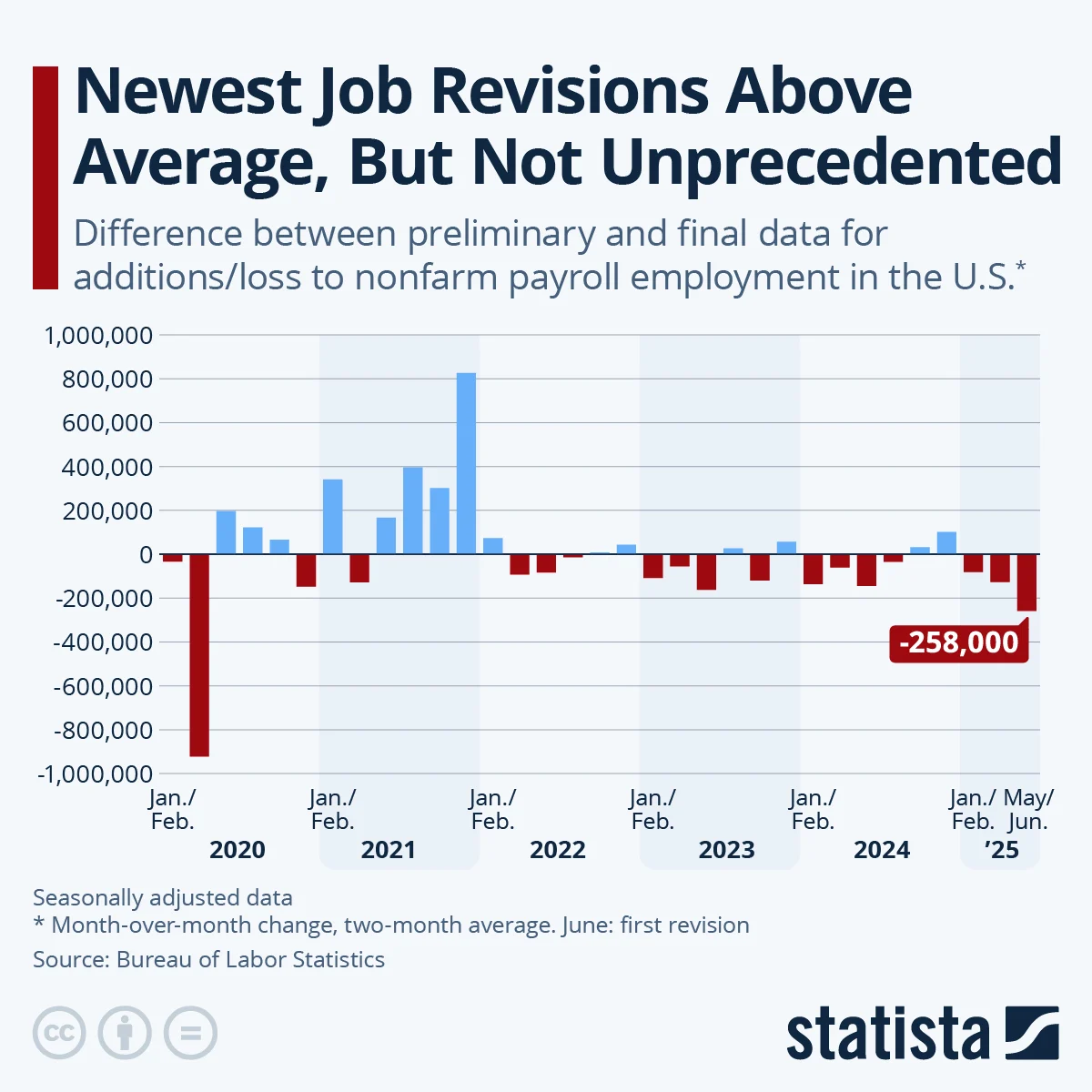
Source: Statista & BLS
The economy isn’t falling off a cliff, but economists are not feeling particularly hot about the news. The revisions point to a labor market that is losing altitude.
This new data adds to the pressure on the Fed to make a rate cut at its September meeting. Inflation is relatively tame (for now), the labor market is slowing, and GDP, while strong at first glance, is showing cracks beneath the surface. Economic growth came in at 3.0% for Q2, a sharp rebound from the -0.5% contraction in Q1; much of that jump was fueled by a steep drop in imports, which artificially boosted the figure. When you strip out trade and inventory distortions, real final sales to domestic purchasers — a more accurate gauge of consumer and business demand — grew just 1.2%, the slowest pace since 2022.
That’s the kind of detail Fed officials are watching closely, and is what Powell meant when he emphasized “downside risks” to the labor market six separate times in his July press conference.
The Fed still has another jobs report and two rounds of inflation data to review before its next meeting. But unless the economy throws a curveball, the runway for cuts is finally starting to clear.
Want more insights like this delivered to your inbox? Sign up for our newsletter below ⬇️
Answers to your questions
Yes. Origin offers partner access so you can manage your finances together at no additional cost. You’ll be able to filter transactions by member—making it easy to see which spending is yours and which belongs to your partner.

Yes. You can edit existing transactions and add new ones directly in Origin, so your records stay accurate and personalized.
Origin connects securely through trusted partners including Plaid, MX, and Mastercard.
Yes. Origin supports CSV uploads. You can upload a .csv file of your transactions, and we’ll import them into your account.
Yes. Your data is protected with bank-level security and advanced encryption. When you connect accounts through Origin, your login credentials are never shared with us. Instead, our partners generate secure tokens that let Origin access only the data you authorize—keeping your personal information private while enabling personalized insights.
Yes. You have full control to organize your spending in Origin. Transactions are automatically categorized by Origin, but you can always edit categories, add your own tags, and filter transactions however you like—so your spending reflects the way you actually manage money.