


Higher for even longer


Back in 2022, inflation was supposed to be “transitory,” remember? Yeah, the good old days. Or maybe just the old days. Four years, several interest-rate hikes, and approximately 10,000 Federal Reserve speeches later, the American economy is still trying to get this thing under control.
And after last week's economic reports, the prospect of cheaper borrowing in 2027 is looking increasingly remote.
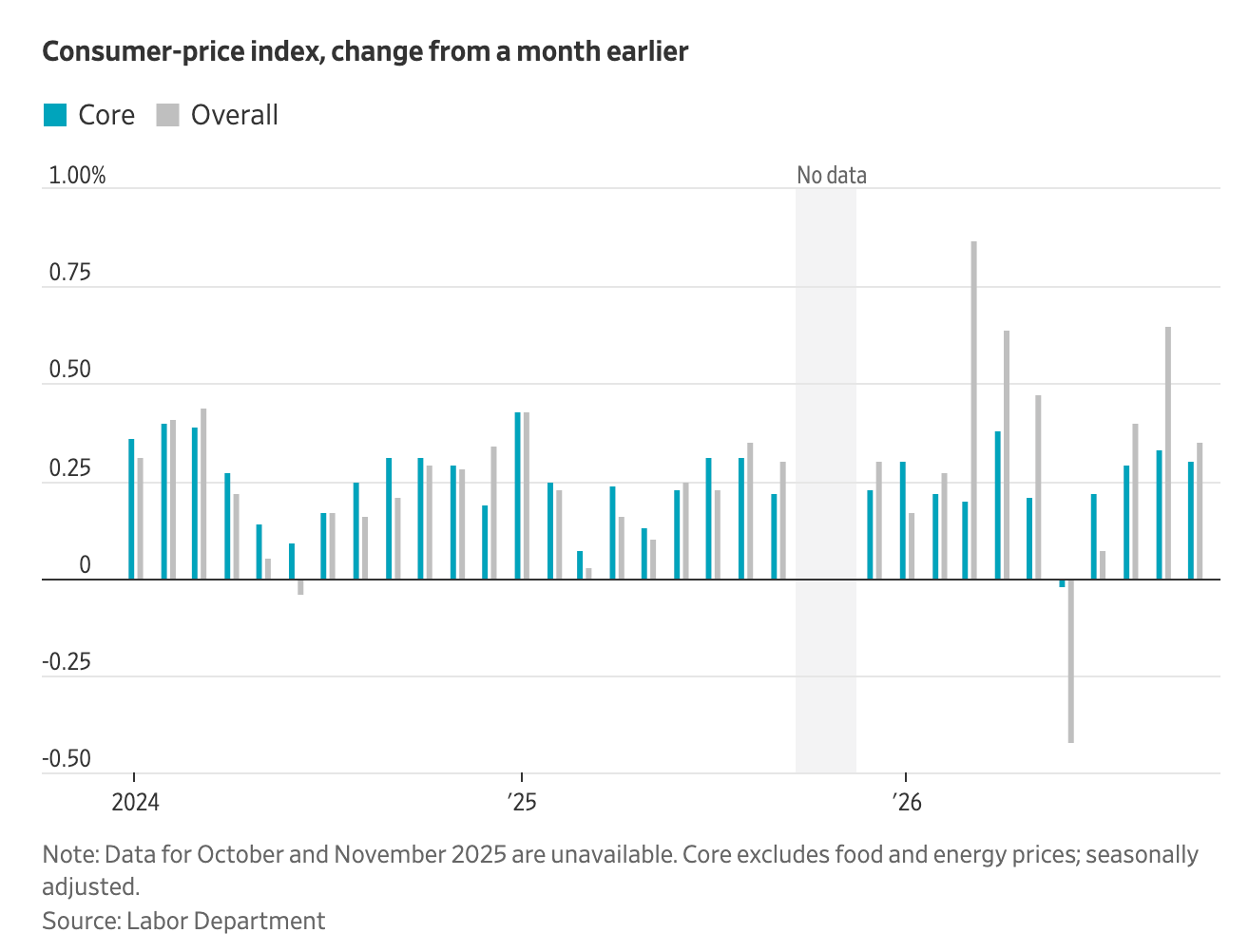
Last Tuesday's Consumer Price Index report delivered the first disappointment. Consumer prices rose 0.4% in October, exceeding expectations of 0.3%, while core inflation, which excludes food and energy, increased another 0.3%. Over the past three months, core prices have risen at a 3.7% annualized pace. That's considerably faster than the Fed's 2% inflation target, and a rather inconvenient development for anyone hoping the central bank was approaching the end of its tightening campaign.
Visual source: BLS
Worse, inflation is becoming increasingly difficult to blame on a handful of volatile categories like fuel and energy, because eventually, higher energy prices trickle into higher everything else prices.
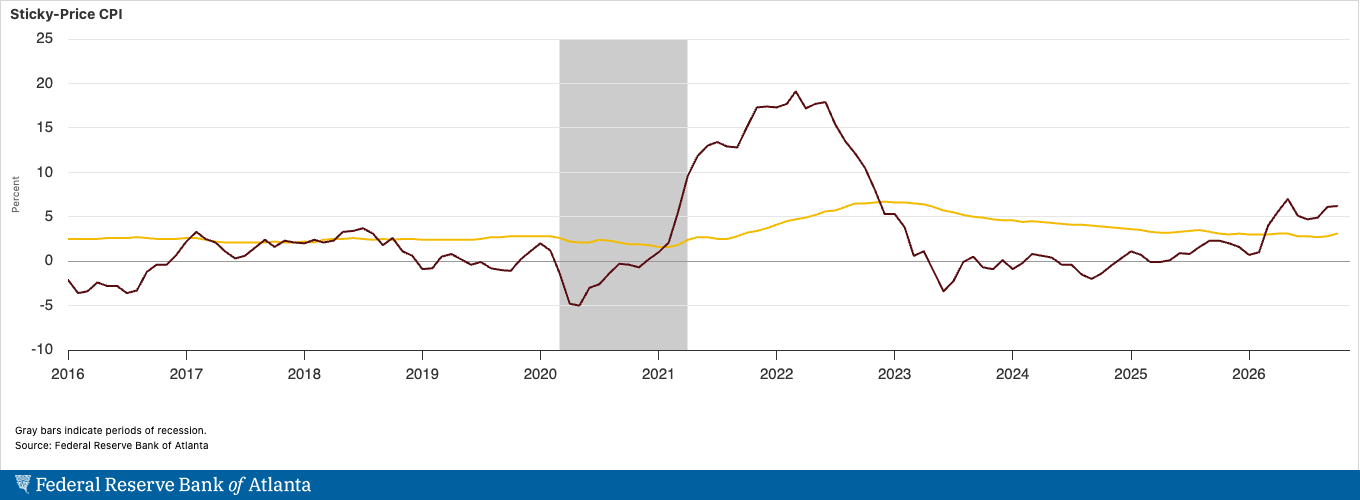
The Cleveland Fed's trimmed-mean CPI, which strips out unusually large price swings, increased 0.4% in October, its biggest monthly gain since May. Meanwhile, the Atlanta Fed's sticky-price CPI, which tracks prices that typically change infrequently, accelerated to a 4.7% annualized monthly pace, its fastest since February 2025.
Visual source: Atlanta Fed
And according to Schwab's Kevin Gordon, more than three-quarters of the CPI basket experienced price increases exceeding 2% annualized in October, the broadest such reading since August 2022.
In other words, inflation has decided to diversify its portfolio.
Friday's producer inflation report wasn't much more reassuring. Wholesale prices rose 0.3% in October, a substantial improvement from September's 1.4% surge. Unfortunately, annual producer inflation still accelerated to 6.5%, its highest since November 2022, while core producer prices were up 5% from a year earlier. Again, relevant. The retailer pays more = the consumer pays more.
The AI hyperscale cycle has created (and destroyed) a lot of wealth in the stock market, but it’s also contributing to inflation. Surging demand for data centers has helped push up prices for electronic components and industrial chemicals, adding another source of pressure to an economy already grappling with higher energy and transportation costs.
And the Federal Reserve has noticed. With October's inflation figures exceeding expectations, markets have effectively priced in another interest-rate hike at the Fed's December meeting as a foregone conclusion. A quarter-point increase remains the favored outcome, although some policymakers have entertained the possibility of a larger half-point move. The outcome is penciled in; the only question is whether the Fed will take a two-stairs-at-a-time pace or not.
That would mean another round of higher borrowing costs for consumers and businesses, even as the economy continues to show signs of resilience. October's surprisingly strong employment report, for example, revealed 165,000 new jobs and a decline in unemployment to 4.1%. A healthier labor market is welcome news for workers, but it also gives the Fed more room to keep monetary policy restrictive while it wrestles with inflation.
Regardless of what the Fed does, the bond market isn't waiting around for permission to increase borrowing costs.
The benchmark 10-year Treasury yield climbed from approximately 4.86% to 5.15% in a single week, one of the sharpest selloffs in government bonds in more than a year. Since Treasury yields influence mortgage rates, corporate borrowing costs, and other longer-term financing expenses, that increase has consequences well beyond Wall Street.
Not precisely related, but very relevant: Tech companies also sell their own bonds, and they’re offering much higher yields than the U.S. government does. This increases demand for higher yields on those U.S. bonds, which not only pushes up borrowing costs for the government (which, yes, is already a massive problem — and yes, also contributes to inflation), but also influences how much you and I have to pay to borrow money. Effectively: Washington's enormous deficits and mounting interest expenses mean the Treasury must continually attract buyers for a growing mountain of government debt. At the same time, corporations are raising capital to finance an unprecedented AI infrastructure expansion (which, eagerly awaits to see how these midterm elections impact it).
Investors have plenty of opportunities to put their money to work, and they're demanding increasingly attractive returns to lend it. For prospective homebuyers, that means mortgage rates could remain stubbornly elevated even after inflation eventually cools. Businesses refinancing debt face a similar predicament, while consumers carrying variable-rate debt may see little relief until the Fed actually reverses course.
Savers, at least, have something to celebrate: Higher rates can translate into better yields on savings accounts, money market funds, and newly purchased bonds. Assuming, of course, inflation doesn't devour the proceeds.
So, where does that leave us heading into 2027?
The economy is still growing, businesses are hiring, and productivity has improved. Under normal circumstances, that's a pretty decent collection of economic headlines. Unfortunately, inflation has proved remarkably resilient, the Fed is preparing to tighten further, and bond investors are already demanding more compensation for lending money.
After years of waiting for interest rates to come back down, Americans may need to confront a rather irritating possibility: Higher for longer is becoming higher for even longer.
Answers to your questions
Yes. Origin offers partner access so you can manage your finances together at no additional cost. You’ll be able to filter transactions by member—making it easy to see which spending is yours and which belongs to your partner.

Yes. You can edit existing transactions and add new ones directly in Origin, so your records stay accurate and personalized.
Origin connects securely through trusted partners including Plaid, MX, and Mastercard.
Yes. Origin supports CSV uploads. You can upload a .csv file of your transactions, and we’ll import them into your account.
Yes. Your data is protected with bank-level security and advanced encryption. When you connect accounts through Origin, your login credentials are never shared with us. Instead, our partners generate secure tokens that let Origin access only the data you authorize—keeping your personal information private while enabling personalized insights.
Yes. You have full control to organize your spending in Origin. Transactions are automatically categorized by Origin, but you can always edit categories, add your own tags, and filter transactions however you like—so your spending reflects the way you actually manage money.