


Good news is bad news | The labor market might be stronger than we thought


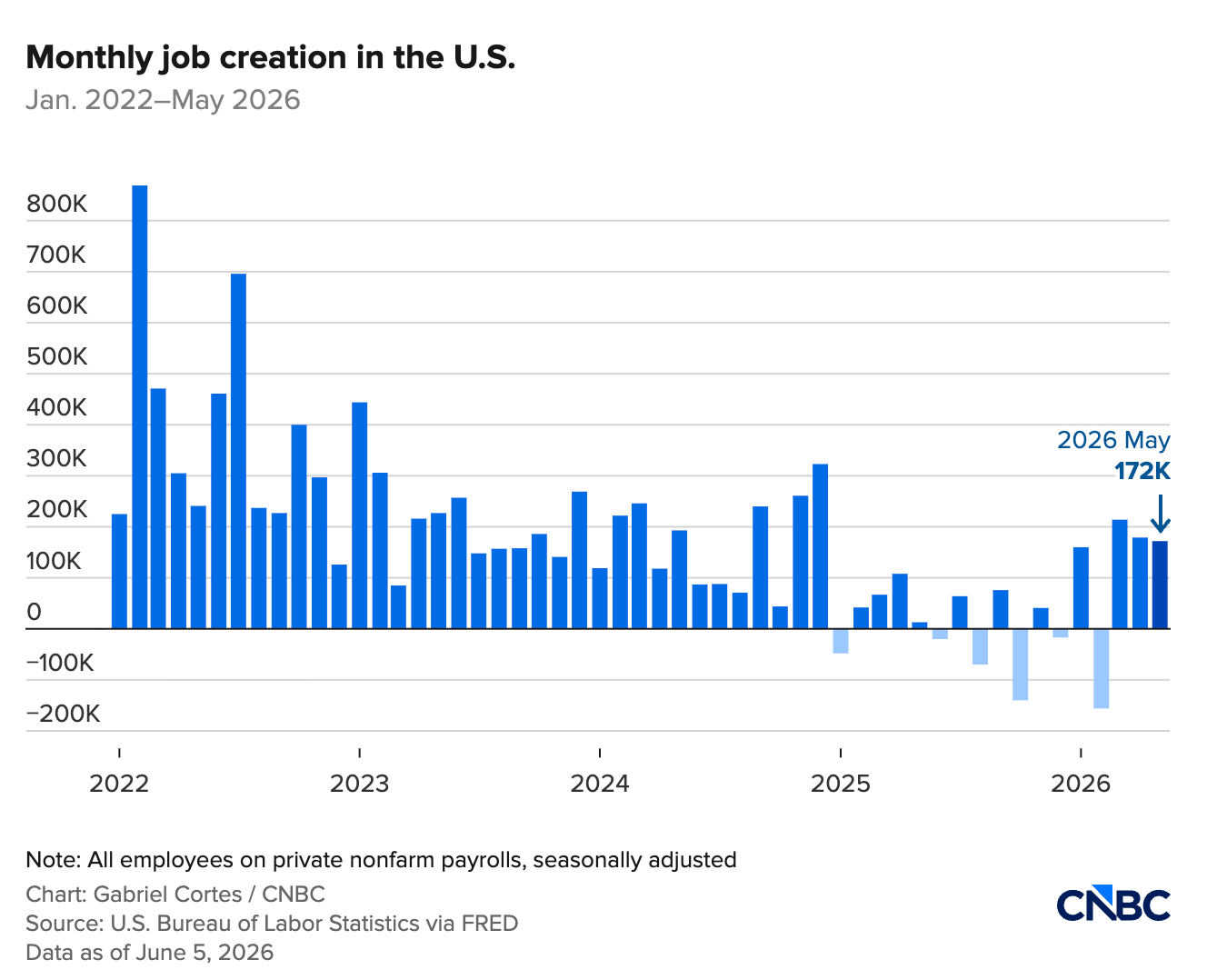
You would think a positive jobs report would be a good thing, but in this weird modern economy we’re in — it wasn’t interpreted that way. Friday’s data shows: The U.S. economy added 172,000 jobs in May — that’s more than double the 80,000 economists expected. Now, they’re not exactly known for being on the money with this forecast, but double is meaningful.
And to elucidate further just how “good” this report was: April’s data was also revised upward from 115,000 to 179,000, and March from 185,000 to 214,000 — adding 93,000 jobs to the prior two months combined. That bucks an earlier trend of consistent downward revisions that raised questions about government data late last year, and it brings the monthly average of payroll gains over the past 3 months to 188,000, which is more historically aligned with the American economy’s growth rate.
Source: CNBC
What’s also noteworthy is that, prior to this report, healthcare had been driving the job market, but this one broke that trend. Leisure and hospitality led with 70,000 jobs — about five times its average monthly pace of 14,000 over the prior year, with food services and drinking places accounting for 48,000 of that alone. Local government added 55,000. Healthcare, which has been carrying the labor market for most of 2026, added 35,000 — right in line with its average monthly gain of 38,000. So healthcare did its usual thing. Bars and restaurants did something unusual. The lead changed hands.
On the flip side, wages aren’t keeping up with inflation. Average hourly earnings grew 3.4% over the past year — decelerating from April's 3.6% — against PCE inflation of 3.8%. Secondary May data adds a granular layer: Salaried workers saw pay grow 2.9%, while hourly workers saw pay grow 1.7%. Gas is up 42% since the war started. The math on what hourly workers can afford right now isn't complicated.
Circling back: You would think this report is mostly good news, and in some ways, it is. But for investors, it signaled something else — a strong labor market doesn’t help the case for rate cuts whatsoever. Tack that onto the fact that inflation has already ticked up this year due to energy prices, and now we’ve got a situation where the new Fed chair might actually have to consider a hike, which is already getting murmurings. Markets did not like that, and Friday’s bloodbath reflected it. Kevin Warsh walks into his first FOMC meeting on June 16th with PCE at 3.8%, job openings at a two-year high, manufacturing at a four-year high, and now a jobs report that doubled consensus. There is no data point in this week's releases — not one — that gives him cover to signal rate cuts.
What it means in practice: Credit card APRs remain at record highs, mortgage rates remain elevated, bonds sell off, the average gas price is $4.22 per gallon — up 42% since the war began — and the savings rate hit 2.6% in April, the lowest in over a year.
The jobs report was strong. The economy is adding jobs. The jobs being added are mostly lower-wage service work. The wages on those jobs aren't keeping up with inflation. The people working them are financing the gap on credit cards at 24.5%. The number went up. The math didn't change.
Answers to your questions
Yes. Origin offers partner access so you can manage your finances together at no additional cost. You’ll be able to filter transactions by member—making it easy to see which spending is yours and which belongs to your partner.

Yes. You can edit existing transactions and add new ones directly in Origin, so your records stay accurate and personalized.
Origin connects securely through trusted partners including Plaid, MX, and Mastercard.
Yes. Origin supports CSV uploads. You can upload a .csv file of your transactions, and we’ll import them into your account.
Yes. Your data is protected with bank-level security and advanced encryption. When you connect accounts through Origin, your login credentials are never shared with us. Instead, our partners generate secure tokens that let Origin access only the data you authorize—keeping your personal information private while enabling personalized insights.
Yes. You have full control to organize your spending in Origin. Transactions are automatically categorized by Origin, but you can always edit categories, add your own tags, and filter transactions however you like—so your spending reflects the way you actually manage money.