


Gen Z might have a savings problem


If you're a fan of the "kids spend too much money on avocado toast" cliché, we've got some data for you — not necessarily to vindicate that narrative, but to contextualize it.
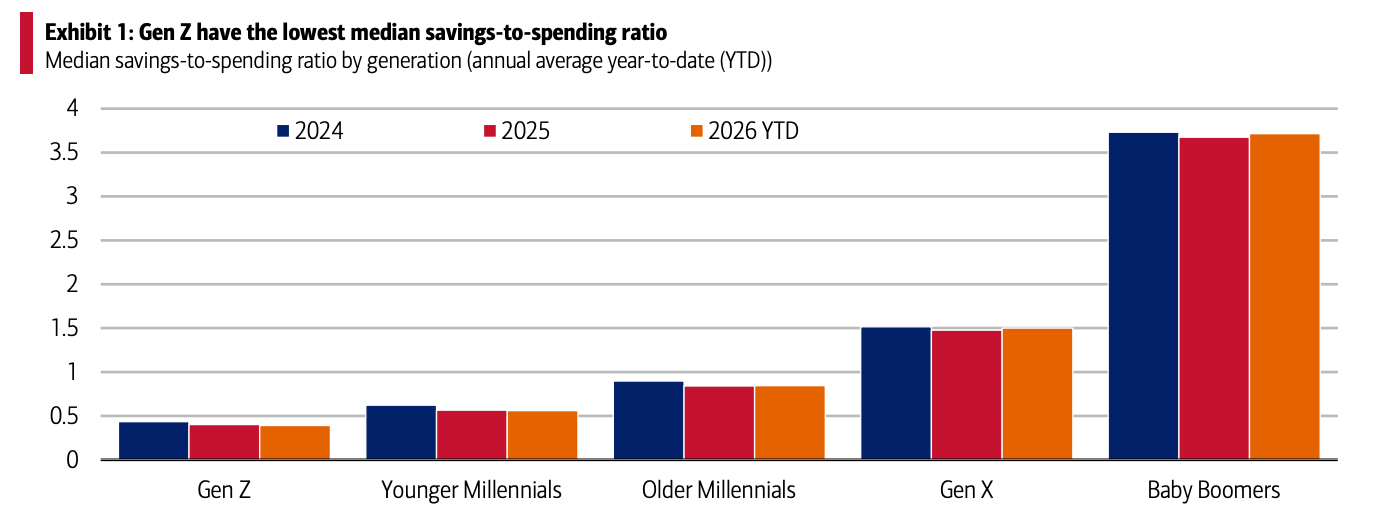
Gen Z has the lowest savings-to-spending ratio of any generation — sitting just below 0.5%. To be precise about what that actually measures: It's their median account balance divided by their median monthly spending — so this is a cushion metric, not a savings-rate metric. A ratio under 0.5 effectively means that the money sitting in their account, if all spending stopped today, would run out in under two weeks.
This isn't the same breed as the personal savings rate the BEA reports monthly, which measures what percentage of this month's income you set aside versus spent. Gen Z could theoretically be diligent monthly savers and still show a thin ratio here — simply because they're young and haven't had years to accumulate a balance yet. Someone saving 8% of their paycheck for 8 months has a much smaller cushion than someone saving the same rate for 8 years. The data doesn't actually distinguish "bad savers" from "new savers." Keep that in mind for everything below.
Source: BofA
That said, the spending side of this doesn't look like a generation being cautious. Discretionary spending has climbed steadily since March 2025, and — breaking the usual pattern — it's climbing evenly across income levels. The gap between high- and low-income Gen Z spending growth is the smallest of any generation. As a result, it’s relatively safe to say that this isn't just wealthy 24-year-olds treating themselves; everyone's spending like this, rich or not.
So…what exactly are they splurging on? Well, Jewelry spending is up almost 11% year-over-year. Beauty and clothing are both nearly matching overall retail growth. And it's not that Gen Z is buying more beauty products more often — it’s that spending per transaction at cosmetics stores grew almost four times faster than the number of transactions itself. They're not shopping more, but they are "treating up" when they do.
BofA calls this the "little treat economy," and 92% of Gen Z respondents say they treat themselves regularly, unchanged from last year.
Travel got the same treatment. Gen Z travel spending rose 8.5% YoY through June, outpacing every other generation's 7% — even as hotel transaction counts stayed flat.
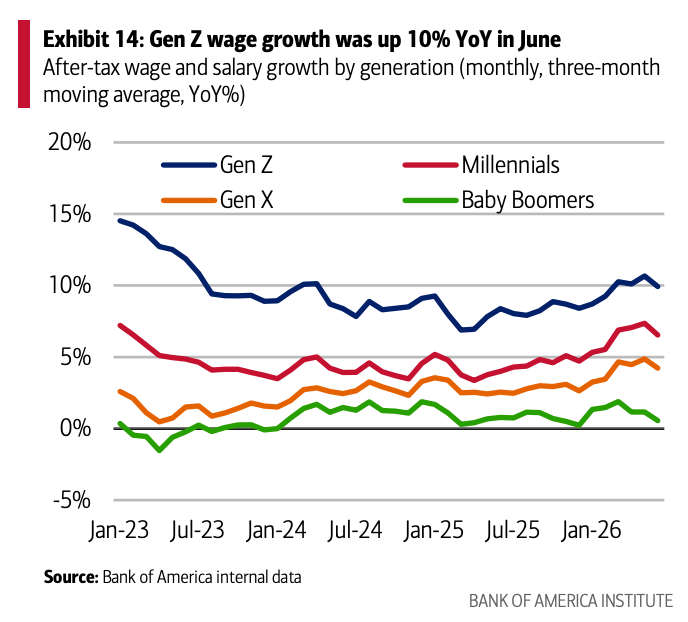
So how are they funding all this while barely holding a buffer? While it is simultaneously true that the unemployment rate amongst recent graduates has been higher recently, those that are working are seeing rewards. Gen Z wage growth recently hit 10% YoY, blowing past every older generation, largely because a lot of them are landing first paychecks.
But also, gig work: The share of Gen Z gig workers has grown faster than any other generation, even as that growth cools from 2025's pace. And a genuinely interesting wrinkle — nearly 40% of that gig income comes specifically from social commerce (think Depop, Poshmark), more than double what comes from delivery gigs. Content creation, despite the "everyone's an influencer" stereotype, accounts for just 5%.
Source: BofA
There are some other complicating factors as well, making it impossible to slap any surefire judgments onto the cohort. On the one hand, nearly a third of Gen Z still leans on family financial support (51% for ages 18-22, dropping to 18% by ages 26-29), and simultaneously, Gen Zers have begun saving for retirement much earlier than the generations that preceded them. This confluence of data points to the most honest conclusion for almost every financial news story: The truth is highly dependent upon the local circumstances. Everyone’s situation is different; you may have some 27-year-olds getting support from their parents, and some doing extremely well for themselves, saving for retirement, etc. There is no one singular synopsis; such is life.
The generous read: Gen Z isn't reckless; they're early — still building a cushion, propped up partially by family support, and rationally prioritizing experiences while they're young with fewer fixed obligations. The less generous read: a thin buffer funded partly by gig income and family transfers isn't exactly a fortress balance sheet heading into whatever the labor market throws at them next.
All of the above can be true. That's usually how it goes with this generation and everyone's takes on it.
Answers to your questions
Yes. Origin offers partner access so you can manage your finances together at no additional cost. You’ll be able to filter transactions by member—making it easy to see which spending is yours and which belongs to your partner.

Yes. You can edit existing transactions and add new ones directly in Origin, so your records stay accurate and personalized.
Origin connects securely through trusted partners including Plaid, MX, and Mastercard.
Yes. Origin supports CSV uploads. You can upload a .csv file of your transactions, and we’ll import them into your account.
Yes. Your data is protected with bank-level security and advanced encryption. When you connect accounts through Origin, your login credentials are never shared with us. Instead, our partners generate secure tokens that let Origin access only the data you authorize—keeping your personal information private while enabling personalized insights.
Yes. You have full control to organize your spending in Origin. Transactions are automatically categorized by Origin, but you can always edit categories, add your own tags, and filter transactions however you like—so your spending reflects the way you actually manage money.