


Foreign investors are buying more American stocks than ever before


Despite concerns about America's debt, expensive stocks, and the possibility that the AI boom is getting a little ahead of itself, foreign investors have apparently reached a different conclusion: Buy more America. A lot more.
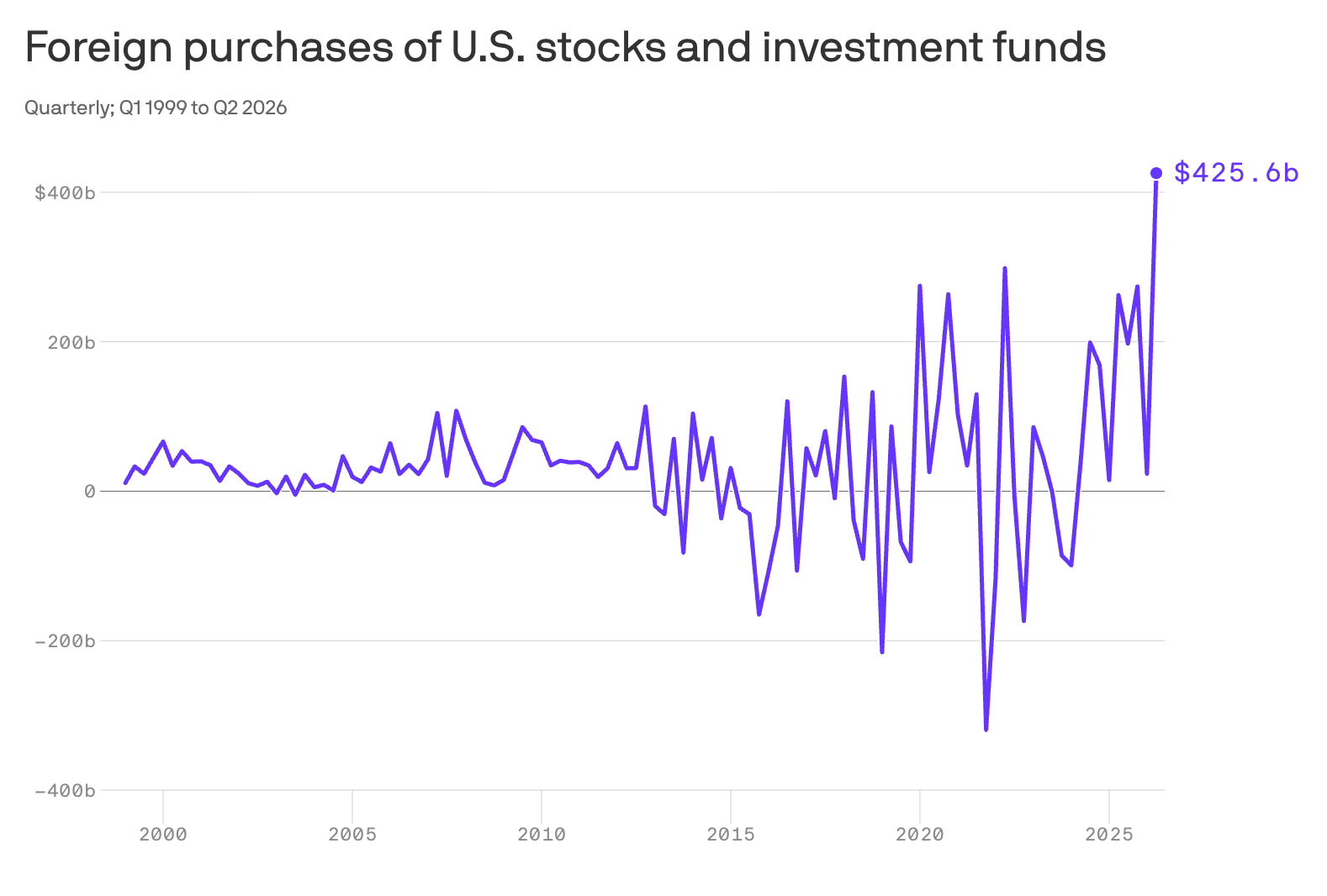
And the underlying trend holds even in the aftermath of late October’s shakiness — the fund flows don’t lie when you zoom out. Foreign investors purchased a record $426 billion in U.S. stocks and investment fund shares during the second quarter of 2026, according to BEA data (Q3 data will arrive in December).
Visual: Axios
That's more than 40% of the nearly $1 trillion in total foreign capital flowing into the country during the quarter. And the enthusiasm extends well beyond one particularly enthusiastic three-month stretch.
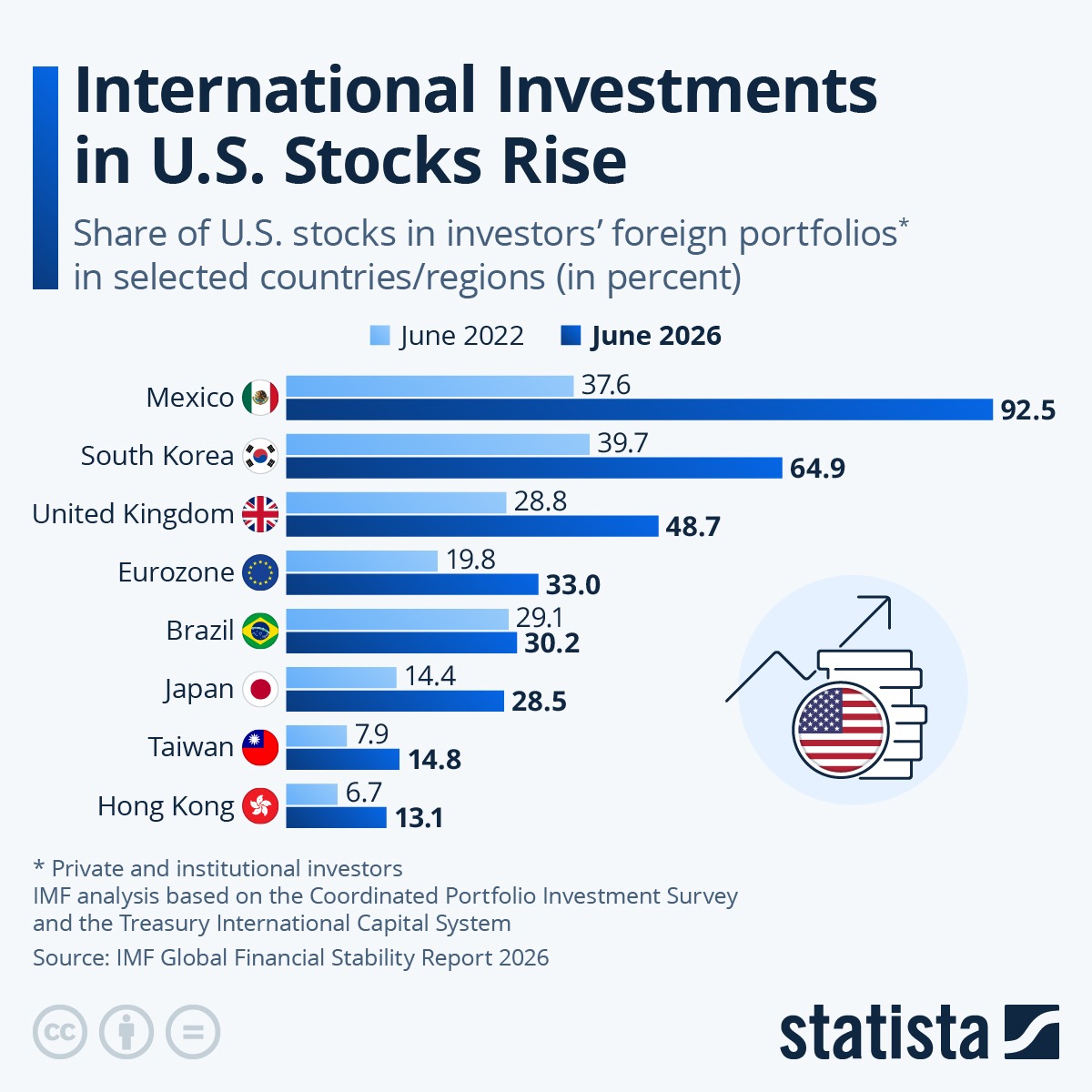
And according to an IMF analysis, investors in all eight economies examined increased the share of their foreign portfolios allocated to U.S. equities between June 2022 and June 2026. In Mexico, that share climbed from 37.6% to an extraordinary 92.5%. South Korea reached 64.9%, while the United Kingdom approached 49%. Apparently, international diversification increasingly means buying American stocks from abroad.
Source: Statista
This is particularly interesting given what's happening on the other side of the American financial system.
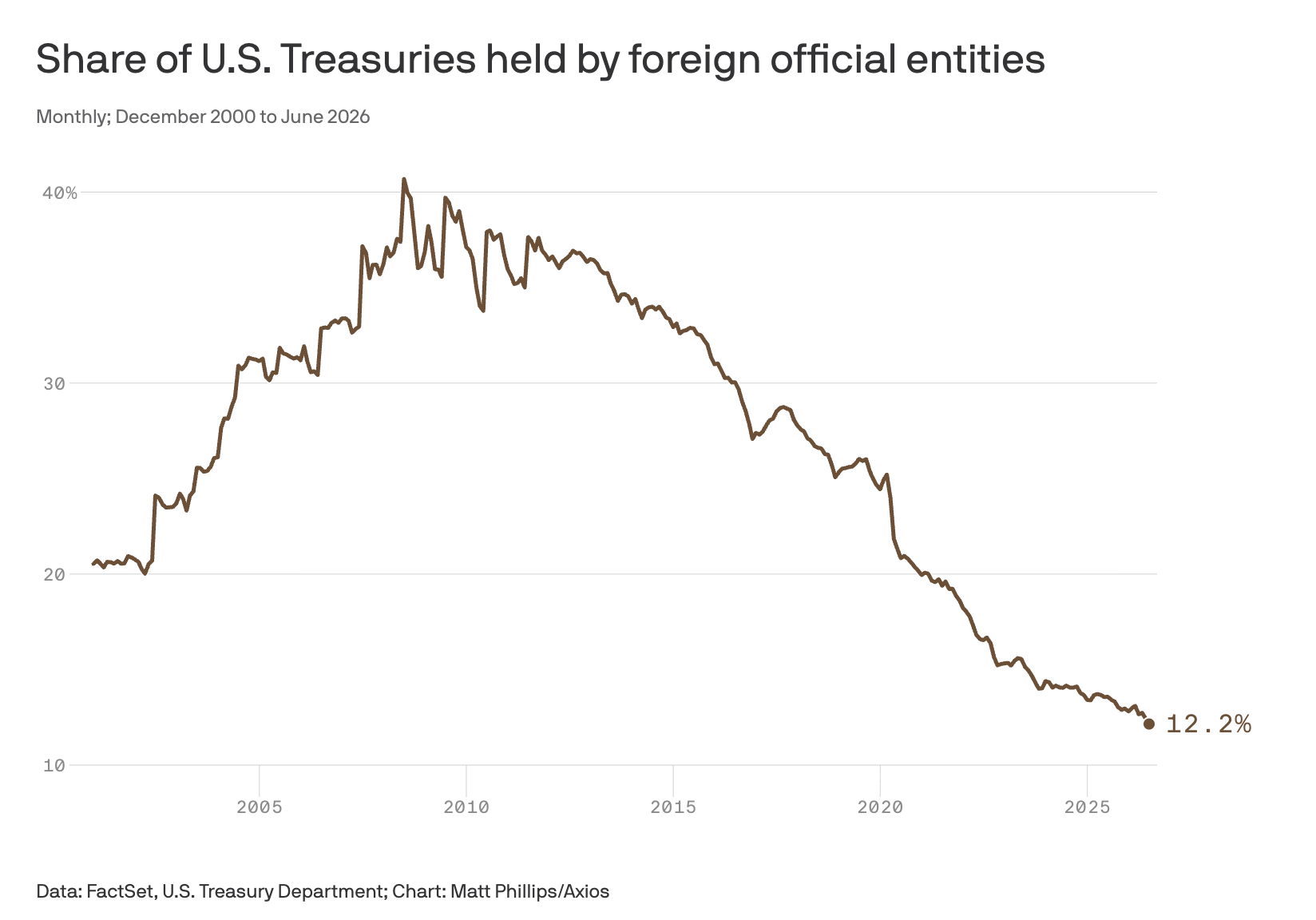
As we've discussed in previous editions, the U.S. has accumulated more than $40 trillion in federal debt, roughly 125% of GDP, with interest expenses running around $3.8 billion daily. Meanwhile, foreign official institutions — historically among the most reliable buyers of American government bonds — now hold only about 12% of Treasuries, down from roughly 40% around the financial crisis. They're not necessarily dumping their holdings; America's borrowing has simply grown much faster than their appetite.
Private investors are making an interesting choice, too. Over the 12 months ending in June, foreign private investors purchased approximately $390 billion in American corporate bonds, compared with $329 billion in Treasury notes and bonds, according to Treasury data. The government is issuing an extraordinary amount of debt, while corporations — particularly those financing the AI buildout — are competing for some of the same capital with higher yields.
So, international investors are increasingly willing to own American businesses, even as some traditional buyers are becoming less enthusiastic about financing the American government. That's a rather fascinating distinction.
Source: Axios
Of course, the explanation has two letters: AI.
The United States is home to many of the companies developing the technology, manufacturing its most valuable components, and spending extraordinary sums building the infrastructure to support it. In our previous market analysis, we covered Goldman Sachs' projection of $765 billion in annual AI capital expenditures for 2026, potentially rising to $1.6 trillion by 2031. Venture capital has become similarly concentrated, with estimates suggesting AI companies have attracted nearly 90% of U.S. VC investment so far this year.
And there's a legitimate argument that this could be the beginning of a prolonged investment supercycle rather than its conclusion. Data centers, electricity generation, semiconductor manufacturing, networking infrastructure, and software all stand to benefit from years of continued spending. The companies supplying that infrastructure are already producing substantial earnings growth. This isn't an entirely hypothetical industry selling promises about what it might accomplish someday.
But the different methods we use to value this market are having a real philosophical argument here.
The Shiller CAPE ratio, for example, which compares stock prices with ten years of inflation-adjusted earnings, recently approached 41, against a long-run average near 17 and a dot-com peak around 44. Technology's concentration in the S&P 500 has also surpassed levels seen during the internet bubble. By several historical measures, investors are paying an extraordinary amount for American corporate earnings. This perspective is your bear case — but foreign investors (and most Americans) seem to be ignoring it in favor of the latter.
Because if you look forward instead of backward, the picture changes considerably. As we noted in our September valuation analysis, the S&P 500's forward P/E fell from about 23.1× to 20.1× even as stock prices rose, because expected earnings grew faster than prices. The index's PEG ratio — which compares valuation with projected earnings growth — had also fallen near historical lows. CAPE says investors are paying something resembling bubble prices; PEG suggests those prices could be remarkably reasonable if the earnings forecasts materialize.
The important word there is if.
That uncertainty is already causing problems in the bond market, particularly among companies financing their AI ambitions with enormous amounts of debt. Consider CoreWeave, the Nvidia-backed cloud-computing company whose borrowing costs have become something of an industry-wide warning light. Its bonds recently plunged in value, pushing yields above 15% as investors questioned whether the company's rapid expansion could generate enough cash to meet its obligations.
That selloff spilled into other AI-related investments earlier last month, creating yet another round of investors having an existential crisis over the AI buildout, and a market that’s been fighting itself all year to rally despite geopolitical unrest.
That doesn't mean CoreWeave's problems represent the entire AI industry. Microsoft and Alphabet have substantially different financial resources than smaller, heavily indebted infrastructure providers. Indeed, Barclays argues that investors are overreacting by treating one company's financing difficulties as evidence that the broader AI buildout is unraveling.
Nevertheless, there is a somewhat uncomfortable circularity developing. Investors are pouring money into American stocks because they expect AI to produce extraordinary future profits. Companies are spending extraordinary amounts to make those profits possible. Some are borrowing heavily to finance that spending, while higher interest rates make the economics progressively more demanding. Meanwhile, the U.S. government is competing for capital to finance its own deficits, and foreign investors are becoming increasingly exposed to the same American technology companies underpinning the whole arrangement.
The IMF has warned that this concentration creates financial risks beyond America's borders. Even countries whose domestic stock markets have relatively little direct exposure to AI could suffer if U.S. technology shares decline, simply because their investors now own so much of them.
And that may be the most interesting part of this entire story. The world is increasingly betting on American corporate growth at a moment when the American government's finances look increasingly difficult, stock valuations are historically stretched, and the technology attracting so much of that investment is still working to justify the scale of its ambitions.
There are perfectly rational reasons to be optimistic. There are also perfectly rational reasons to be concerned. The same earnings growth that makes today's valuations look reasonable could sustain the market for years; a slowdown could make those valuations look ridiculous remarkably quickly.
For now, foreign investors seem willing to make that bet. The question is whether they're buying into the next great American economic expansion, or whether the entire world is becoming increasingly exposed to the same very expensive expectations.
Answers to your questions
Yes. Origin offers partner access so you can manage your finances together at no additional cost. You’ll be able to filter transactions by member—making it easy to see which spending is yours and which belongs to your partner.

Yes. You can edit existing transactions and add new ones directly in Origin, so your records stay accurate and personalized.
Origin connects securely through trusted partners including Plaid, MX, and Mastercard.
Yes. Origin supports CSV uploads. You can upload a .csv file of your transactions, and we’ll import them into your account.
Yes. Your data is protected with bank-level security and advanced encryption. When you connect accounts through Origin, your login credentials are never shared with us. Instead, our partners generate secure tokens that let Origin access only the data you authorize—keeping your personal information private while enabling personalized insights.
Yes. You have full control to organize your spending in Origin. Transactions are automatically categorized by Origin, but you can always edit categories, add your own tags, and filter transactions however you like—so your spending reflects the way you actually manage money.