


Fed holds rates steady as expected — markets sell off anyway


Kevin Warsh's first FOMC meeting as Fed Chair went exactly as the data suggested it would: the Federal Funds Rate remained unchanged in the 3.50%-3.75% range, just like… well, basically the entire universe expected.
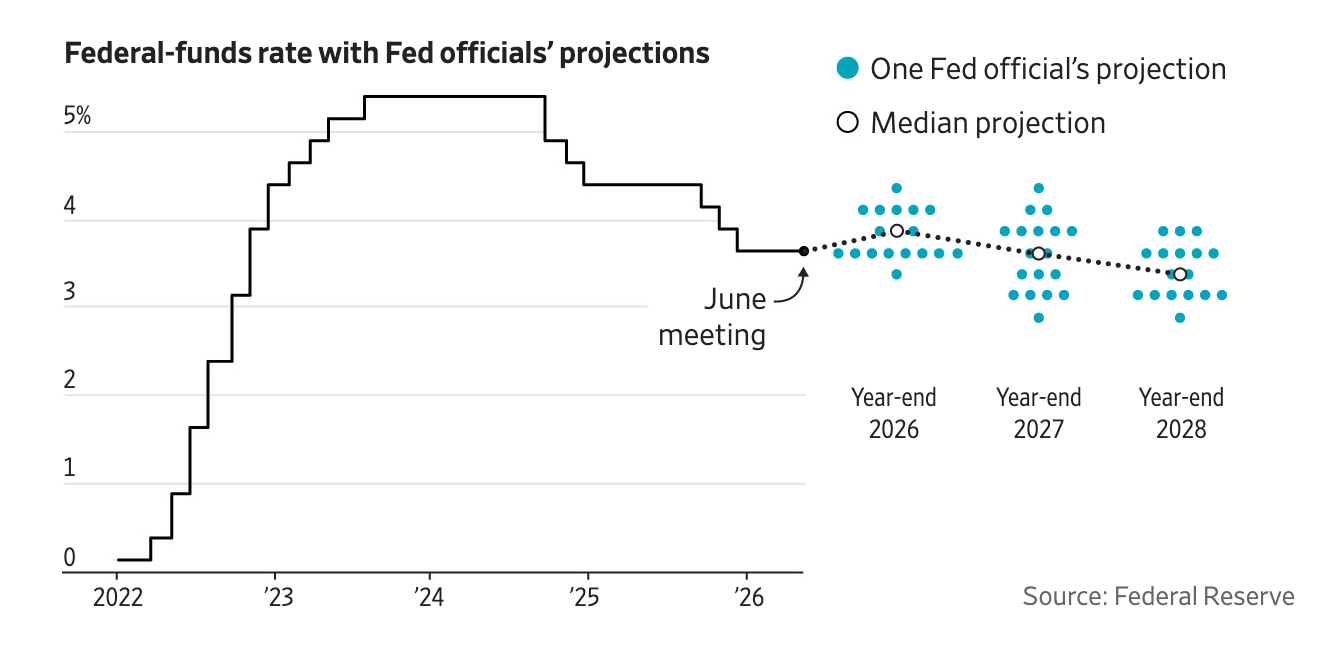
That part was never in question — futures markets had priced a hold at 97% odds for days and weeks, but markets sold off anyway. Why? Because what actually moved markets was buried inside the quarterly Summary of Economic Projections, the so-called dot plot, where each FOMC member anonymously submits where they think rates should land by year-end. The median year-end estimate jumped to 3.8%, up from 3.4% in March — meaning the committee, taken as a whole, now sees a hike as more likely than a cut before 2026 ends. Goldman Sachs' Kay Haigh put it plainly: "Despite the recent pullback in oil, half of the members of the FOMC expect rate hikes as soon as this year, reflecting strong labor market and inflation data." That's a full reversal from where the committee stood three months ago.
One unusual wrinkle: Warsh abstained from submitting his own dot, complicating the read on where he personally stands. This isn’t that surprising, actually. Warsh was quoted as saying last week that the Fed should “talk less, think more” and “if you’re not very good at something, you should do less of it” (forecasting), so…some analysts had speculated he'd do exactly this — submitting a hawkish projection risks public friction with the president who appointed him, while submitting a dovish one risks looking like he's bending to political pressure rather than data. Either way, the omission became its own kind of statement.
Source: WSJ
Treasury yields jumped on the news, and markets moved in the opposite direction, with the 2-year rising by 11 basis points to 4.16%. Claudia Sahm, chief economist at New Century Advisors, summed up the market's read: "The market reaction at this point is largely to the dot plot...being much more hawkish. The wind has changed a lot in terms of the inflation picture."
Stocks didn't love it. The S&P 500 and Nasdaq each fell about 1%, with major tech names — Microsoft, Meta, Alphabet, and Amazon — leading the slide. SpaceX, fresh off its blockbuster IPO, posted its first decline since going public. By the close, losses had eased somewhat as Warsh detailed plans for new internal task forces on Fed communications and the balance sheet, with the Dow and Nasdaq erasing earlier losses to trade roughly flat and the S&P down about 0.1%.
Arguably, the most quotable line of the day came when Warsh was pressed on the Fed's long-held “2%” inflation target. "That is the Federal Reserve's long-held objective of 2%," he said. "The 'two' is the left of the decimal point. For now, 'zero' is to the right." Translation, for anyone who missed the decimal joke: The second number there is ambiguous, inflation isn't anywhere close to target, and he's not interested in redefining success to pretend otherwise.
There's a real irony sitting underneath all of this: Trump pushed aggressively for Warsh specifically because he kind of expected him to deliver on cuts, but the data (nor the board of governors) hasn't cooperated — yet. A president who wanted a dove got a chair whose own committee just signaled a hike is now the base case — and who personally declined to say where he stands.
For anyone carrying a credit card or shopping for a mortgage, the practical read is unglamorous but important: a Fed that's signaling hikes rather than cuts means the relief on borrowing costs that seemed plausible earlier this year is, for now, off the table. The 30-year fixed mortgage rate sits at 6.52%, just shy of 2026's high. The brief easing in oil prices following Sunday's Iran agreement helped some, but it didn't change the committee's underlying read on inflation. Rates aren't going up today. They're also, by the Fed's own admission, not coming down anytime soon either.
Answers to your questions
Yes. Origin offers partner access so you can manage your finances together at no additional cost. You’ll be able to filter transactions by member—making it easy to see which spending is yours and which belongs to your partner.

Yes. You can edit existing transactions and add new ones directly in Origin, so your records stay accurate and personalized.
Origin connects securely through trusted partners including Plaid, MX, and Mastercard.
Yes. Origin supports CSV uploads. You can upload a .csv file of your transactions, and we’ll import them into your account.
Yes. Your data is protected with bank-level security and advanced encryption. When you connect accounts through Origin, your login credentials are never shared with us. Instead, our partners generate secure tokens that let Origin access only the data you authorize—keeping your personal information private while enabling personalized insights.
Yes. You have full control to organize your spending in Origin. Transactions are automatically categorized by Origin, but you can always edit categories, add your own tags, and filter transactions however you like—so your spending reflects the way you actually manage money.