


Demand for American Stocks Remains Stronger Than Ever.


US equity ETFs have pulled in roughly ~$880 billion in inflows year-to-date, including foreign buying. That already beats every full-year total on record except 2025 itself — and we're not even through Q3 yet. At the current pace, 2026 looks to finish north of $1.4 trillion, roughly $500 billion above last year's record of $920 billion.
These inflows also align with foreign investors shrinking their U.S. bond exposure: Foreigners now hold $24.5 trillion in U.S. equities against just $9.3 trillion in Treasuries — more than 2.6 times as much. The foreign share of publicly held federal debt has fallen from 49% in 2008 to roughly 30% today. And, on top of that, overall global equity exposure is at an all-time high. That aligns perfectly with this broader narrative here.
Investing is more popular than ever, and the world seems to think America is uniquely positioned to benefit from the current boom cycle. Investors would rather own the upside with downside risk than a fixed-rate return.
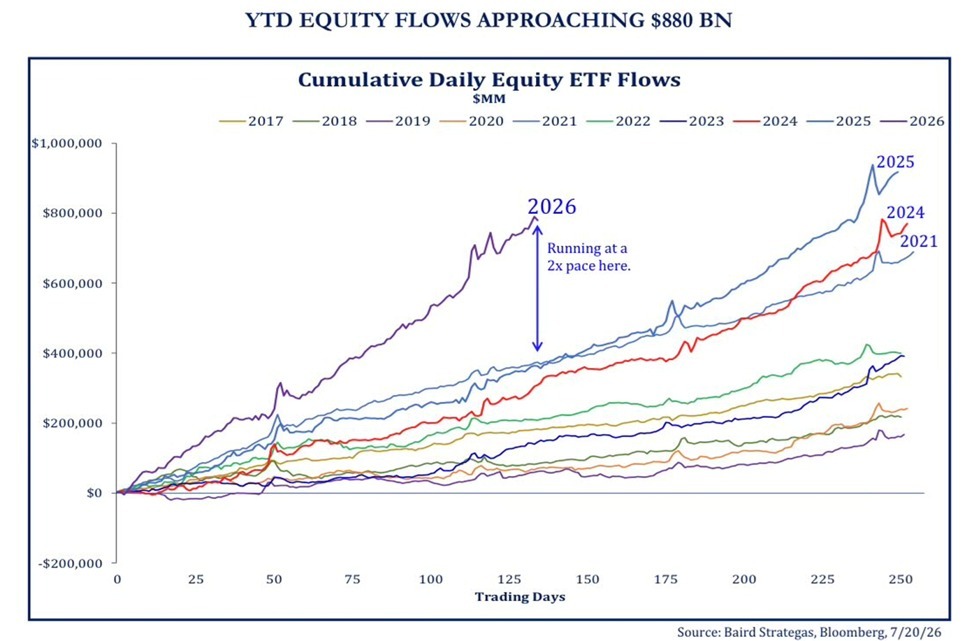
Current inflows are running more than twice the pace seen at this same point in both 2021 — which is highly relevant, because that was peak meme-stock mania — and 2025 (the prior record year). Whatever caution existed after those two runs, it evaporated.
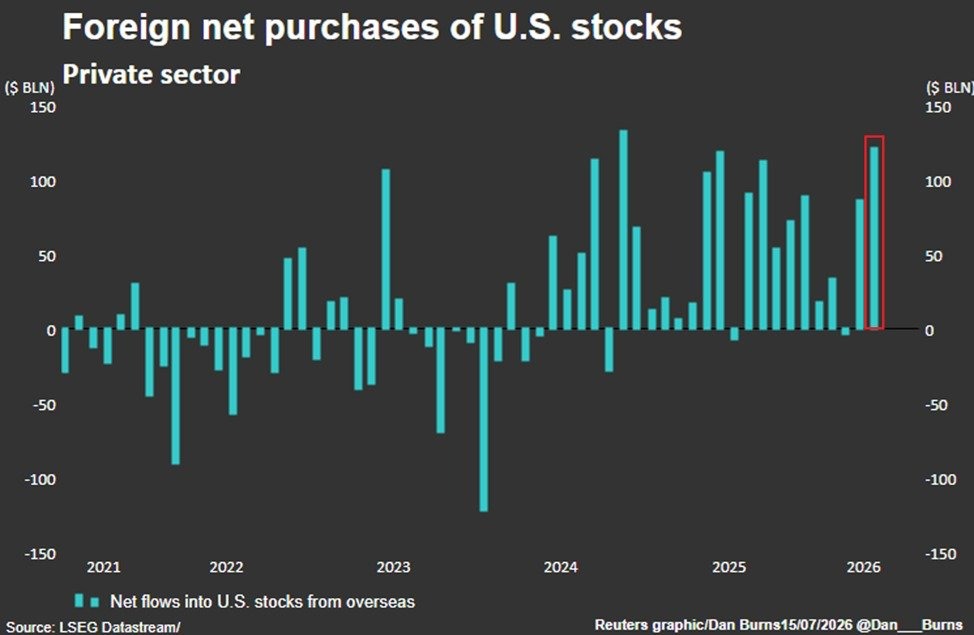
Foreign private investors bought a net $121 billion of U.S. stocks in May (broader than ETF flows, but limited to foreign private investors) — up $35.2 billion from April, and the second-largest monthly inflow ever recorded (this data lags ~two months). That's two consecutive months of acceleration. The all-time record was roughly $130 billion, set in November 2024. Year-to-date, foreign buyers have plowed roughly ~$270 billion into US equities.
Again, this data lags a couple of months — but it still indicates the absurd demand heading into the summer before July’s correction and our August rebound (so far).
During this summer’s pullback, anything exposed to AI suffered a big hit, including U.S. markets. Elsewhere, foreign investors dumped $31 billion and $28 billion of South Korean stocks in June and May, respectively — the two largest monthly outflows on record for that market. Taiwan wasn't spared either; foreign investors sold $18 billion of Taiwanese equities in June, the second-largest sale ever. Selling continued in July, as global investors dumped roughly $30 billion of equities across those two AI-exposed markets.
We don’t have exact fund flows for August yet, but we can say for certain that both South Korea and Taiwan, and anything related to AI, have absolutely ripped back upward. This changes the narrative a little bit. It’s not just that investors have a hankering for U.S. stocks — it’s that anything AI-related demands exposure, and America happens to be the biggest horse in the race.
As a share of total US equity market cap, foreign purchases now represent about 1.3% — the highest level since the post-financial-crisis recovery in 2010. For comparison, the 2021 meme-stock frenzy — which felt, at the time, like the ceiling for retail and global exuberance — only reached 1.1%. We've already blown past that peak, and this time it's not retail day-traders. It's institutional foreign capital.
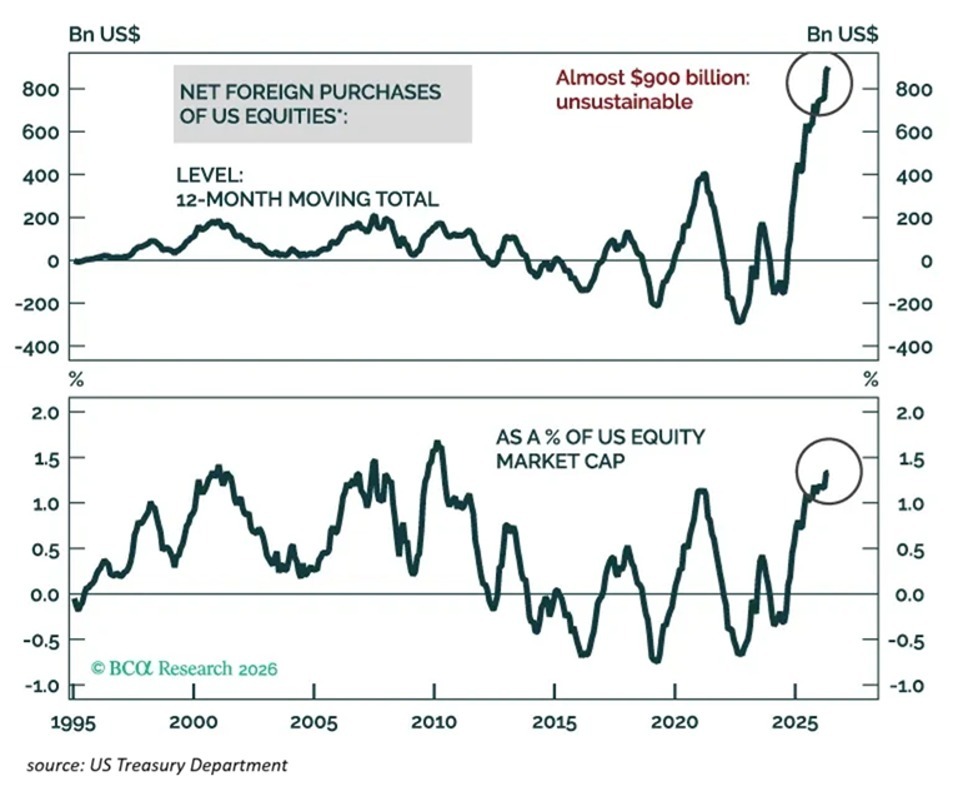
This data, as always, directs us back to the bubble conversation. Are American investors just enjoying another euphoric rally amidst what’s otherwise been a turbulent market with conflicting narratives? We’ve got some technical indicators flashing red — CAPE ratios, the Buffett Indicator, market concentration figures; there is plenty of bearish data to go around. On the other hand, the genuinely absurd profitability metrics this market is printing right now are wagging their finger in the bear’s face. This is a unique set-up that can’t be perfectly likened to 1999, 2008, or any other prime bubble territory, and how it plays out will likely be just as atypical.
Answers to your questions
Yes. Origin offers partner access so you can manage your finances together at no additional cost. You’ll be able to filter transactions by member—making it easy to see which spending is yours and which belongs to your partner.

Yes. You can edit existing transactions and add new ones directly in Origin, so your records stay accurate and personalized.
Origin connects securely through trusted partners including Plaid, MX, and Mastercard.
Yes. Origin supports CSV uploads. You can upload a .csv file of your transactions, and we’ll import them into your account.
Yes. Your data is protected with bank-level security and advanced encryption. When you connect accounts through Origin, your login credentials are never shared with us. Instead, our partners generate secure tokens that let Origin access only the data you authorize—keeping your personal information private while enabling personalized insights.
Yes. You have full control to organize your spending in Origin. Transactions are automatically categorized by Origin, but you can always edit categories, add your own tags, and filter transactions however you like—so your spending reflects the way you actually manage money.