


Could America be more productive with fewer workers?


Growth has always been the mandate in America. GDP, revenue, the stock market, jobs — for as long as anyone's been paying attention, the same rule applied to the labor market too: if job growth slowed too much, something was wrong. That rule might not apply the same way anymore.
The economy used to need well over 100,000 new jobs a month just to hold unemployment steady, but recently, that threshold has collapsed toward zero. May and June's reports came in at 63,000 and 20,000 after revisions. July subtracted 23,000 against an 80k+ expectation. And yet, unemployment sits at 4.1%, barely budging. The math genuinely works now — but only because the labor force itself has stopped growing the way it used to. Boomers are retiring, immigration has slowed, and fewer new workers are entering the pipeline. When the denominator stops growing, the numerator doesn't need to grow much either to keep the ratio stable.
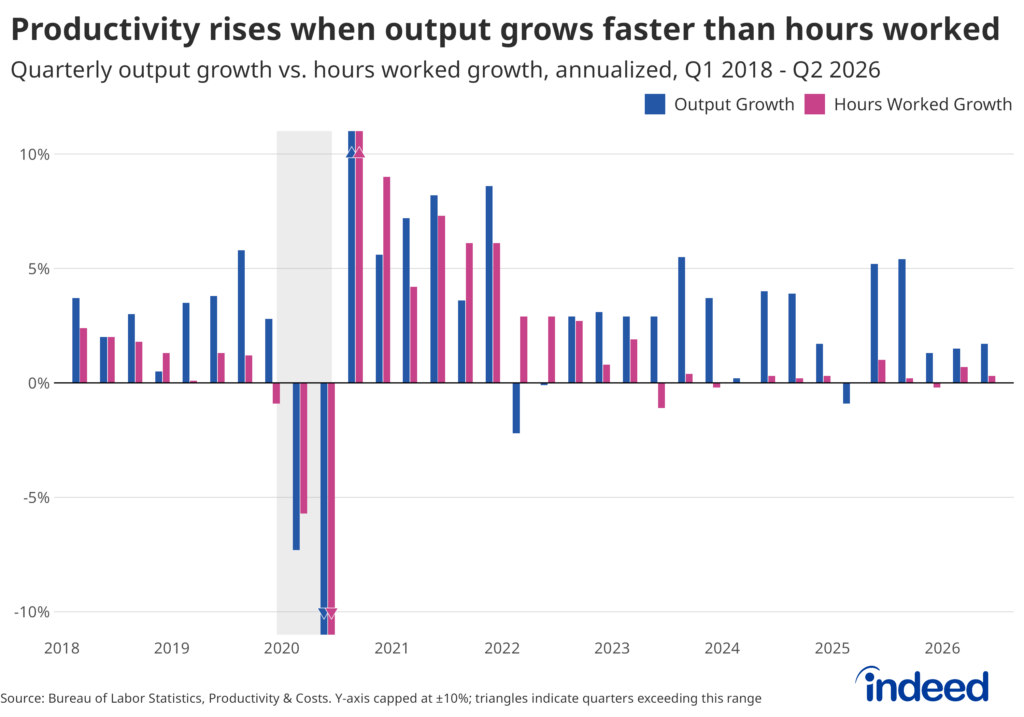
The productivity side of this equation is sorting itself out in real time. Some data points suggest yes, higher production with fewer people is possible, whereas others say hold on — this is evidenced cleanly by this year’s first two productivity prints. Q1 2026 nonfarm business productivity grew just 0.3% annualized — the smallest increase since Q1 2025, when it actually fell. If AI were cleanly substituting for hiring, you'd expect productivity climbing steadily while headcount growth stalled. Instead, the first quarter looked like neither side of the ledger was doing much.
Then Q2 data swooped in to vindicate that narrative again. Productivity jumped to 2.2% year-over-year, with output climbing 2.5% while hours worked grew just 0.2%. That's the "doing more with the same people" signal, finally showing up in the data — output growing more than twelve times faster than hours worked. One quarter of confirmation isn't a trend, but it's the first quarter this year where the math actually lines up with the thesis. We’ll need to monitor this metric for months to come and see how the entire year shakes out.
Source: Indeed
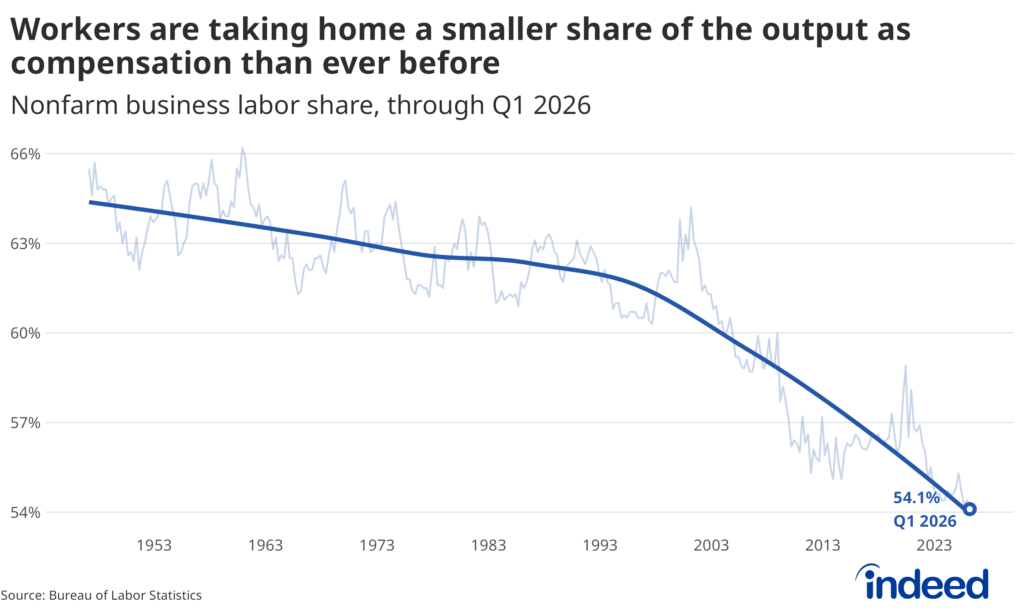
So it’s a maybe — for now. It’s quite possible that the future/modern economy will simply be a smaller share of a shrinking population doing exponential amounts of work. We will see. Meanwhile, labor's share of national income — the percentage of output that flows to workers as compensation, rather than to profits, dividends, or capital — fell to 54.1% in Q1 2026, the lowest reading since the series began in 1947. So even in the quarters where productivity is genuinely rising, workers aren't capturing a growing share of that gain. The output is real. Where it's going is a separate, less flattering question.
Source: Indeed
Economists surveyed by Indeed last month were still expecting unemployment to tick slightly upward this year, though. Their mean forecast had unemployment drifting to 4.29% in July — which they missed, as it actually fell to 4.1% — and 4.37% by December, with job postings continuing to decline through the rest of the year. And for the first time, a slim majority — 52% — now think AI will be at least a mild net drag on employment over the next twelve months, up from a more ambivalent split earlier this year. But the same panel is almost unanimous that AI's productivity effect will be real, just not transformative: 70% expect a modest-to-moderate boost, only 4% expect anything resembling the more breathless claims.
Academic research so far mostly backs the cautious read. Studies tracking AI-exposed occupations through 2024 and 2025 haven't found evidence of broad employment declines tied specifically to AI adoption — the visible effects show up as task reallocation and within-firm productivity gains, not mass layoffs. But that's a lagging picture. Separate corporate surveys already show large firms (500+ employees) increasingly anticipating AI-driven headcount reductions going forward, even as smaller firms still expect to add.
But the reality is that this isn’t just an AI equation; it’s also a population that’s due to start shrinking, aging, and ultimately having more retirees. Those two narratives feed one another, and could continue to give credence to this “fewer workers, more output” narrative over time.
Answers to your questions
Yes. Origin offers partner access so you can manage your finances together at no additional cost. You’ll be able to filter transactions by member—making it easy to see which spending is yours and which belongs to your partner.

Yes. You can edit existing transactions and add new ones directly in Origin, so your records stay accurate and personalized.
Origin connects securely through trusted partners including Plaid, MX, and Mastercard.
Yes. Origin supports CSV uploads. You can upload a .csv file of your transactions, and we’ll import them into your account.
Yes. Your data is protected with bank-level security and advanced encryption. When you connect accounts through Origin, your login credentials are never shared with us. Instead, our partners generate secure tokens that let Origin access only the data you authorize—keeping your personal information private while enabling personalized insights.
Yes. You have full control to organize your spending in Origin. Transactions are automatically categorized by Origin, but you can always edit categories, add your own tags, and filter transactions however you like—so your spending reflects the way you actually manage money.