


An economic holding pattern


The U.S. economy grew at an annualized rate of 1.5% during the second quarter, according to the Bureau of Economic Analysis’ second estimate released Wednesday, unchanged from its initial estimate and down from 2.1% during the first three months of the year. Taken at face value, that looks like a fairly straightforward slowdown — and technically it is low; below ideal targets, especially when you consider America’s need to “grow its way out” of the national debt problem.
But, unfortunately, the economy has once again declined to be straightforward.
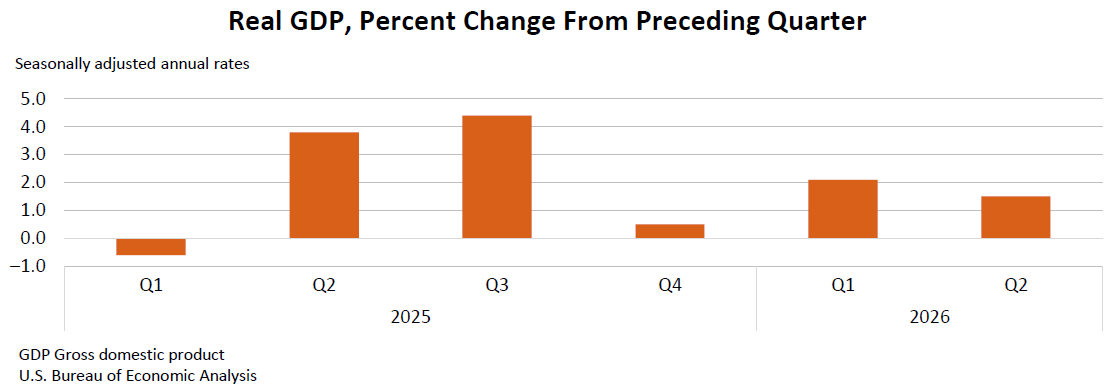
Source: BEA
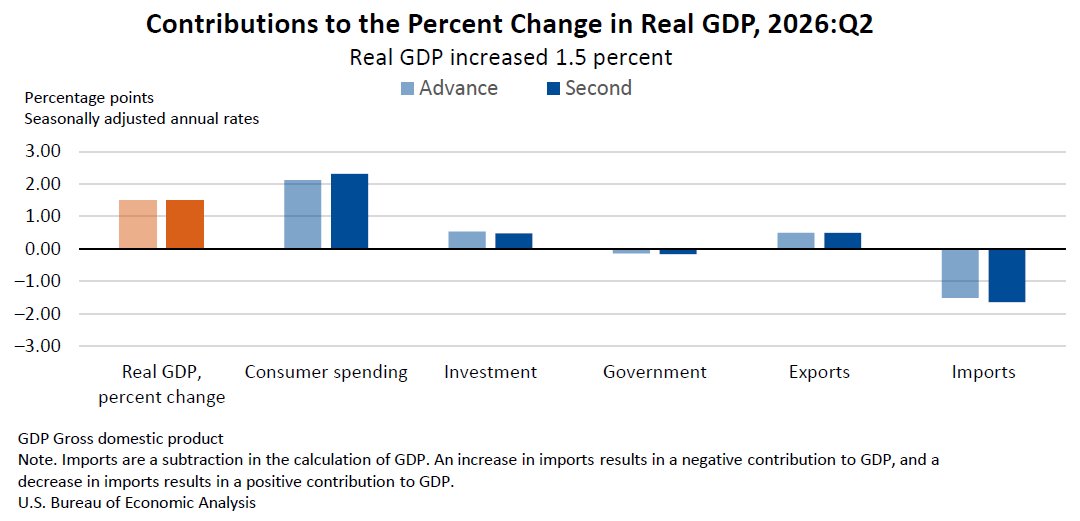
The composition of that GDP estimate was considerably stronger than the headline suggests. Consumer spending, exports and private investment all increased during the quarter, while government spending fell and imports rose, which mathematically subtracts from GDP. More importantly, “real final sales to private domestic purchasers” — basically consumer spending plus private fixed investment, and a useful way of measuring what the domestic private economy is actually doing — was revised up from 3.9% to 4.2%.
So yes, GDP grew by “only” 1.5%, but American households and businesses were hardly lying motionless on the floor. The underlying private economy expanded considerably faster, while corporate profits from current production increased by roughly $401 billion during the quarter. The slowdown is real; it just isn’t particularly well distributed.
Source: BEA
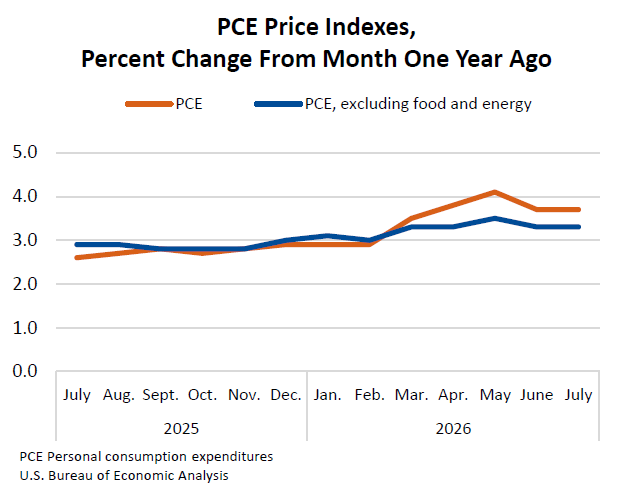
That becomes slightly more inconvenient when you look at inflation. The Fed’s preferred inflation gauge, the Personal Consumption Expenditures price index, also came in this bundle of data — and it rose 0.2% in July and 3.7% from a year earlier. Core PCE, which removes food and energy, rose 0.2% for the month and remained at 3.3% annually. Both are still comfortably above the Fed’s 2% target, and the BEA also revised second-quarter inflation higher: quarterly PCE inflation increased at a 5.3% annualized rate, rather than the previously estimated 5.1%.
There was at least some reasonably constructive household news hiding in the same release. Personal income increased 0.4% in July, disposable income rose 0.5%, while consumer spending rose just 0.2%. After accounting for inflation, spending was essentially unchanged, and the personal saving rate increased to 3%. In other words, consumers earned a little more, spent a little less aggressively, and kept slightly more of the difference. Groundbreaking fiscal restraint has apparently entered the chat.
Source: BEA
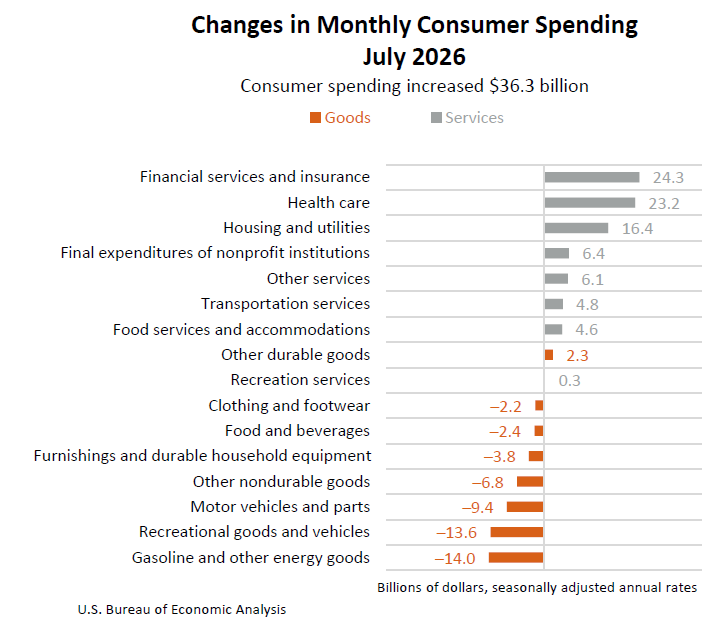
Spending composition also points toward the consumer becoming more selective. Americans increased spending on services by about $86 billion in July while spending on goods fell by roughly $50 billion. That fits reasonably well with what retailers and housing data have been telling us lately: households have not stopped spending altogether, but expensive, discretionary and finance-dependent purchases are having a much harder time making the cut.
Source: BEA
Housing provided a particularly rude example this week. New-home sales fell 10.5% in July to an annualized rate of 607,000, even as inventory rose to 9.6 months of supply and the median sales price declined to $393,800. More homes are available on the market, prices are slightly lower, and there are substantially fewer buyers. Mortgage rates remain capable of taking what should be a buyer’s market and stamping it out before anyone gets to enjoy it.
Consumers themselves appear to recognize the contradiction. The Conference Board’s Consumer Confidence Index slipped to 89.4 in August, but views of current conditions actually improved sharply.
Its Present Situation Index — basically, how consumers think business and job-market conditions look right now — rose to 121.2, while expectations for future income, jobs and business conditions fell 5.8 points to just 68.2. So, Americans are essentially telling economists that things are tolerable right now, but they would prefer not to discuss what happens next.
That leaves the Fed with an economy that is kind of “slowing” in the aggregate without displaying the kind of broad weakness that would make easier policy obvious. Private demand remains healthy, corporate profits are rising, and inflation is still running well above target.
Meanwhile, consumers are becoming more cautious, housing is largely frozen due to interest rates, bonds, and mortgages, and confidence in the future continues deteriorating.
This data dump gives us one ambiguous takeaway: Things aren’t exactly falling apart, but the economy also doesn’t have any one cohesive narrative to console us — what happens to our personal finances over the next six months will largely depend on these exact unresolved factors.
Answers to your questions
Yes. Origin offers partner access so you can manage your finances together at no additional cost. You’ll be able to filter transactions by member—making it easy to see which spending is yours and which belongs to your partner.

Yes. You can edit existing transactions and add new ones directly in Origin, so your records stay accurate and personalized.
Origin connects securely through trusted partners including Plaid, MX, and Mastercard.
Yes. Origin supports CSV uploads. You can upload a .csv file of your transactions, and we’ll import them into your account.
Yes. Your data is protected with bank-level security and advanced encryption. When you connect accounts through Origin, your login credentials are never shared with us. Instead, our partners generate secure tokens that let Origin access only the data you authorize—keeping your personal information private while enabling personalized insights.
Yes. You have full control to organize your spending in Origin. Transactions are automatically categorized by Origin, but you can always edit categories, add your own tags, and filter transactions however you like—so your spending reflects the way you actually manage money.