


America Runs on Bonds


America runs on bonds — literally. The country as we know it hasn't been debt-free in nearly 200 years, since 1835, when President Andrew Jackson paid off the nation’s balance of just $33 million at the time, and it returned almost immediately, becoming an integral part of the financial system.
Since then, the government has run an annual deficit about 60% of the time, and most of those years have been recent — since 1971 to now, we’ve been in a deficit pretty much every year. How does that deficit get covered? The Treasury sells bonds and uses the proceeds to fund the excess spending — that’s the majority of it, anyway. Philosophies about the economic morality and implications of making debt a key component of government spending emerged in real time as the situation evolved, with the primary yardstick being: What’s the debt-to-GDP ratio? Gross Domestic Product represents the country’s propensity to actually pay back the debt, because growth = tax revenue and prosperity. For decades this ratio was meager, then it spiked to 106% due to World War 2, retreated again during the post-war economic boom, but has climbed steadily since 1975 — most recently, the ascent has been exponential: We’ve gone from a ratio of ~67% in 2008 to almost 125% today.
This has drawn increasing news coverage and conversation recently, and rightly so, especially since the U.S. also just crossed the $40 trillion threshold in total outstanding debt, while debt held by the public is around 100% of GDP. Interest alone is reportedly running around $3.8 billion per day. And forecasts have repeatedly underestimated the trajectory: the CBO's 2009 projection had public debt at roughly 42% of GDP by 2019; reality was ~78%. Its current projection puts it at roughly 120% by 2035. Fixing this requires some combination of higher taxes, lower spending, or considerably faster growth — three options governments tend to enjoy approximately as much as dental surgery.
For centuries, U.S. bonds have been a default option for investors, pension funds, foreign governments, institutions — you name it — offering a risk-free, viable return. No one questioned whether the government would default on its debts — it technically still hasn't, to this day. Now, though, prospective bond buyers and bondholders have to ask: Is this getting risky? Is it worth it? Is it the best option out there for its purpose? Which brings us to the present situation: Yields are hitting multi-decade highs because investors are demanding more bang for their buck on what’s increasingly being viewed as a less attractive asset.
Why is that? Reasons tend to congregate, so per usual, there are several. This narrative has gained traction at the same time that Americans are dealing with stubborn inflation, international conflict, oh, banks offering already high yields on cash, and tech giants offering their own triple AAA-rated bonds that pay a much higher yield than government debt.
So, the era of cheap long-term money is getting violently repriced, and it’s not just America (though we are the poster child). Thirty-year government yields have climbed to roughly 5.3% in the U.S., 5.8% in the U.K., 4.1% in Japan, and 3.7% in Germany — levels ranging from multi-year to multi-decade highs, depending on which increasingly expensive government you’d like to lend money to.
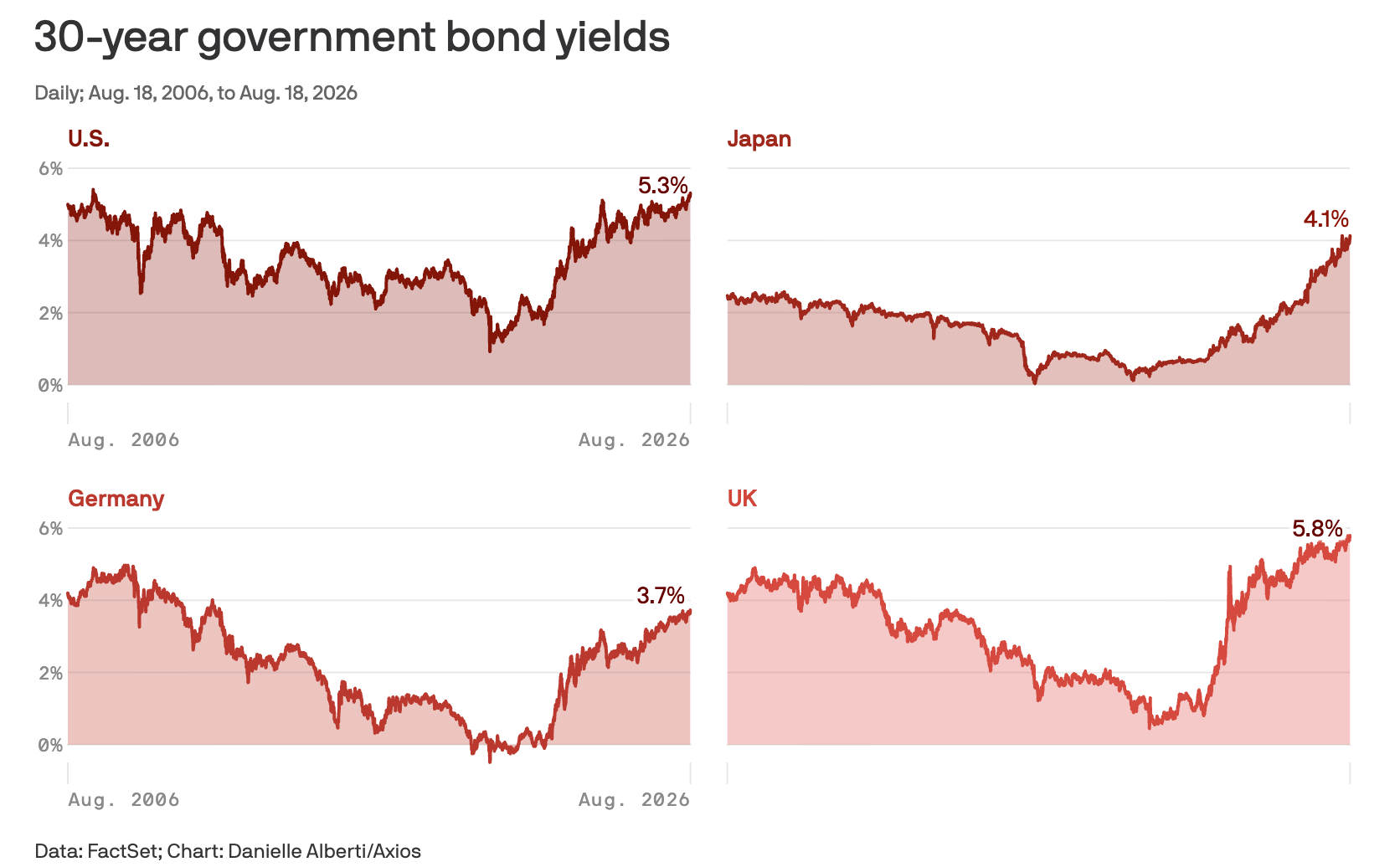
Source: Axios | This is a previous overview, but you get The Gist (literally)
The immediate suspects are familiar: Inflation, enormous deficits, aging populations, defense and energy spending, and now an AI infrastructure boom requiring absurd amounts of capital. But the deeper problem is who is supposed to buy all this debt, and at what price? Governments need trillions, just like corporations. U.S. investment-grade companies issued $1.36 trillion through July, +27% YoY, potentially challenging 2020's $1.85 trillion record; foreign private investors bought $390B of U.S. corporate bonds over the past year versus $329B of Treasury notes and bonds.
That is an unprecedented degree of parity in a league that used to be one-sided.
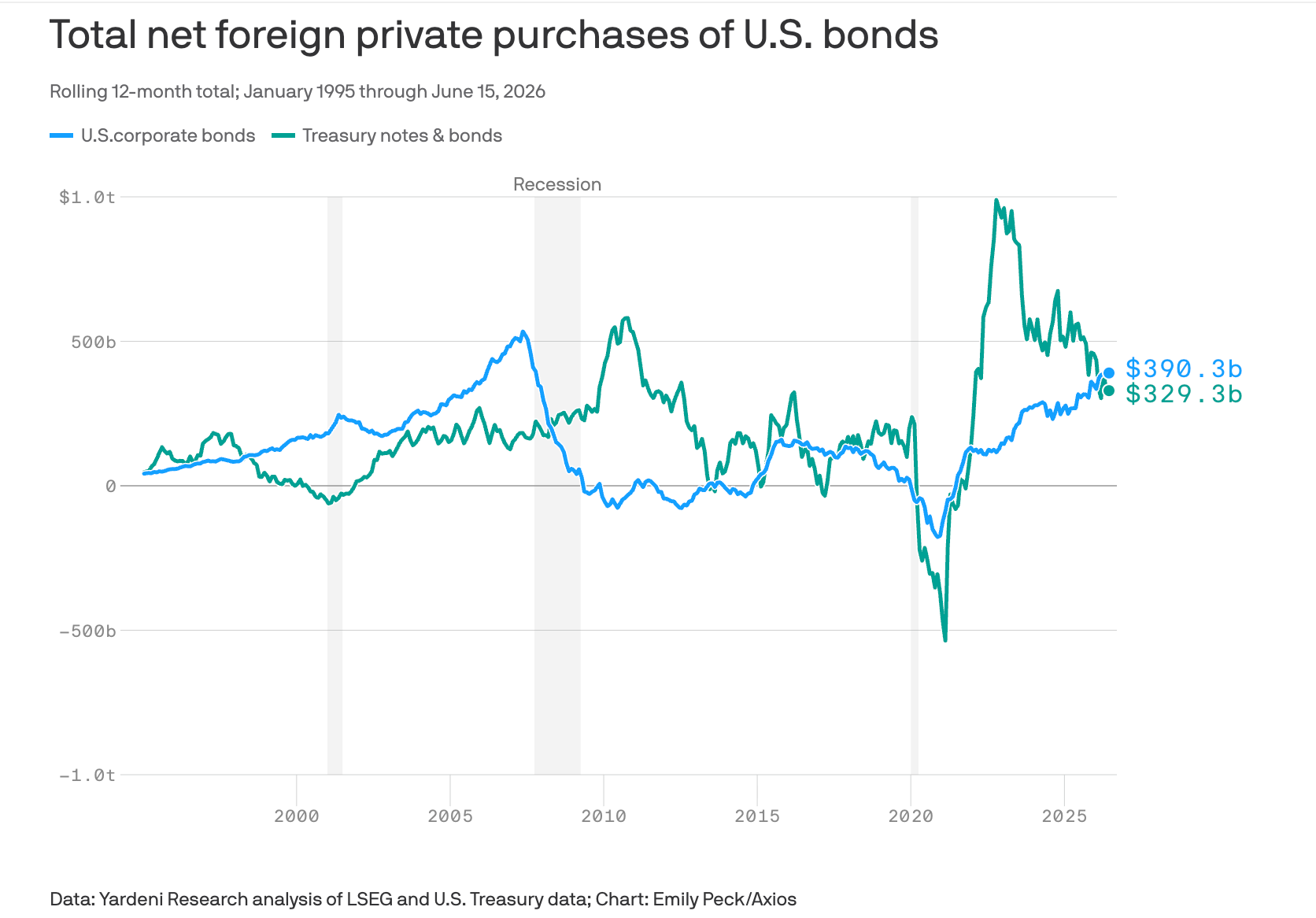
Source: Axios
Meanwhile, foreign governments — the wonderfully price-insensitive buyers who once treated Treasuries like a gigantic savings account — now own only about 12% of the Treasury market, down from roughly 40% around the financial crisis. They're not necessarily dumping Treasuries; America's debt pile simply grew around them.
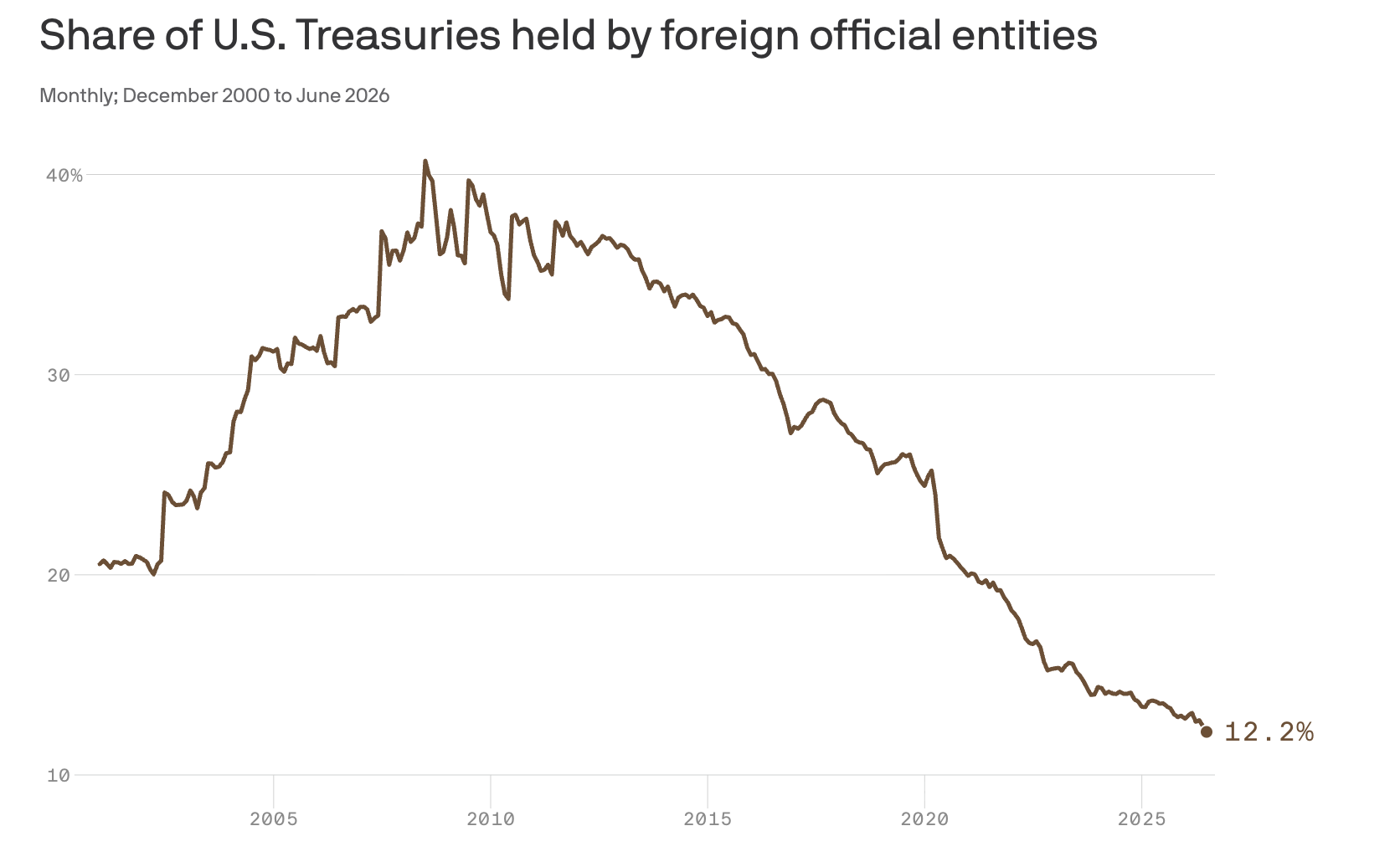
Source: Axios
The classic safe-haven relationship is wobbling too: stocks and Treasury prices increasingly fall together during stress, the long-term term premium has risen, and Treasury yields have lost advantages they historically enjoyed versus swaps and AAA corporate debt.
Investors themselves are voting with their feet: Treasury-bill ETFs have absorbed $51B since Feb. 27 versus only $7B for long-term bond ETFs, despite bills yielding roughly 3.7% versus 4.7% on long bonds. They're voluntarily accepting less income to avoid duration risk.
Government debt may seem abstract from afar, but all of this affects your personal finances in a very real way.
Treasury yields establish the floor underneath borrowing throughout the economy — and homebuyers shoulder the biggest burden. Thirty-year U.S. mortgage rates are now wandering back into the 7% range; existing-home sales dropped to a 14-month low last month; and the actual mortgage math is getting destroyed. The median new home sold for $410,700 in Q2; at a roughly 7.2% mortgage rate, even putting 18% down leaves a buyer with a monthly housing payment around $3,350 once taxes, insurance, and PMI are included. That’s about 46% of the median household’s gross income. And that number is: both household income and gross income, two obfuscations that make the already egregious ratio look a little better. Don’t even ask about post-tax or median individual income.
That is the foremost example of how government debt impacts us,
The takeaway: this isn't simply “government debt is high.” The world is simultaneously trying to finance AI, aging populations, wars, energy infrastructure, and enormous fiscal deficits at the precise moment the structural buyers of long-duration government debt are becoming less enthusiastic about owning it. Capital demand is up, bond supply is up, price-insensitive demand is down, and perceived duration/fiscal risk is higher. Governments can either pay investors more, borrow less, tax more, spend less — or increasingly meddle with the market to suppress yields.
Treasury already tried the latter by doubling long-bond buybacks; the relief lasted roughly a day. The world hasn't run out of money. Money has simply stopped being cheap at exactly the moment everyone needs an ungodly amount of it.
Answers to your questions
Yes. Origin offers partner access so you can manage your finances together at no additional cost. You’ll be able to filter transactions by member—making it easy to see which spending is yours and which belongs to your partner.

Yes. You can edit existing transactions and add new ones directly in Origin, so your records stay accurate and personalized.
Origin connects securely through trusted partners including Plaid, MX, and Mastercard.
Yes. Origin supports CSV uploads. You can upload a .csv file of your transactions, and we’ll import them into your account.
Yes. Your data is protected with bank-level security and advanced encryption. When you connect accounts through Origin, your login credentials are never shared with us. Instead, our partners generate secure tokens that let Origin access only the data you authorize—keeping your personal information private while enabling personalized insights.
Yes. You have full control to organize your spending in Origin. Transactions are automatically categorized by Origin, but you can always edit categories, add your own tags, and filter transactions however you like—so your spending reflects the way you actually manage money.