


Financial Planner vs Financial Advisor


You’ve decided to introduce financial wellness benefits to your organization. And one of your offerings is giving your employees 1-on-1 access to financial professionals. Congratulations! This is one of the best ways to support the financial well-being of your employees. But one thing may have you stumped: what’s the difference between a financial planner and a financial advisor? And which financial professional is the best choice for your employees? In this post, we’ll explain the difference and help you decide which one might make the most sense for your workforce.
Story continues below
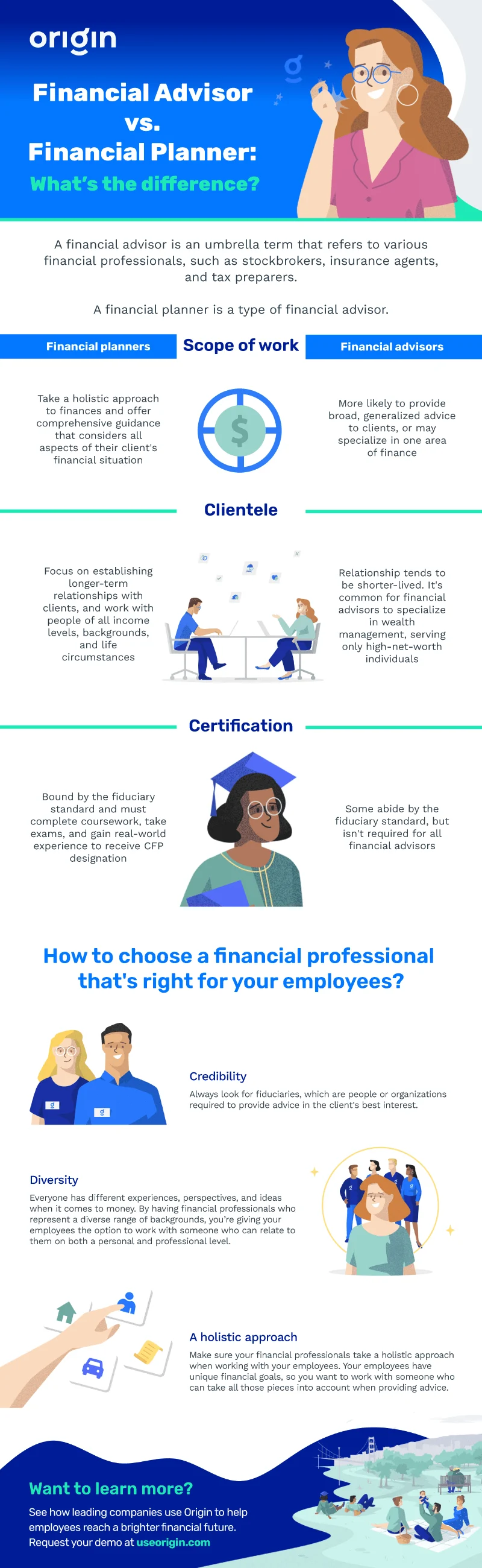
Wondering the difference between a financial advisor and a financial planner? This infographic can help.
What’s the difference between financial advisors and financial planners?
There are a lot of gray areas when it comes to defining the difference between financial advisors and financial planners. One of the reasons it’s so ambiguous is because there are no federal regulations around the titles financial professionals can use. But in general, people agree that financial advisor is an umbrella term that refers to various financial professionals, such as stockbrokers, insurance agents, and tax preparers. A financial planner is a type of financial advisor. There are other differences that we’ll outline below as well.
Scope of work
While this isn’t always the case, financial advisors are more likely to provide broad, generalized advice to their clients. Or, they may specialize in one area of finances—such as investment management—and only offer guidance in that specific area. Financial planners, on the other hand, typically take a more holistic approach to finances. While financial planners can certainly specialize in various areas—from investing to estate planning to taxes—they prefer to offer comprehensive guidance that considers all aspects of their client's financial situation.
Clientele
Due to the varying scopes of their work, financial planners and financial advisors tend to attract different types of clients. Since people typically seek out financial advisors when they have a specific question or milestone in mind, the relationship tends to be shorter-lived. It’s also common for financial advisors to specialize in areas like wealth management, so they only work with high-net-worth individuals. Financial planners help people understand, manage, and track progress on their finances in an ongoing manner. Because of this, financial planners usually focus on establishing longer-term relationships with their clients. Generally, financial planners also work with people of all income levels, backgrounds, and life circumstances.
Certification
One key difference between financial advisors and financial planners is that the latter has a formal certification process. A Certified Financial Planner™ (CFP®) must complete coursework, take exams, and gain real-world experience to receive their designation. Most importantly, all CFP® professionals are bound by the fiduciary standard—which means they have to work in the clients’ best interest. Some financial advisors abide by the fiduciary standard as well. For instance, advisors who buy and sell stocks must hold a Series 65 securities license. However, this isn’t required for all financial advisors, which risks clients receiving biased or harmful guidance.
How to choose a financial professional that’s right for your workforce
OK, now that you understand the difference between a financial planner and a financial advisor, how do you choose the right professional for your employees? Whether you decide to cover the cost of 1-on-1 sessions with a financial professional or offer your workforce access to a network through a platform like Origin, there are 3 things to look for:
- Credibility. Always look for fiduciaries, which are people or organizations required to provide advice in the client's best interest. This is the financial industry's highest standard, and it ensures that your employees are receiving unbiased guidance.
- Diversity. Everyone has different experiences, perspectives, and ideas when it comes to money. By having financial professionals who represent a diverse range of backgrounds, you’re giving your employees the option to work with someone who can relate to them on both a personal and professional level.
- A holistic approach. Make sure your financial professionals take a holistic approach when working with your employees. Your employees have unique financial goals, so you want to work with someone who can take all those pieces into account when providing advice.
What type of financial professionals does Origin have?
At Origin, we chose to create a network of CFP® professionals to provide the most comprehensive financial wellness experience for employees. We believe CFP® professionals are the most capable of providing holistic and comprehensive guidance to your employees. Also, as fiduciaries, our financial professionals are legally obligated to recommend services that best meet your employees’ needs. We put a lot of time and care into selecting the financial professionals we choose to work with. We have the largest financial planning network globally, and our CFP® professionals are:
- Diverse. Given that Black and Latino CFP® professionals make up less than 5% of all CFP® professionals, we wanted to ensure our network was more representative. That’s why we have a network of BIPOC, LGBTQ+, and bilingual CFP® professionals. It’s also why we allow employees to request planners they feel comfortable with and personally identify with.
- Experienced. Our financial planners have an average of 8 years of experience and work with people across all life stages. This ensures that your employees are getting access to the most experienced professionals and can find someone who understands their unique circumstances.
- Invested. Origin Financial Planners are dedicated to building lasting relationships with the clients they serve. Employees are matched 1-on-1 with a financial planner who provides ongoing, personalized support. Working with a dedicated planner helps employees establish a long-term relationship with someone who truly understands their financial needs.
Now that you understand the distinction between financial planners and financial advisors, it’s time to take the next step in your financial wellness program! If you want to learn how Origin’s network of CFP® professionals can support your employees, request a demo.
Answers to your questions
Yes. Origin offers partner access so you can manage your finances together at no additional cost. You’ll be able to filter transactions by member—making it easy to see which spending is yours and which belongs to your partner.

Yes. You can edit existing transactions and add new ones directly in Origin, so your records stay accurate and personalized.
Origin connects securely through trusted partners including Plaid, MX, and Mastercard.
Yes. Origin supports CSV uploads. You can upload a .csv file of your transactions, and we’ll import them into your account.
Yes. Your data is protected with bank-level security and advanced encryption. When you connect accounts through Origin, your login credentials are never shared with us. Instead, our partners generate secure tokens that let Origin access only the data you authorize—keeping your personal information private while enabling personalized insights.
Yes. You have full control to organize your spending in Origin. Transactions are automatically categorized by Origin, but you can always edit categories, add your own tags, and filter transactions however you like—so your spending reflects the way you actually manage money.